BigWeather's Blog

July 17, 2010

Yellowstone may be too big

Filed under: Travel — Tags: — BigWeather @ 3:40 am

After another McDonald’s breakfast (we really need to stop doing that… but we usually don’t get out until 9 AM (or 10, eep) and then are in a rush to make up lost time) we headed into the park.  We spotted a dog-like animal that was likely a coyote next to a river.

Headed a different this way this time, across new road.  Quite a bit of construction was going on in one stretch.  While I’ve often felt bad for the terrible conditions that North Carolina construction crews endure (102F and 60% humidity, yay!) I felt no such sympathy for this crew — 70F, sunny skies, low humidity, beautiful mountain view on one side and a bubbling hot pool on the other.  They were building a really nice looking low stone wall.  They had a guy who walked down the line of waiting cars informing them on when they’d be moving again — nice!

Stopped at the Canyon Village (B on the map below) and went through their impressive visitor center which focused on the geological aspects of Yellowstone.  Yellowstone is one of the few “hot spot” volcanoes on Earth that is over land.  This hot spot was under Nevada then moved under Idaho and into its present position — or more technically, Nevada then Idaho then Wyoming moved over the hot spot, which didn’t move at all — I guess that helps explain some of the sites we’ll be visiting in Idaho like Craters of the Moon.  There was a bit more about the 1959 earthquake and its effects as well as the changing nature of Yellowstone due to its great amount of activity.  We also learned that Yellowstone has half of the world’s geysers (three to five hundred).

After the visitor center we drove to the south rim of the Grand Canyon of the Yellowstone to see the Yellowstone Falls.  We got a very nice view of the Upper Yellowstone Falls.  The upper falls is smaller than the lower falls at 109 feet versus the lower falls’ 308 feet.  The upper falls has a longer “run” to it, however, and is every bit as impressive as the lower.
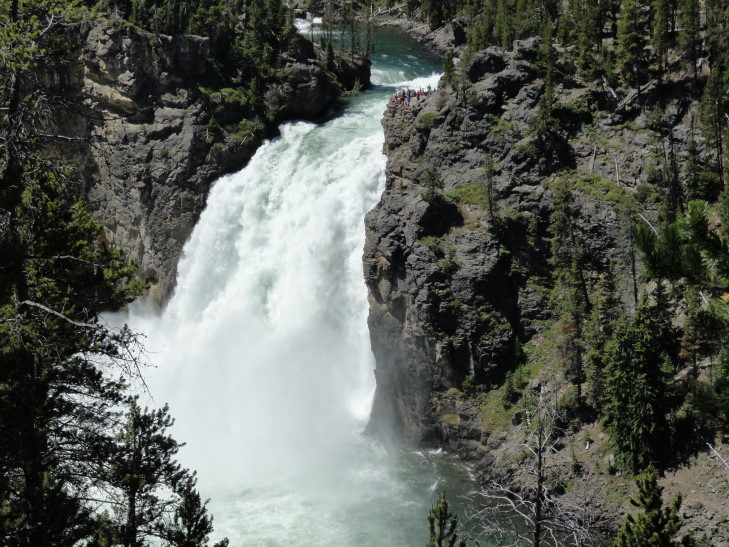
Upper Yellowstone Falls from the south rim, YNP, Wyoming

Upper Yellowstone Falls from the south rim, YNP, Wyoming

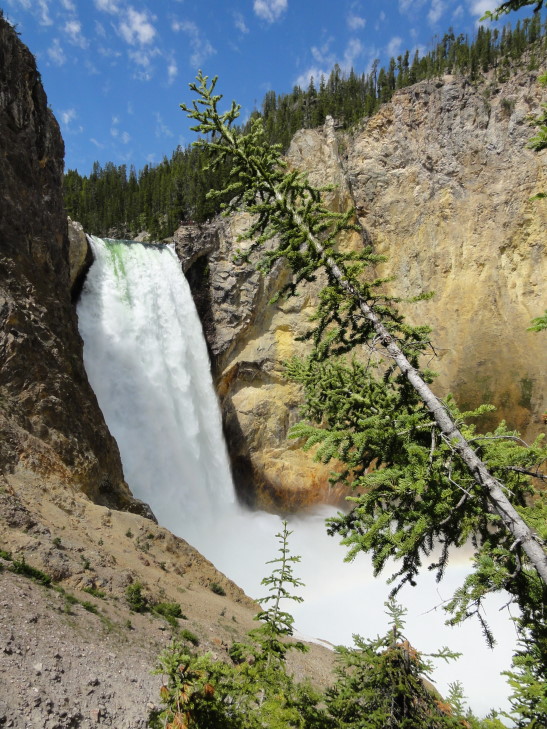
Next we took a hike down three-quarters of the way into the 1,000 foot canyon to get a great view of the lower falls on a trail called “Uncle Tom’s Point”.  This was a very steep trail mostly consisting of punctured sheet metal stairs suspended over huge drops by metal support beams.  Michelle decided not to go all the way — and in retrospect she may have been the smartest one of us all!  However, the three of us pressed on and got many beautiful shots of the lower falls, its spray field, and a rainbow that arched over the spray.  We also ran into a couple of friendly chipmunks.
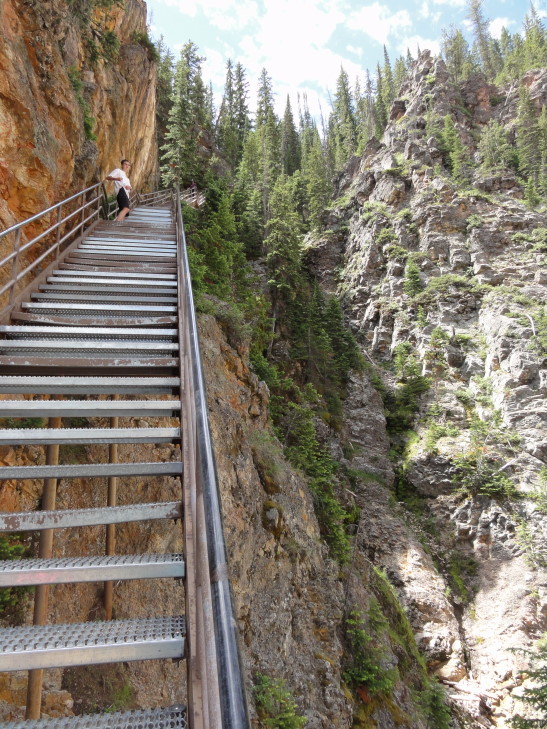
Uncle Tom's Point trail, YNP, Wyoming
Uncle Tom's Point trail, YNP, Wyoming

Lower Falls from Uncle Tom's Point trail, YNP, Wyoming
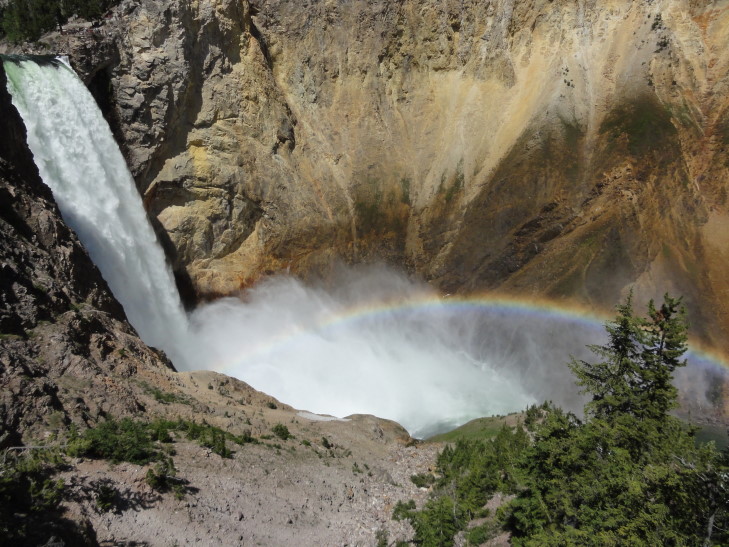
Lower Falls from Uncle Tom's Point trail, YNP, Wyoming

Lower Falls and rainbow, YNP, Wyoming

Lower Falls and rainbow, YNP, Wyoming

Winded we made it back to the top and proceeded on to Artist Point where there is a spectacular view of the falls (at least the lower) and the canyon itself.  The canyon is indeed quite yellow, giving the river and the park its name.  A group of bikers with North Carolina plates as well as their support vehicle, a Jeep, made us quite homesick.  What a long ride to get to Yellowstone from home!
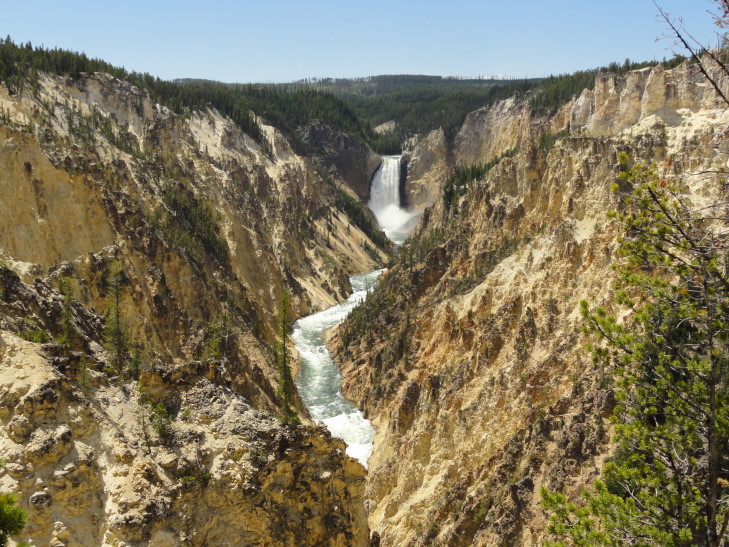
Artist Point, YNP, Wyoming

Artist Point, YNP, Wyoming

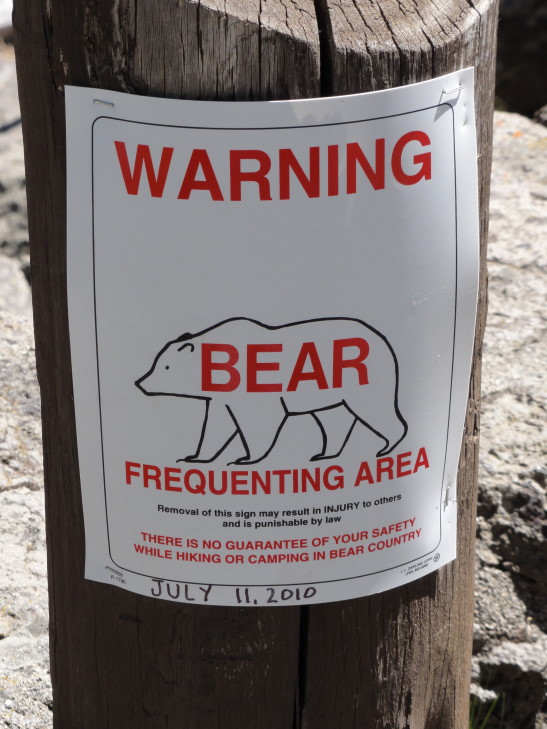
Next went to an observation point above the upper falls.  The roar of the water as it flowed from Hayden Valley and over the brink was deafening.  Addison and I found a number of spots for great photographs.  There was also a sign about a bear sighting at that spot on July 11th and to be vigilant for bears.  If only we could be so lucky!
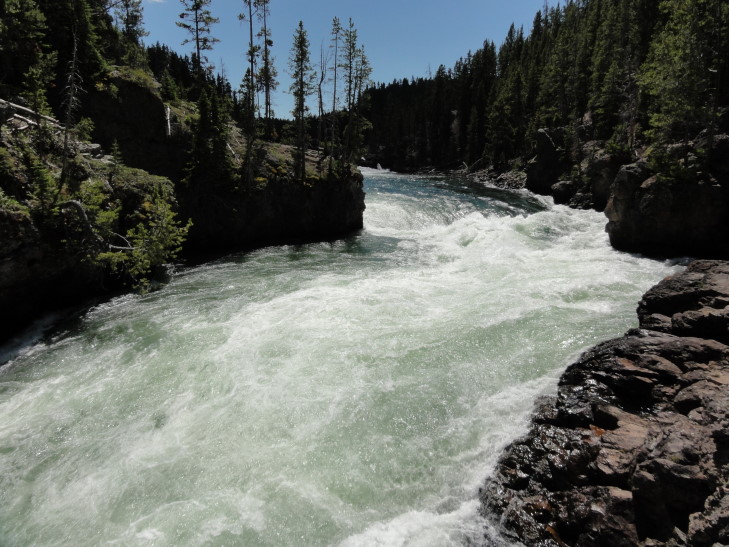
Brink of the Upper Falls, YNP, Wyoming
Brink of the Upper Falls, YNP, Wyoming

Bear Frequenting Area Sign

Bear Frequenting Area Sign

Finally we headed to the north rim of the canyon and checked out Inspiration Point, a point that overlooks the canyon some distance to the east.  The original observation point was almost one hundred feet further than the current one and offered a spectacular view of the falls.  Unfortunately it had been destroyed in the 1959 quake when the cliff under it gave way and the newly shortened observation point doesn’t offer nearly the view.  What it did offer, however, was a very stiff wind — thank goodness my Tilley hat was strapped on or it would’ve been lost.  We also a large boulder deposited by glaciers during the last Ice Age.
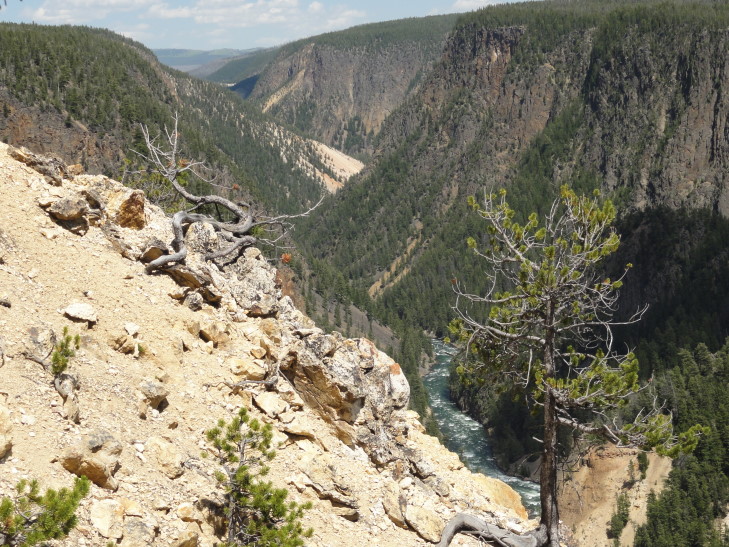
Inspiration Point, YNP, Wyoming

Inspiration Point, YNP, Wyoming

Returned to Canyon Village and ate at a cafeteria.  The food wasn’t great at all and it was quite expensive.  Note to self: don’t ever eat at a cafeteria again.  I always pay too much, eat too much, and don’t feel I got tasty food.  I guess nothing will top the great Picadilly swiss steak Saturdays of my youth!

We drove to the north over a mountain pass and past Mount Washburn.  In one of the alpine meadows there were a lot of cars parked to the side of the road and people milling about.  Turns out it was a “bear jam” as the Rangers call it.  We didn’t stop, however, as there weren’t really many places to pull over (steep on both sides of the road) and it was a perfect opportunity to pass this dreadfully slow compact in front of us.  Seems like it is always Colorado people that go slow which doesn’t compute — I mean, they should be used to this mountain crap, no?  Anyhow, I did manage to snap a picture as we went by of the bear’s back or butt or something.  It isn’t worth posting in this blog, though.

Arrived at Tower Falls (C on the map), a pretty impressive fall of Tower Creek from a side canyon into the Yellowstone River’s canyon.  Addison and I decided not to go to the bottom, however — we’d had enough steep trails for the day.  We learned that a layer of rock with vertical “slats” that we had seen was the result of a large lava flow (25 feet thick) that cooled.
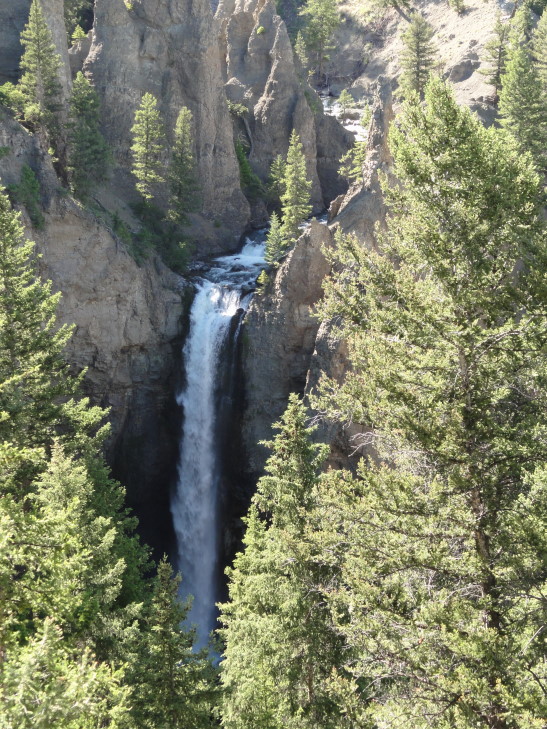
Tower Falls, YNP, Wyoming

Tower Falls, YNP, Wyoming

One (of many) thing that that is remarkable about Yellowstone is the variety of terrain.  You’ll go from lands blasted white by thermal activity with steam and bubbling hot pools to alpine meadows with little trees to forests to deep canyons.  We next passed by the entrance to the Lamar Valley.  A co-worker had strongly advised us to visit the valley to see wildlife but, being tired and the day growing late, we had to bypass it.  We did see a series of wagons and horseback riders leaving the Roosevelt Lodge (Go Teddy!) to a chuck wagon dinner.  We had tried to do that but it turns out they were booked all week.  I feel bad about this trip sometimes because I didn’t get us nights in the park nor things like this dinner.  I think the kids are a little disappointed but I simply didn’t plan this trip out far enough in advance.

Turned towards Mammoth Hot Springs (D on the map).  On the way I saw a tiny black bear cub — didn’t linger long because it was far off and not that interesting and also I didn’t want mama flanking me and protecting her cub.

Arrived at the Ranger headquarters about 6 PM.  The headquarters occupy the site of the original Fort Yellowstone with many buildings remaining and used by park personnel.  There is also a herd of elk that frequent the grounds as they’ve grown fond of the yummy human-introduced grass.  The drill field also still exists and is home to a prairie dog town (though not nearly as large as Devils Tower).  Congress made Yellowstone our first National Park in 1872 but didn’t provide many funds for it in typical fashion.  Poaching was rampant.  The park administrator finally convinced the government to send the Army in to secure the park from 1886 to the formation of the National Park Service in 1918.

As it was about 7 PM we didn’t have much time to tour the nearby Mammoth Hot Springs.  A friendly Ranger urged us to visit Liberty Cap, Devil’s Thumb, and some other easily reached sites, skip the middle terrace walk and instead drive the upper terrace road and see the Main Terrace (particularly Canary Spring) as well as Orange Spring Mound.

Liberty Cap was kind of interesting (as much as odd shaped rocks can be, to which Adrianne would say “very!”) but I was struck more by the beauty of Devil’s Thumb and Palette Spring.  I’m not even going to try and describe them — just check out the picture(s) below.  It was amazing seeing the water flowing off the cliff edge above and dripping through the terraces.
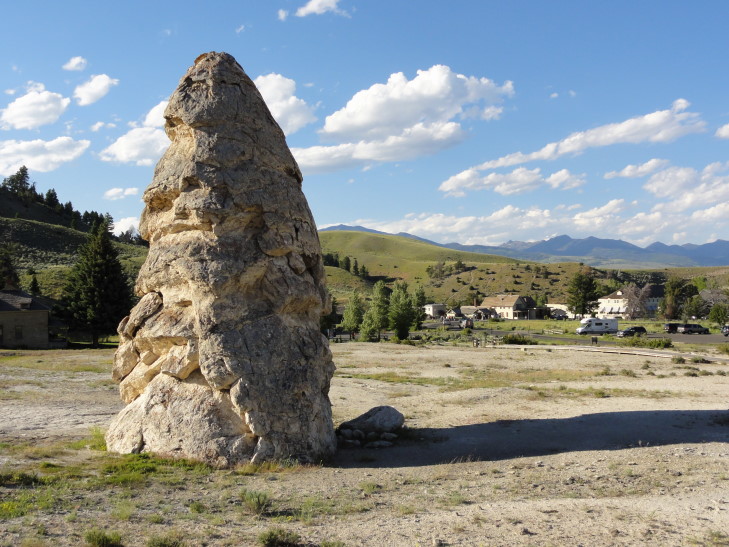
Liberty Cap, YNP, Wyoming
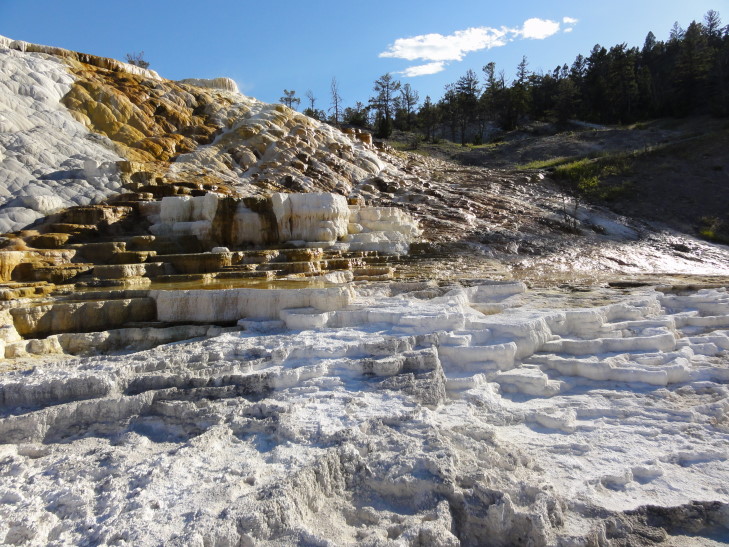
Liberty Cap, YNP, Wyoming

Devil's Thumb, YNP, Wyoming

Devil's Thumb, YNP, Wyoming

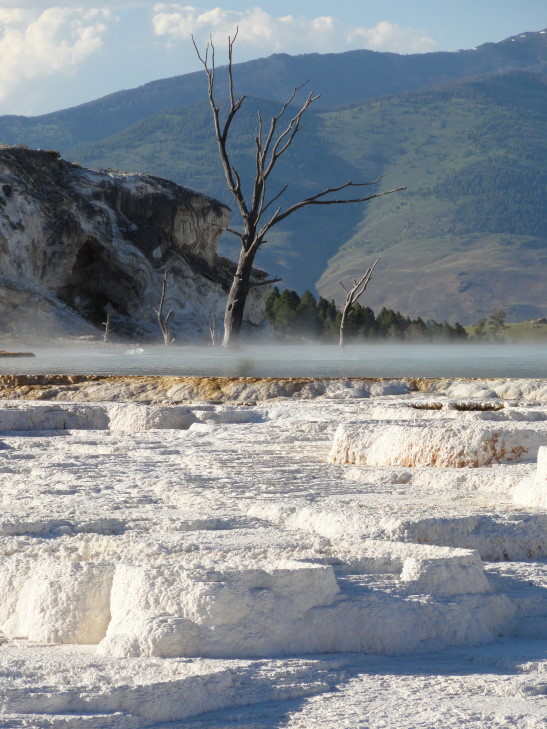
The Main Terrace, and particularly Canary Spring, may very well be the highlight of Yellowstone for me so far.  Again, describing it is impossible.  You know how rich folk have those cool pools that don’t have edges but instead the water flows over the edge of the cliff face and such?  That’s what it looked like, except add in really cool looking dead trees, add brilliant color, bubbles, and a bit of steam to the pool, and have the water flow over multi-colored terraces.  Let’s ignore the egg smell, though — although it wasn’t too bad here.
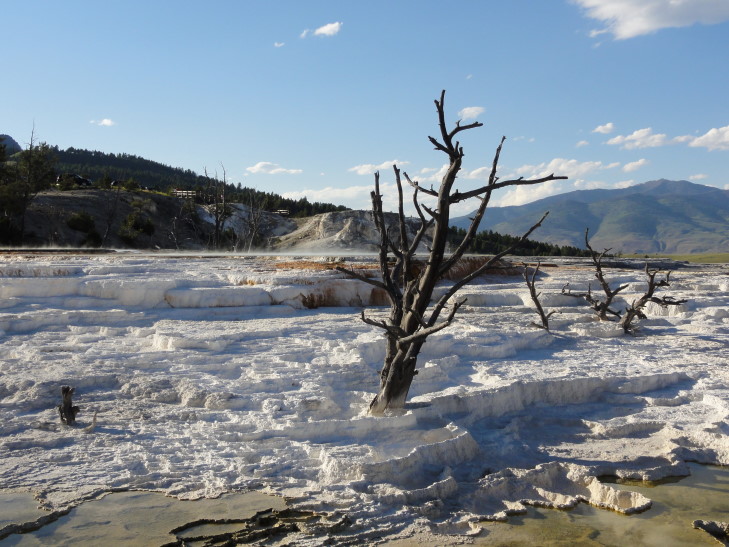
Main Terrace, YNP, Wyoming
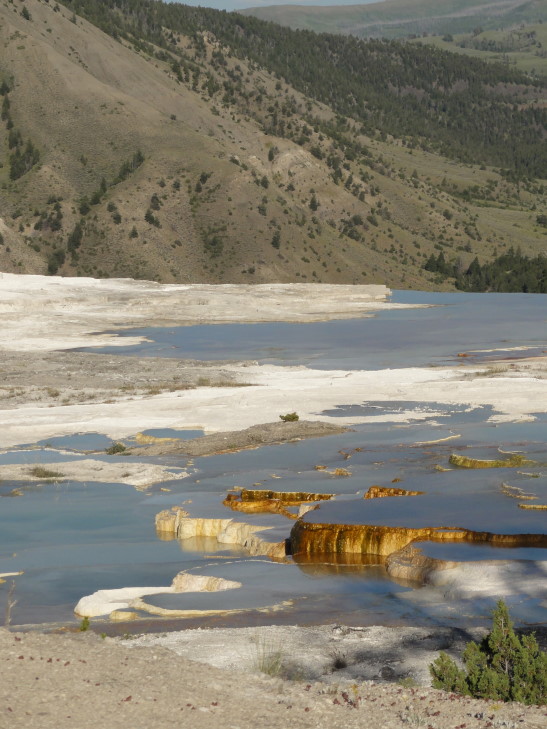
Main Terrace, YNP, Wyoming

Canary Spring, YNP, Wyoming

Canary Spring, YNP, Wyoming

Unfortunately there were some foreign people (they were speaking another language and driving a car with Alberta plates so I’m fairly comfortable saying they were probably foreign — no profiling here, don’t boycott me!) that kept sticking their fingers in the cooler areas of water.  This does great damage to the site and made me angry, causing me to shout at them to leave the water alone and go spoil their own lands if they wanted.  A German-speaking tourist also got on them and it was amusing to see her get so worked up but not have the English vulgar vocabulary to fully express what she wanted.  I actually restrained myself and didn’t cuss.  Miracle in July, who would’ve thunk it?!

Drove to Orange Spring Mound or, more precisely, mounds.  Basically big mounds of minerals with bubbling springs at the top drizzling water down the sides.  Due to minerals it colored the mounds orange.
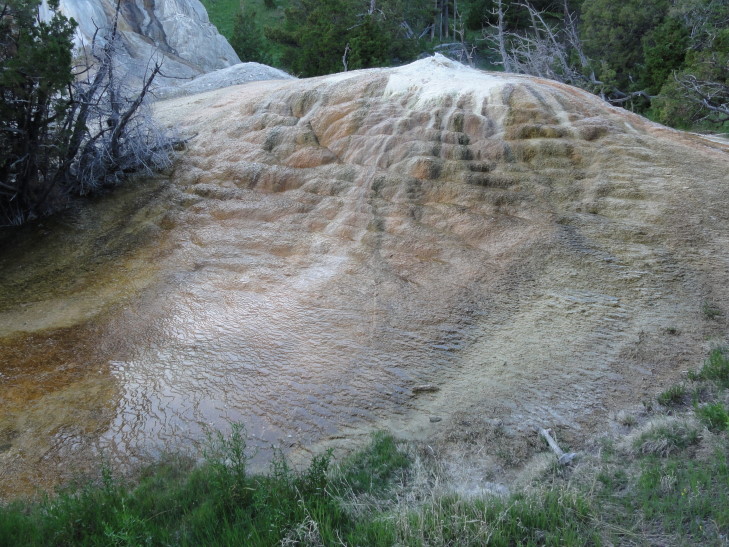
Orange Spring Mound, YNP, Wyoming

Orange Spring Mound, YNP, Wyoming

Headed home past Norris Geyser Basin.  Saw a photographer that had managed to find a grizzly but again there was no place to stop and we were very, very tired.  There was also a storm to the east and I got to see some really amazing quilted cloud puffs descending from the rear of the storm.  Greg would’ve love it.
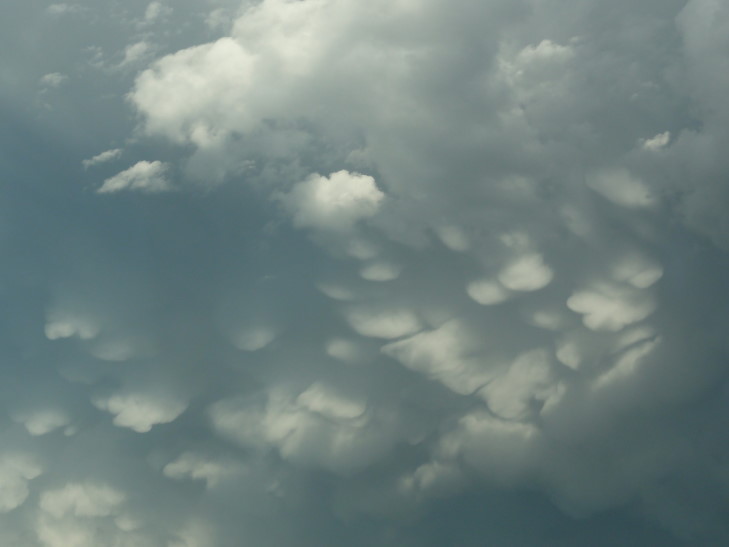
Clouds

Clouds

A long day behind us we headed back to West Yellowstone, Montana.  Clueless people were lined along the road with their cars looking at the bald eagle despite the sign that clearly indicated it was a bald eagle protection zone and people should not stop or bother the eagle in any way.  Humans!

Went to Beartooth Barbecue for some pulled beef barbecue, potato salad, and baked beans.  While tasty it was a bit on the pricey side but we’re getting used to that.

While we had a great day I can’t help feeling that in a way Yellowstone is too big.  We spent a good portion of the day going from A to B and still have barely scratched the surface.  Tomorrow I’ll have to take it a bit easier — everyone is getting a bit tired and we still have a week to go.  I don’t want anyone burning out.
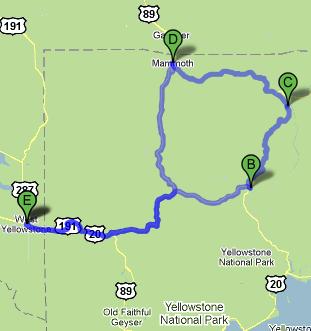
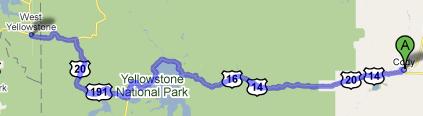
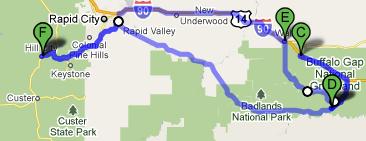
Route for July 16, 2010
Route for July 16, 2010
July 16, 2010
Geyser Obsession

Filed under: Travel — Tags: — BigWeather @ 4:39 am

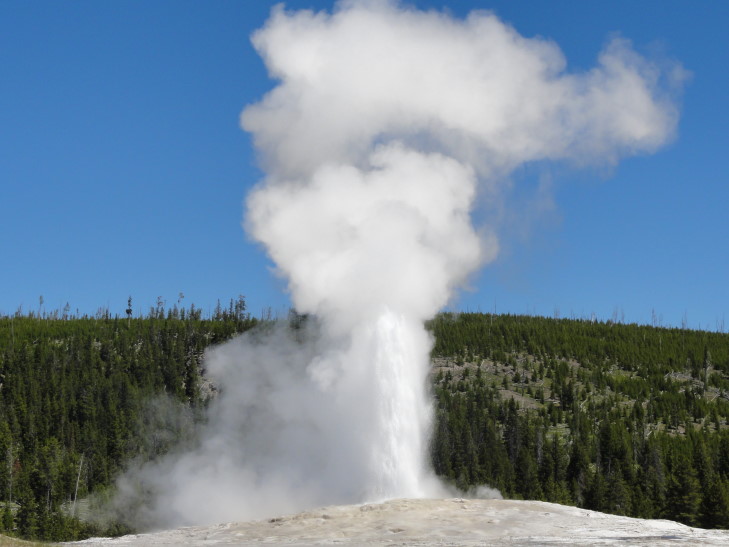
Woke up and proceeded to eat at McDonald’s (again).  We entered the park with the intention of starting with Old Faithful, the famous geyser for which Yellowstone is so well known.  Finally found a parking space (though Old Faithful was quite crowded it wasn’t too bad, and the rest of the park hasn’t had the nightmarish traffic I’ve heard about either) and parked our butts on some benches surrounding the geyser — being careful not to sit downwind so that steam from the eruption would not obscure the water.

The predicted time was 12:37 PM so we didn’t have long to wait as we arrived just before noon.  Old Faithful used to have a shorter interval between eruptions but events like the 7.5 magnitude 1959 quake are believed to have lengthened it.  It is still quite predictable, however, and spews water 100 to 180 feet in the air for between one and a half and five minutes.  Because the eruption length dictates the following interval it is impossible to predict more than one eruption in advance.

At 12:42 PM Old Faithful erupted, only five minutes off the estimate (the Rangers always give a +/- 10 minutes on all of their predictions).  It was quite beautiful but a bit short in duration.  It was neat to see the water jetting up and then just as one burst started to falter another would rise.  Unfortunately because the seating is so far from the geyser you don’t get to hear it very well nor get wet — it kind of mutes the whole “power of nature” effect.

Old Faithful, Yellowstone National Park, Wyoming

Old Faithful, Yellowstone National Park, Wyoming

Old Faithful sits in a basin, called the Upper Geyser Basin, of many thermal features.  Not only are there numerous geysers but also springs and hot pools.  A series of boardwalks (some with railings, most not), roads, and trails allow fairly easy access to the sights.  It is quite an awesome sight to look across the mostly treeless expanse (mostly treeless due to the thermal features, of course) of low hills and see colorful pools and plumes of steam rising.

Upper Geyser Basin, Yellowstone National Park, Wyoming

Upper Geyser Basin, Yellowstone National Park, Wyoming

We had originally intended to walk around a small loop near Old Faithful and move on to other things — a half mile at most.  I kind of caught Geyser Obsession, however, and I kept adding to the route in order to see more and more sights — in total we walked probably two to three miles.

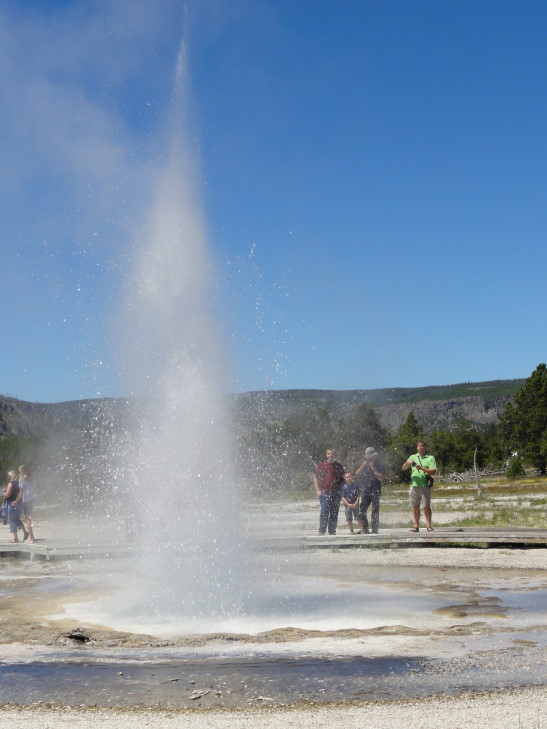
A particular highlight was Sawmill Geyser, a relatively minor geyser.  What made it stand out, however, was that we were standing about six feet away from it when it erupted and though the eruption is only about 10 feet high it sprayed water (and that rotten egg smell) all over us.

Sawmill Geyser, YNP, Wyoming

Sawmill Geyser, YNP, Wyoming

In addition to Sawmill Geyser we also saw several other geysers but sadly none erupted while we were there.  We saw Grand, Daisy, and Castle among many others.  Some of the geysers are connected with other geysers or hot pools and the like making eruption times harder to predict.  Those relationships, however, will often lead to interesting predictors — a hot pool draining may indicate an eruption by a connected geyser is imminent, for instance.  Another case is one geyser not erupting unless another one is erupting though it is not always the case that they will both erupt.

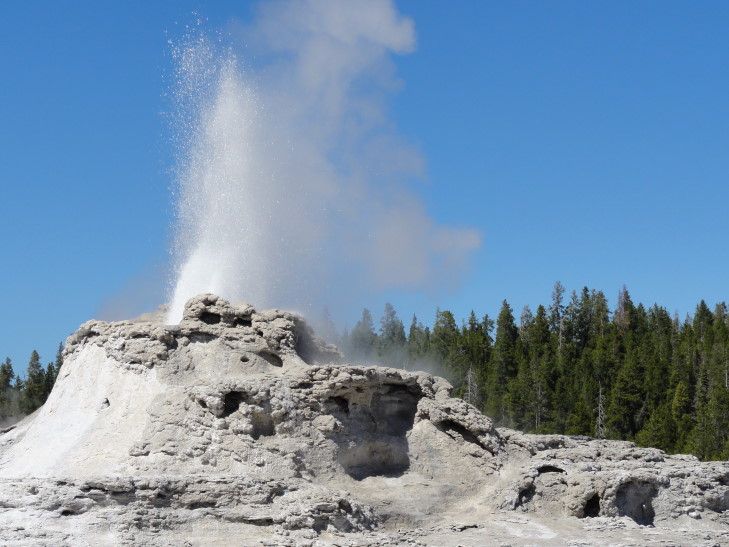
Addison was particularly impressed by Castle’s cone (and name, though he kept referring to it as a glacier rather than a geyser).  What is interesting about Castle is that it has such a large sinter cone indicating that it is quite old, much older than the relatively young Old Faithful.  Castle also regularly tosses water up five feet or so in between eruptions which make it a bit fun to see at all times.

Castle Geyser, YNP, Wyoming

Castle Geyser, YNP, Wyoming

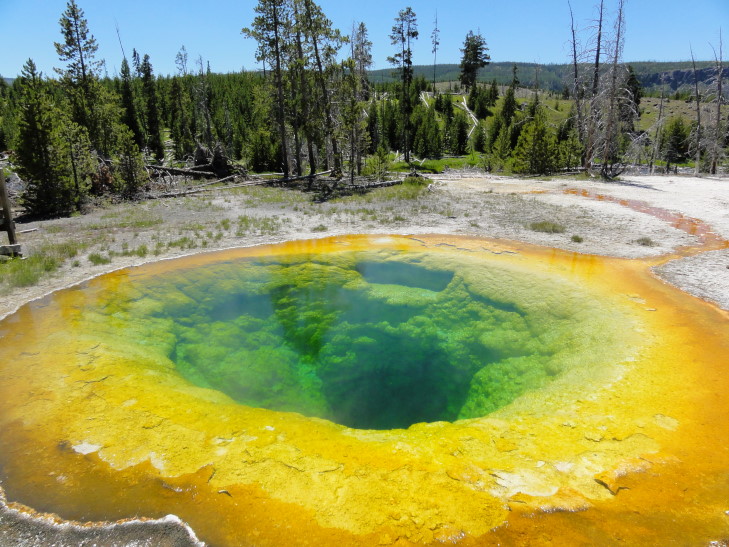
Also of note were the many hot pools in the basin.  I love the variety: different sizes, depths, colors, bubbling, steam, you name it.  We read about one pool in particular, Morning Glory, that has gotten cooler (and more green and brown as explained in yesterday’s entry) because of people tossing in coins and such — it blocks the vents and despite the Rangers’ best efforts to fetch as many objects as possible many still can’t be retrieved.  People can be such pigs at times.  Compare the photo below with those in the above link — the blue is all gone.  Some people have taken to calling Morning Glory by another name: Fading Glory.  While I understand that part of the allure of Yellowstone is that it is in a constant state of change it is sad when that change is caused by humans and their recklessness.

Morning Glory Pool, YNP, Wyoming

Morning Glory Pool, YNP, Wyoming

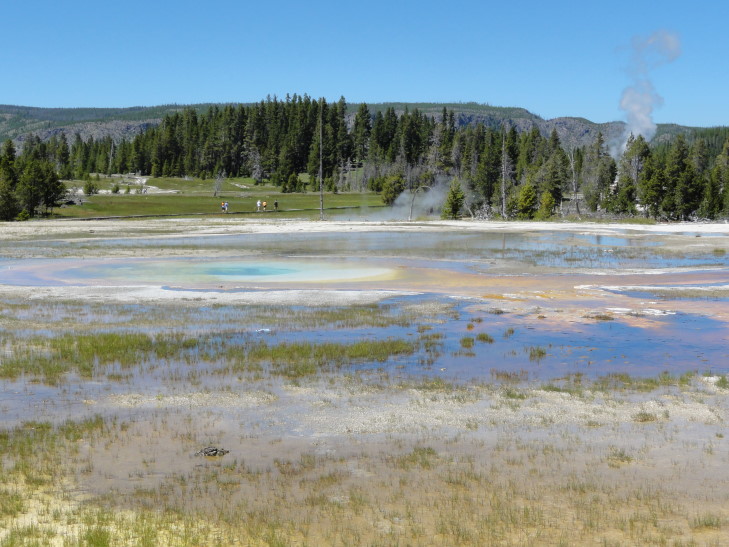
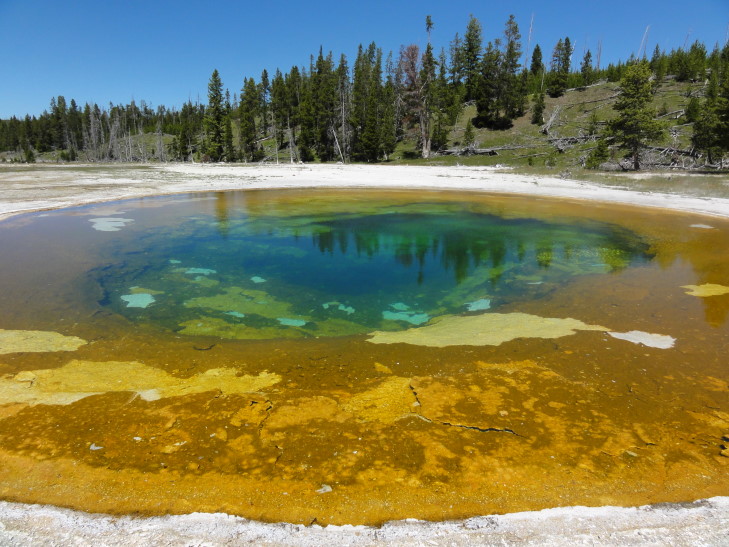
Following is a shot of another particularly beautiful pool, aptly named Beauty Pool.  It is linked to nearby Chromatic Spring.  When one is full and beautiful the other has less water in it and doesn’t have that “pop” that the other one has.

Beauty Pool, YNP, Wyoming

Beauty Pool, YNP, Wyoming

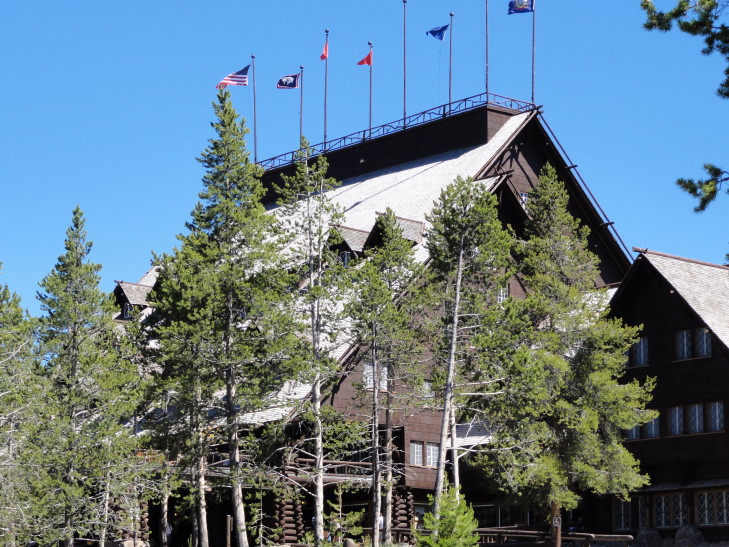
By the time we finished the walk it was well after 3 PM and the kids and Michelle were very tired.  Rather than risk a mutiny we headed to the Old Faithful Inn and made dinner reservations for the earliest slot, 4:30 PM.  In the meantime we got some ice cream (yeah, great lunch there!) at the inn.

Old Faithful Inn, YNP, Wyoming

Old Faithful Inn, YNP, Wyoming

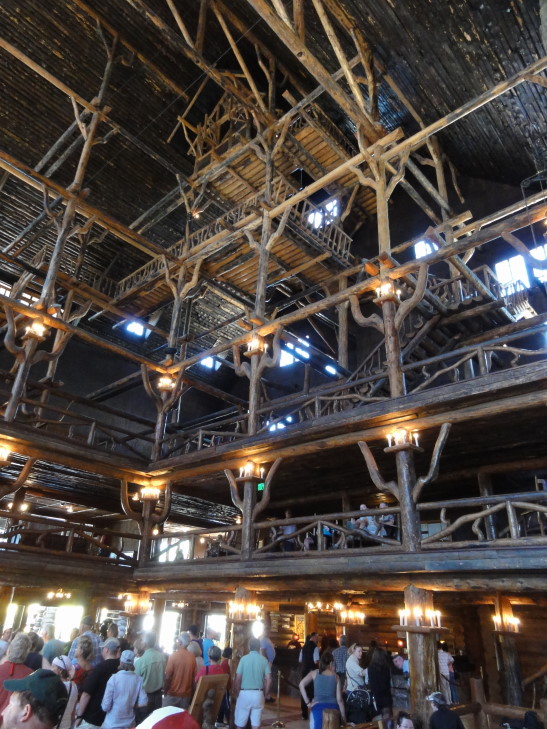
The inn is beautiful!  It was built in 1904 and has an amazing lobby that almost looks like Hogwarts in terms of multiple floors and such.  It is almost entirely built of logs other than the giant stone fireplace which had many chairs in which to sink into and relax.  Above the third floor was a complex system of wooden log walkways and such called the Crow’s Nest.  Back in the day an orchestra would play up there while people below danced.  The 1959 earthquake put a stop to that, however, as the supports were deemed unsound.

Old Faithful Inn lobby, YNP, Wyoming

Old Faithful Inn lobby, YNP, Wyoming

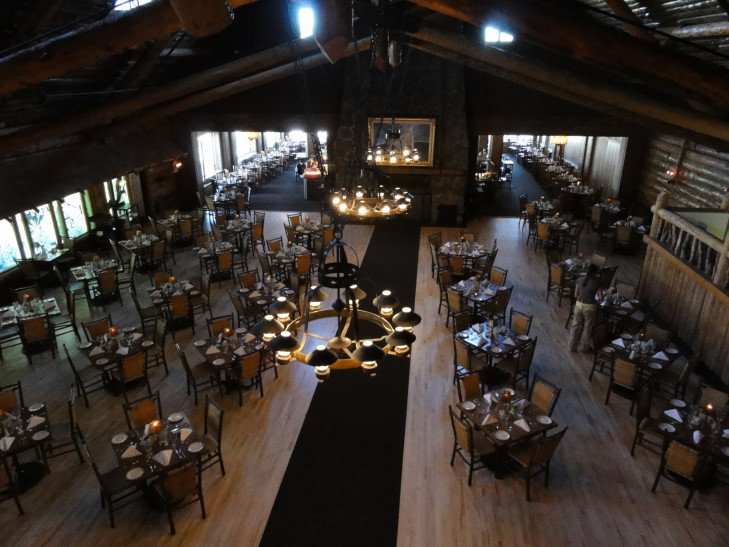
Time came for dinner — served in a really grand dining hall.  We were waited on by a guy from Lexington, Kentucky who had lived in Ocean Isle for a while.  Talk about a small world!  Michelle had the Pork Osso Buco which turned out to be superb — the pork just fell off the bone.  She also had the vegetables of the day which included such odd ones as rutabagas.  I had fettuccine with blackened chicken that was very good.

Old Faithful Inn dining hall, YNP, Wyoming

Old Faithful Inn dining hall, YNP, Wyoming

After our early dinner we headed to the Black Sand Basin and checked out some of the thermal sights there.  Honestly they weren’t as impressive as the ones near Old Faithful nor, we were to soon find out, those of Midway Geyser Basin.  We headed to the latter, to see two of the most incredible thermal features to date: Excelsior Geyser and the Grand Prismatic Spring.

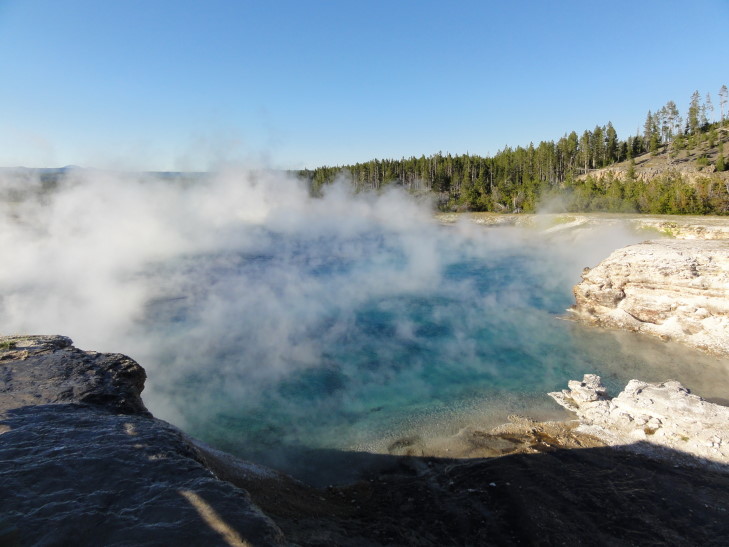
Excelsior Geyser dumps 4,000 gallons of water per minute into the nearby river via a spectacular rivulet discharging steam as it goes.  It also occupies a crater — formed during a particularly violent eruption in the past.  A constant cloud of steam plays across the surface of the geyser, occasionally clearing to allow viewing of the blue waters within.

Excelsior Geyser, YNP, Wyoming

Excelsior Geyser, YNP, Wyoming

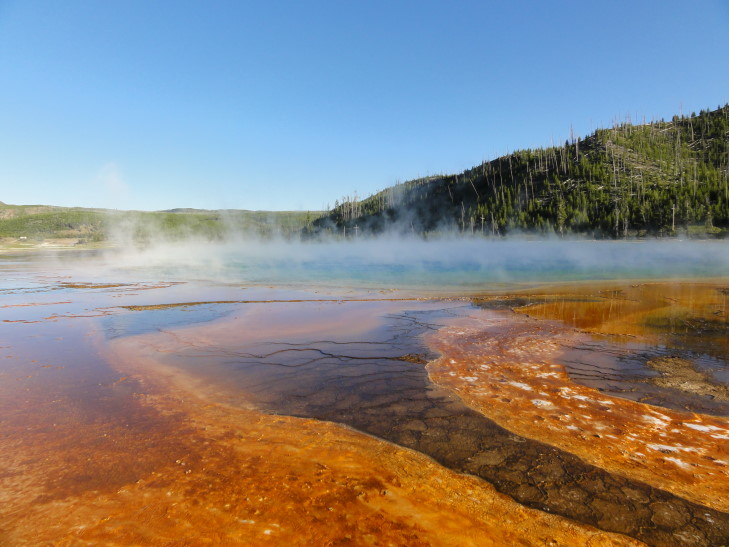
Up from Excelsior is the Grand Prismatic Spring, the largest of its kind in America at a diameter of 300 feet.  As with Excelsior steam clouds constantly play upon its surface and the only truly great photos can be obtained from above — my photo simply doesn’t do it justice.

Grand Prismatic Spring, YNP, Wyoming

Grand Prismatic Spring, YNP, Wyoming

Piled into the car and headed back to the hotel.  Michelle and I went and got groceries while the kids watched some TV in the hotel for a few minutes.  Michelle also did some laundry at the gas station a few blocks away — that should take care of laundry for the rest of the trip.

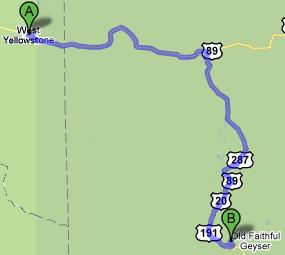
Route for July 15, 2010
Route for July 15, 2010
July 15, 2010
It wasn’t me, I didn’t do it!

Filed under: Travel — Tags: — BigWeather @ 3:06 am

Woke up and Michelle headed to McDonald’s to pick up breakfast (as our night in Cody did not supply the usual breakfast we had grown accustomed to).  Checked out and headed to the Buffalo Bill Historical Center only a couple of blocks from our hotel.

What a great museum!  Well, actually, more like five museums in one.  We started with the wing dedicated to the Plains Indians (with a nod towards other Indian cultures such as the Inuit and Northwest peoples).  I particularly enjoyed seeing the small shields (more like bucklers) that they carried into battle.  They were decorated (one even incorporated a complete dead small bird) and something I normally didn’t imagine the Indians using much of.  Also learned such interesting things as the children learned to put up tipis (note, not teepees) on small scale models and that dogs pulled many of the tribes’ belongings (even after the introduction of the horse).  A dog can pull 75 pounds of gear.  Genetta particularly enjoyed seeing some bows (even one completely covered in rattlesnake skin, though she vowed she’d never use that one) and arrows.  Also covered some of the conflicts as the United States expanded westward.

The second wing was an art gallery.  They had many great paintings and sculptures including “Madonna of the Prairie”, some paintings by George Catlin (not to be confused with that other genius), and plenty of Frederic Remington paintings and sculpture.  Remington produced a staggering 3,000 works from his studio in New Rochelle, New York.  His studio had tons of western objects and such to inspire him.  They also had some N. C. Wyeth works, an artist I like.  Finally they had a very interesting painting depicting the Battle of the Little Bighorn (a.k.a. Custer’s Last Stand), though it was referred to as the Battle of Greasy Grass Creek as it was done by a Native American illustrator.  What was interesting about it was that rather than showing one moment of the battle it represented all of the battle — parts of the painting depicting events also showed had the time indicated.  Addison and Genetta both took some time to draw at an activity center as well.

The third wing was all about firearms.  It houses the largest collection of American firearms in the world and, in total, has 2,700 weapons from hand cannons of the 15th century through modern weaponry.  Addison loved this wing, as expected.  We all particularly enjoyed seeing the evolution of weaponry through the ages and particularly the dead-ends (especially attempts to introduce more than one bullet such as several guns with multiple barrels before they hit upon the solution).  There was even a gun attached to a swivel with four trip wires that would fire when any wire was tripped — intended to protect watermelon patches from deer.

The fourth wing was dedicated to the natural history of Yellowstone.  It was informative but we were getting a bit ansy (ok, I was) to get on our way to our hotel so we blew through it.  A mosaic of the Yellowstone area was very interesting, however, and I am indebted to it for giving me the name of the area we drove through the night before on the way to Cody: the Bighorn Basin.

Before entering the fifth wing we checked out an exhibit of photographs by Gertrude Kasebier (I’m not going to attempt to represent the umlaut in her name on this blog — I’ll probably crash it) that covered the Indians in Buffalo Bill’s Wild West Show.  Fascinating stuff and a few were particularly intimate.  One difficulty she had was photographing children as they believed that it could steal their soul and kill them.  She persisted, however, in doing the session.  A few weeks later she went back to visit and everyone was grabbing their kids and keeping away from her — one of the girls had died.

The fifth wing was dedicated to Buffalo Bill and his Wild West Show.  We learned a ton there, such as Buffalo Bill being a Congressional Medal of Honor recipient and two of his performers being from Riverhead, New York (a town near to some of my family’s history).  Lots of incredible artifacts there like many of his belongings as well as Annie Oakley‘s saddle and riding suit and even his boyhood home, shipped in from Missouri.  Fascinating stuff but by that time we were zipping through.

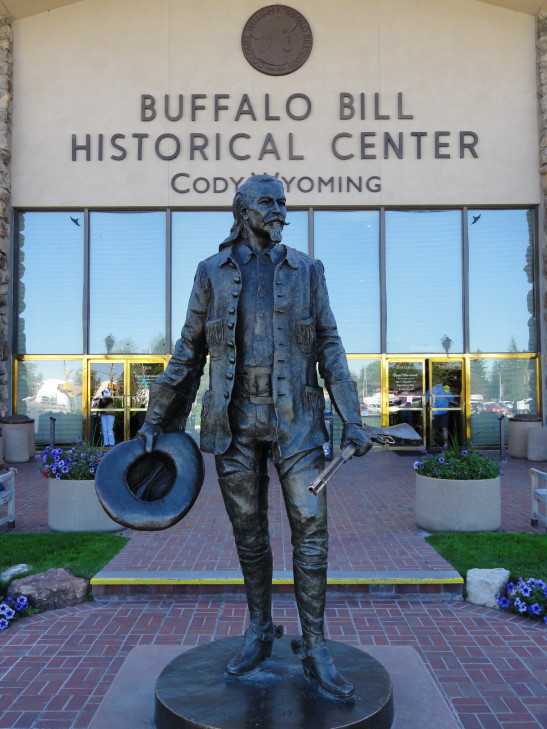
I apologize for the long discussion on the museum but it did take up a big portion of the day so to omit it wouldn’t be right.  I’ll try not to let culture invade this blog again!  I also didn’t want to post any pictures from the museum as I’m not sure what I have a right to do with them, so here’s one from the entrance showing a statue of Buffalo Bill.

Buffalo Bill Historical Center, Cody, Wyoming

Buffalo Bill Historical Center, Cody, Wyoming

Oddly enough, Addison is the one that takes the longest in museums as he tries to read everything.  I used to be that way but I’ve since gotten to the point that I prefer to hit the highlights.  Having already had lunch at the museum (they had these very odd almost red potato chips that were quite good) we left directly from the museum to head towards Yellowstone by taking US-20 through the Absaroka Range.

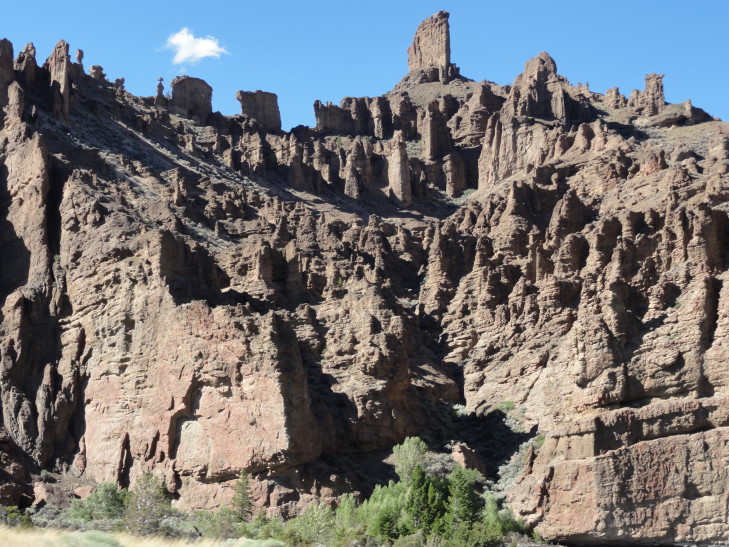
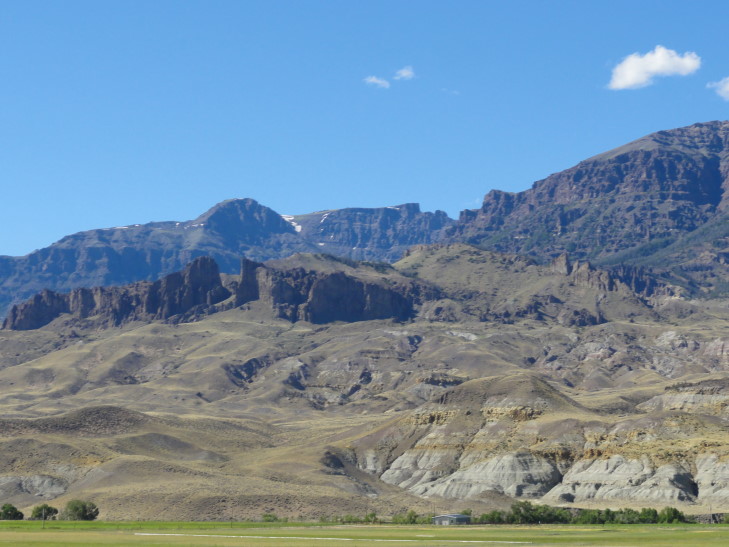
The terrain started out quite arid with many jagged peaks with rock formations that looked like a toothy grin.  Before entering the range we had feared that there’d be a lot of climbing and such but a series of tunnels fixed that.  Addison was very grateful — the trip through the Bighorns the day before had been hell on his ears.  There was also a reservoir, Buffalo Bill Reservoir, that was quite scenic.  As we neared Yellowstone the terrain became a bit more tree-filled and we passed a number of ranches (mostly dude ranches).

Jagged terrain in the Absaroka Range, Wyoming

Jagged terrain in the Absaroka Range, Wyoming

Absaroka Range, Wyoming

Absaroka Range, Wyoming

We finally made it to the east entrance to Yellowstone and paid our $25 per vehicle entry fee (good for a week, though).  The east entrance is quite alpine with long climbs and many twisty curves.  To the right the walls of the mountains rose just feet from the car, broken only by small waterfalls.  The left plummeted into the valley below.  We were very nearly at the height of the snow on a few of eastern Yellowstone’s peaks and also caught many sights of Yellowstone Lake to the west and south as well as the far distant, snow-capped Grand Tetons.

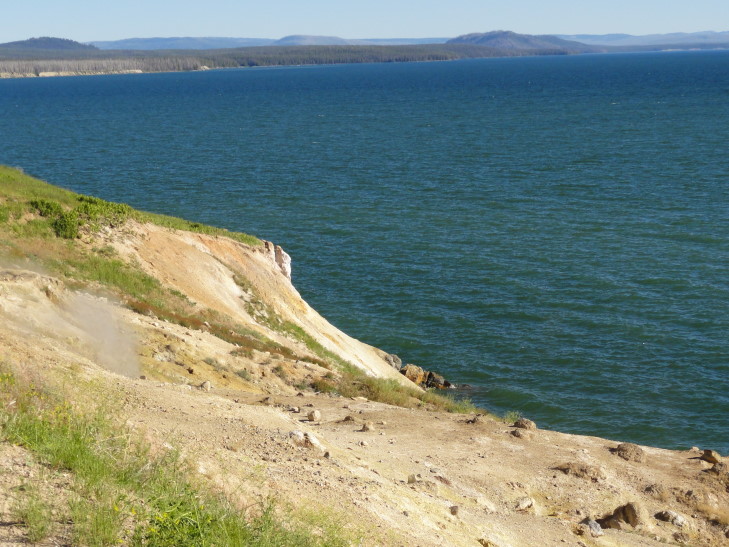
The road eventually settled to the level of Yellowstone Lake.  I was struck by how large it was (turns out it is the largest high altitude lake in the United States).  Large enough that even without a stiff breeze there were some little waves washing on the rocky shore.  One of the first places we came across was a place called Steamboat Point.  It was remarkable because steam was coming out of the ground in several places.  This area of the lake and lake shore was on top of a hot spot that ran into the mountains surrounding the lake.  You could even see an area on the mountainside where all of the trees were dead due to the hot spot.

Steamboat Point, Yellowstone Lake, Wyoming

Steamboat Point, Yellowstone Lake, Wyoming

We then went on to a smaller lake that was actually formed when a hot spot exploded, sending hundreds of tons of rock into the air and creating a crater.  That was many, many years ago, of course.  Near the lake were two bison grazing.  Some tourists were standing within arms reach of them — cuh-razy.  Addison and I stuck to the trail and took pictures from a safe distance.

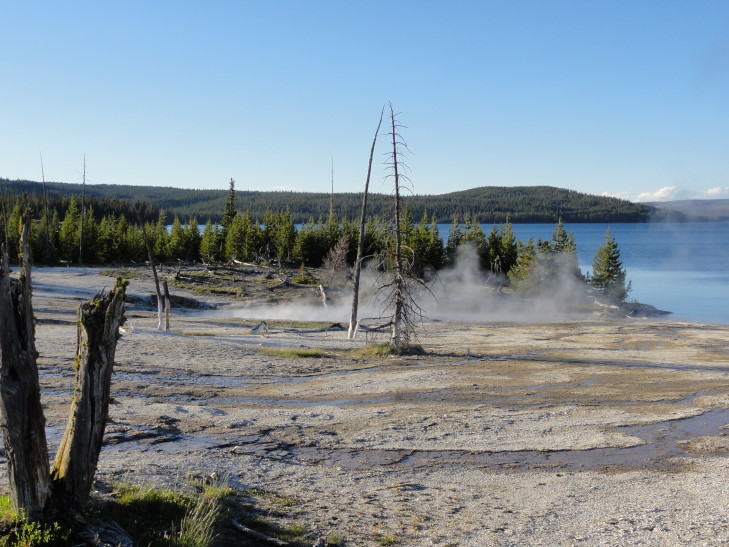
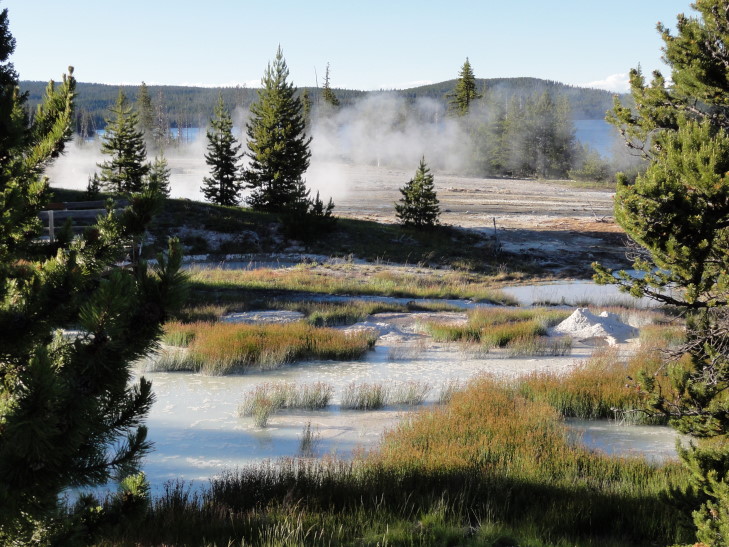
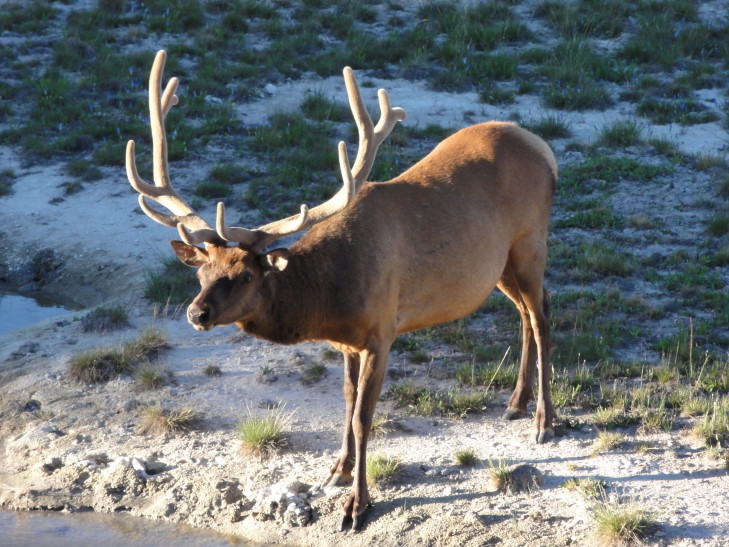
We continued to drive along the lake shore when we came upon the “West Thumb” and its thermally active basin.  Michelle chose to remain in the car but the rest of us walked around the basin on an elevated walkway.  Genetta walked ahead of us and headed back to the car while Addison and I took our time to see everything close-up.  In addition to the geological wonders (no geysers, but some springs and hot pools) there were a fair number of elk (that Addison kept amusingly — at first, at least — referring to as donkeys, camels, and horses) and even a bull elk with a huge rack of antlers.

West Thumb Basin, Yellowstone National Park, Wyoming

West Thumb Basin, Yellowstone National Park, Wyoming

Elk bull, West Thumb Basin, YNP, Wyoming

Elk bull, West Thumb Basin, YNP, Wyoming

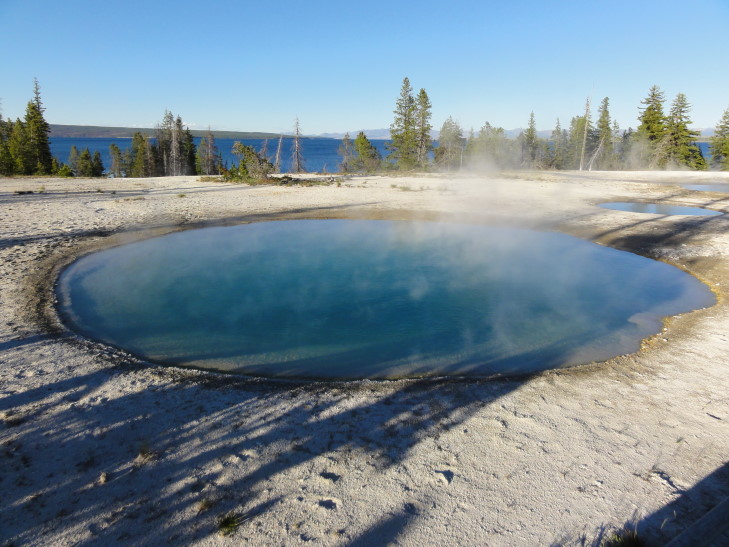
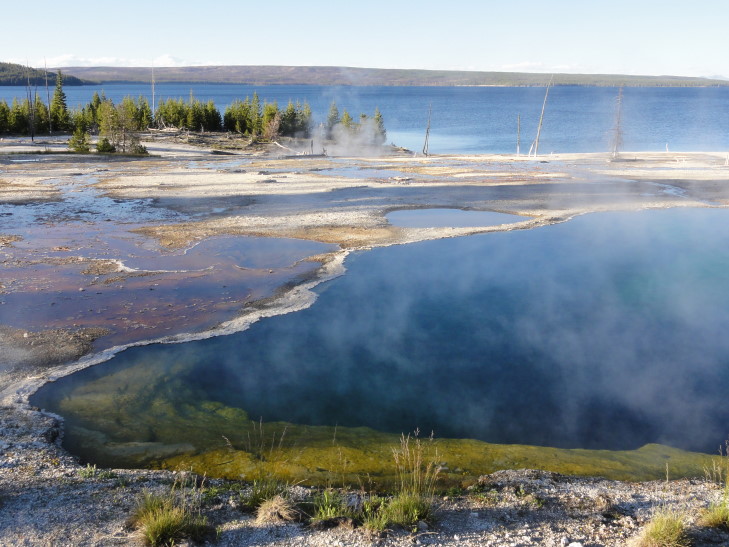
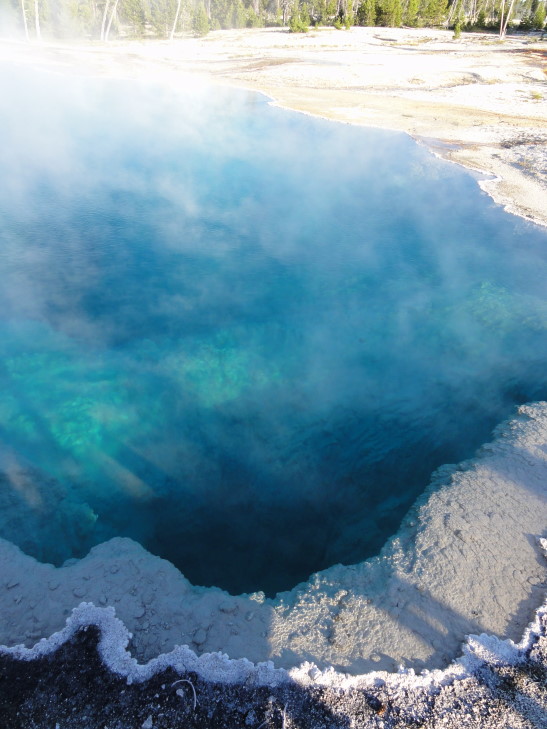
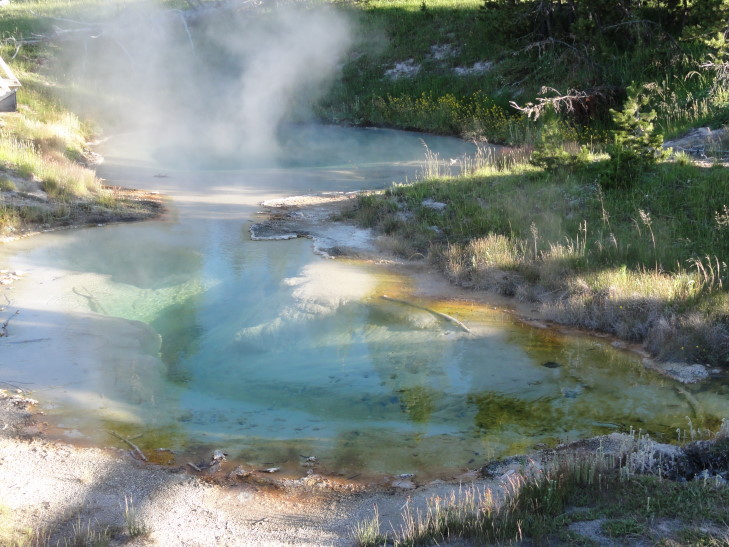
I’ve taken quite a liking to the hot pools in particular with their steam, bubbles, clear water, and breathtaking colors.  The hotter the pool the bluer.  Cooler water (though still very hot!) brings with it algae and such that change the color into greens, browns, and oranges.

Hot pools, West Thumb Basin, YNP, Wyoming

Hot pools, West Thumb Basin, YNP, Wyoming

I wish I could remember the names of all the individual hot pools and the like but there are so many of them and they all have similar names like Opal Pool, Sapphire Pool, etc.  The steam coming up from some of them stank of sulfur.  Addison took great pleasure in accusing me of farting, my response (“It wasn’t me, I didn’t do it!”) forming the title of today’s blog.

One neat thing about the West Thumb Basin is that it is one of the few thermal zones in Yellowstone that is right on the lake — in this case right on the West Thumb (which, incidentally, was formed much in the same way the other lake I mentioned was — a massive explosion).

After West Thumb Basin we proceeded past many of the more famous sights in Yellowstone (including Old Faithful and the Grand Prismatic Spring) as it was getting dark and we needed to get to our hotel.  And, oh, eat.  Checked in to our hotel and then immediately went to eat at the Timberline Cafe.  Pricey but not too bad.

Tomorrow will be fun — going to see more of Yellowstone’s thermal features like Old Faithful and more hot pools, springs, and the like.

Route for July 14, 2010
Route for July 14, 2010
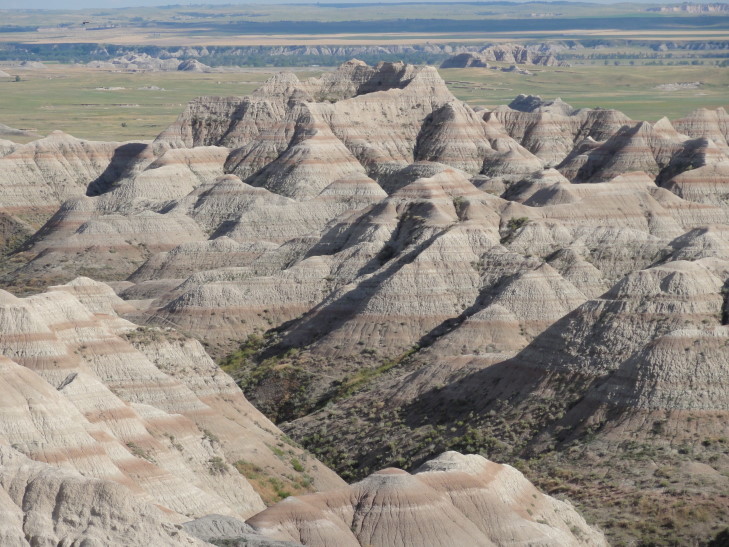
July 14, 2010
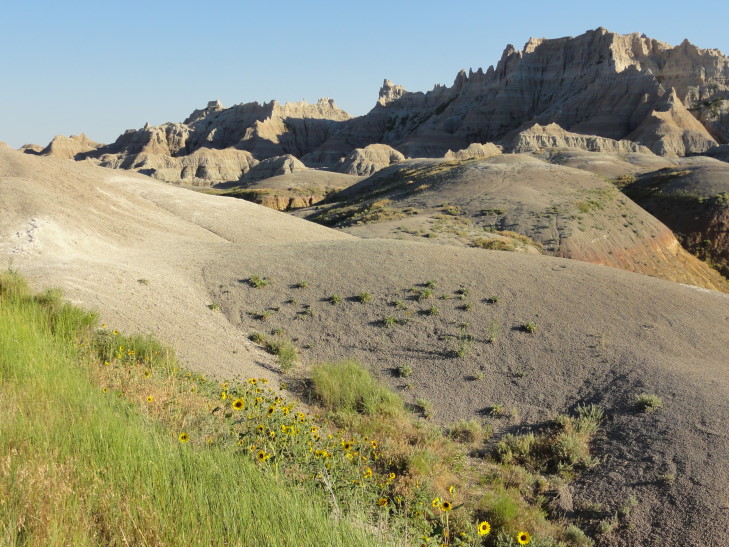
Vast open spaces (as well as a hell of a place to make your fortune)

Filed under: Travel — Tags: — BigWeather @ 4:39 am

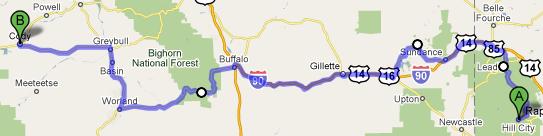
Awoke earlier than usual in an attempt to get an early start on the longest driving day of the trip.  I tried to avoid a day of this much driving but aside from two quick stops in the beginning there just wasn’t much to do between A and B (or, in this case, almost-B) but grind out miles.  Thankfully, as has become typical on this trip, the terrain defied expectations and kept things interesting.

After our breakfast we checked out.  Less than a mile from the hotel a turkey and her chick picked the worst possible time to fly across the road.  Luckily we narrowly missed them.  Pro tip for any birds reading this blog: You have three dimensions you can travel in — USE THEM ALL.  Having dealt with the suicidal wildlife, well at least the suicidal wildlife so far, we headed north to Deadwood.

It’s no secret I’m a big fan of the HBO series by the same name and despite the knowledge that the series embellished a ton of stuff I still couldn’t come to South Dakota and not see Deadwood with my own eyes.  The problem is very little of the original city (at least, the original city of 1876 — when it was a rough-and-tumble town of gold miners in Indian Territory) remains.  Deadwood burned in 1879, 1899, and 1959.  Second pro tip of the day: Move out of Deadwood before years ending in nine.  To stem the decline of the city gambling was allowed recently and while I guess that is keeping in with the history of the place it just doesn’t appeal to me.

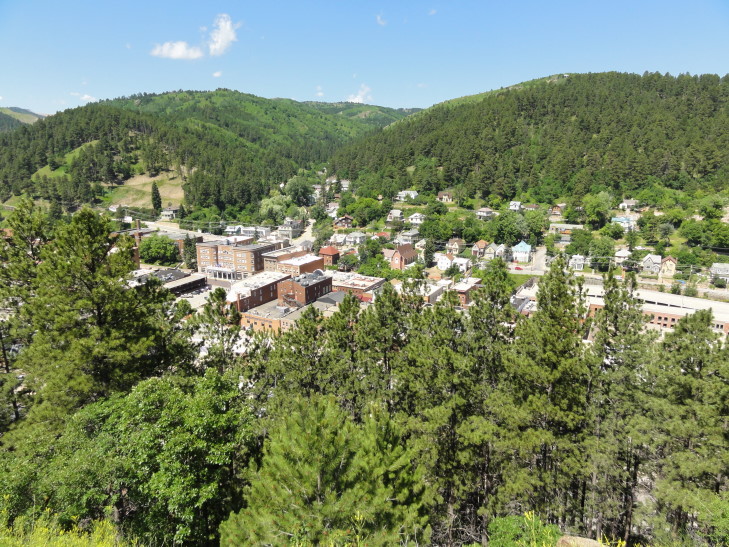
Deadwood, South Dakota

Deadwood, South Dakota

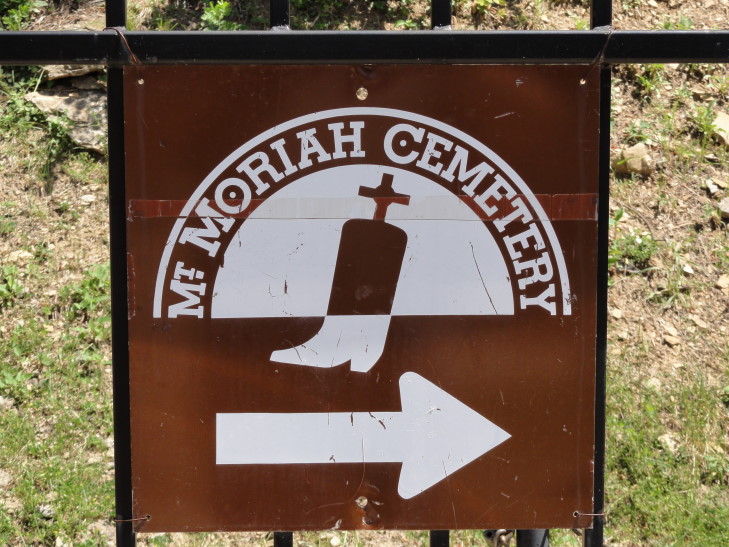
We did, however, visit the Mount Moriah Cemetery where many notables are interred including Wild Bill Hickok, Calamity Jane, Seth Bullock, the Reverend Smith, and others.  The cemetery lies on a hill overlooking town and walking about it was quite tiring, particularly the walk up to Seth Bullock’s grave site.  It technically isn’t in the cemetery proper but rather well above it further up the hillside.  Seth Bullock was one of those rare all-around Americans — lawman, businessman, great friend of Theodore Roosevelt (in fact, Roosevelt sent his sons to visit with Bullock in Deadwood).  He died in 1919, shortly after completing a memorial for his friend Theodore Roosevelt.  The kids were struck by how young many of the people buried in the cemetery were — it really drove home that just a century ago life was much harder.  Rather than post images of grave sites (which kinda weirds me out, to be honest) I figured I’d show the logo for Mount Moriah Cemetery — a logo I feel is just incredibly awesome.

Mt. Moriah Cemetery logo, Deadwood, South Dakota

Mt. Moriah Cemetery logo, Deadwood, South Dakota

In the visitor’s center for the cemetery they had many of Reverend Smith’s items.  He was the first preacher in the hill country of South Dakota and a Civil War veteran.  He was killed in that bloody summer of 1876 (as was Wild Bill Hickok by McCall while he played poker — his hand of Aces and Eights is still known as the Deadman’s Hand).  Initially Indians were suspected, as attested to by Bullock’s touching letter to Smith’s family back in Kentucky notifying them of his death.  Letter writing sure is a lost art, sadly.  There is now some speculation that it was not Indians but rather those unhappy with his preaching on the corners of Deadwood.  I guess we’ll never know.

We left Deadwood and headed into Wyoming on I-90.  Our first Wyoming stop was to be Devils Tower National Monument and I figured we could get a bite to eat in Sundance.  Wrong on that account.  I thought that Sundance was the site of the Sundance Film Festival and therefore there would be plenty of places to eat.  Sundance has only a Subway and a stoplight — turns out that the festival is in Utah, not Wyoming, so any hope of a decent lunch were dashed.

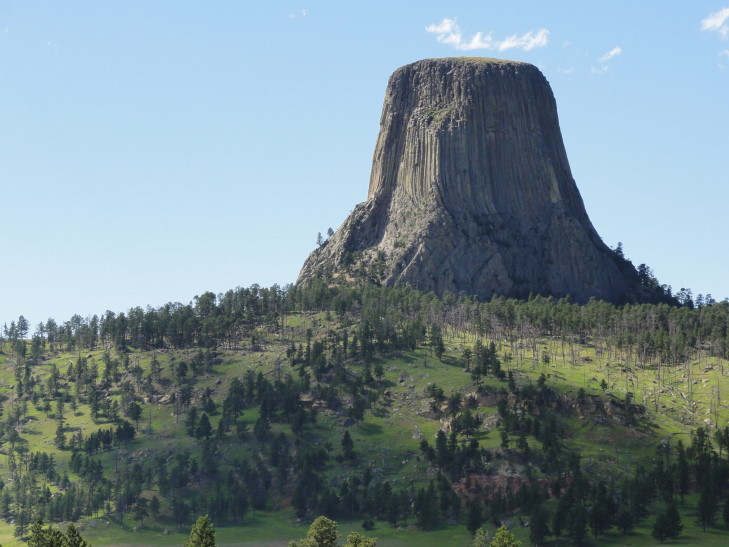
Hungry, we decided to press on to Devils Tower National Monument.  The monument rises over 1,200 feet.  Sioux legend has it that seven sisters were being chased by bears and took refuge on a low rock outcropping.  They prayed to escape the bears’ clutches and those prayers were answered when the rock rose rapidly.  As it rose the bears’ claws cut the vertical ridges in the rock.  The rock kept rising, however, until the seven sisters were launched into the sky where they can still be seen today as the Pleiades constellation.  Now I don’t know about that, but I do know that it is a very impressive sight.

Devils Tower National Monument, Wyoming

Devils Tower National Monument, Wyoming

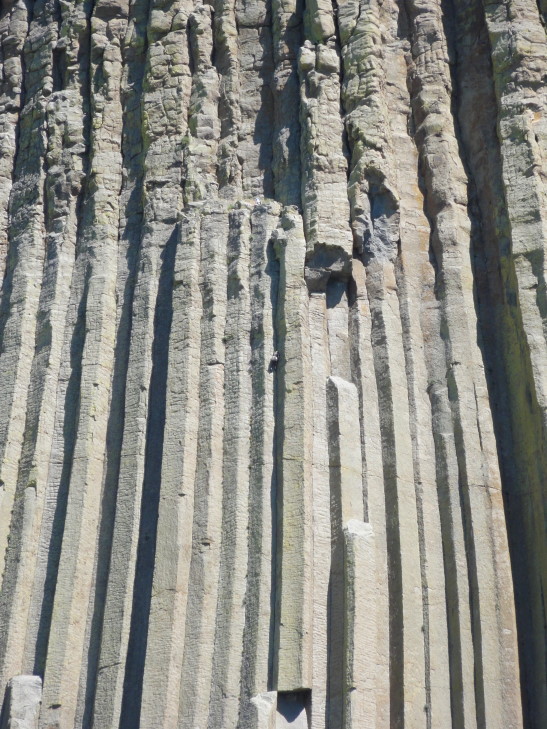
At the visitor’s center we learned that Devils Tower was the first national monument, set aside in 1906 by Theodore Roosevelt.  It had been climbed many times by early climbers using crude wooden ladders (cuh-razy!) but now it is climbed with technical rock climbing techniques.  It was being climbed when we got there, in fact.  Check out the center of the photo below — see that little bump with a shadow?  That’s a person!

Climber, Devils Tower National Monument, Wyoming

Climber, Devils Tower National Monument, Wyoming

Climbers typically take three to five hours to get up and back down.  They are not permitted to stay up top overnight.  Addison was telling me the story of this guy that had parachuted on to the top but was stranded for six days until a group of climbers could get him down.  I found this very hard to believe — why didn’t he just call a helicopter or something?  Turns out it was in 1941 — no way to call the helicopter (that hadn’t been invented yet!).

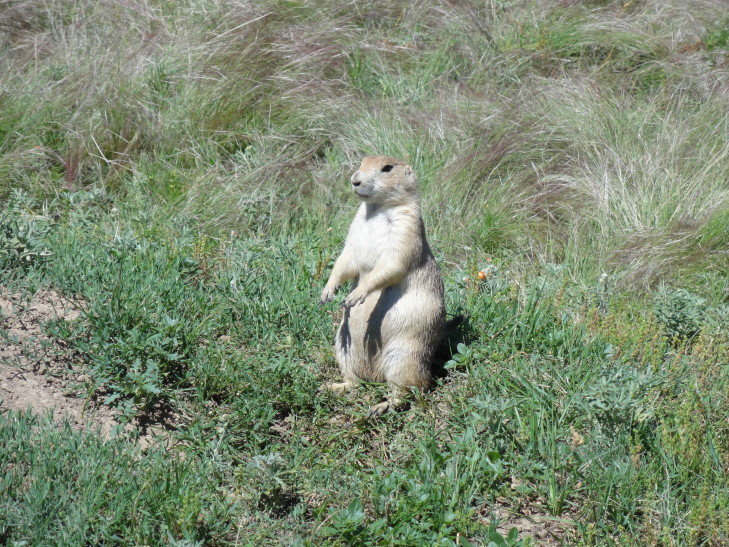
Incredibly hungry by this point (as the visitor’s center had no food) we stopped by to see the prairie dog town on the grounds.  What amazingly cute creatures!  Addison and I got out of the car and walked down a trail for a bit.  We took some really close pictures (can get to about four or five feet away without spooking them — though that is fun in its own right because they start doing a high-pitched bark to their buddies).

Prairie dog, Devils Tower National Monument, Wyoming

Prairie dog, Devils Tower National Monument, Wyoming

Just outside the entrance to Devils Tower NM there was a KOA restaurant that we weren’t brave enough to try (and couldn’t find parking, regardless) earlier.  We were hungry enough now that we didn’t care.  It turned out to have reasonably priced good food — Michelle and I both had an excellent BBQ beef sandwich with potato salad (kind of a mustard / mayo mixed type) and I had a tasty green apple shake.  It was nearing 4 o’clock, however, and we had a ton of driving left to do so we ate quickly and hit the road.

The road to Buffalo along I-90 was relatively flat with prairie extending in all directions.  It was even more treeless and desolate than in Nebraska.  We saw a dust devil kick up and when we drove through it the car was shaking it the wind was blowing so hard.  The temperature was in the mid-90s and the wind felt like a furnace blast.

Once we got beyond Buffalo and started climbing over the Bighorn Mountains, however, the temperature plummeted to the upper-60s / lower-70s.  The vegetation was lush forest, mostly evergreen with beautiful purple flowers in their shadow or stands of birch.  Not one, but two, suicidal beavers cross the road right in front of us.  Sadly not a bighorn sheep in sight, not even on the slopes of the snow-capped 13,000+ foot peaks we passed.

Bighorn Mountains, Wyoming

Bighorn Mountains, Wyoming

We crossed over the Powder River Pass (and passed the amusingly named “Crazy Woman Creek” — Michelle and I enjoyed that one) at 9,666 feet and descended down to the town of Ten Sleep through a beautiful canyon with many switchbacks.  The town was named Ten Sleep because it took the Indians ten days (or, ten “sleeps”) to get there from their base near Casper, Wyoming.

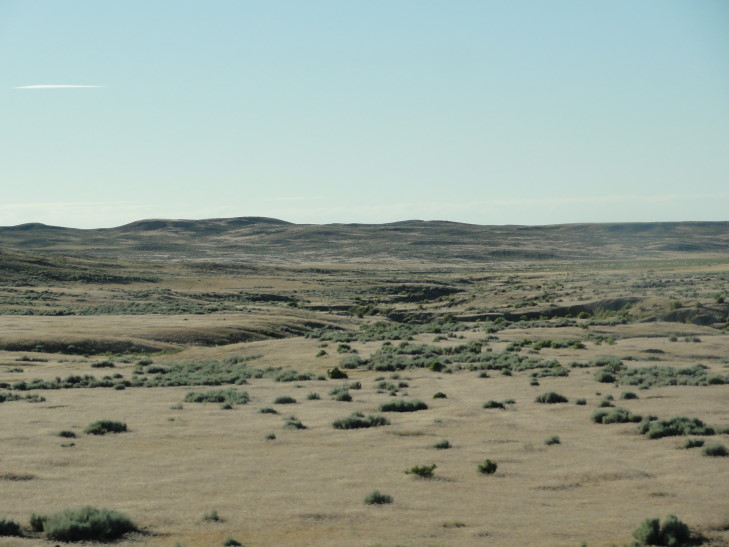
What is amazing about this trip is how it continues to defy expectations.  I didn’t expect to be greeted by what was essentially a moonscape, or at least badlands, on the other side of the mountains.  This terrain continued all the way on to Cody, our destination, with only a few towns (and surrounding irrigated fields) breaking up the spectacle.  Well, that and a final suicidal critter, this time a rabbit.  Silly rabbits!

Moonscape west of the Bighorn Mountains, Wyoming

Moonscape west of the Bighorn Mountains, Wyoming

Tomorrow we drive through Yellowstone National Park to our lodging of the next five days in West Yellowstone, Montana.  Stay tuned!

Route for July 13, 2010

Route for July 13, 2010

July 13, 2010

If this is bad I don’t wanna be good

Filed under: Travel — Tags: — BigWeather @ 2:02 am

Woke up early and ate our now-standard hotel breakfast.  The group of French (or more likely Quebecois) motorcycle riders, no doubt up here early for Sturgis (we’ve seen a TON of cycles), had checked out and the traffic in the breakfast room was much better for it.  Hit the road to Badlands National Park a good hour and a half to the east.  The weather had noticeably improved with some little popcorn clouds to break up the blue expanse.  Other than some construction on US 44 towards the town of Interior (population 67!) the drive was mostly pleasant.  Heck, even the kids were getting along.

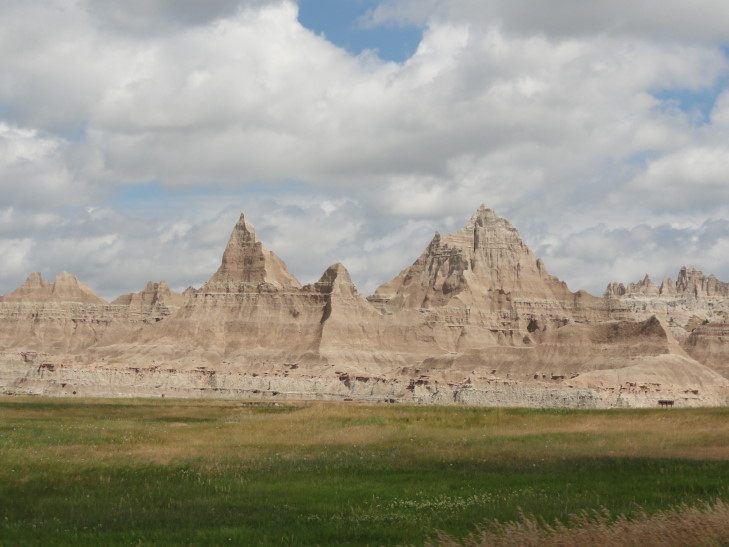
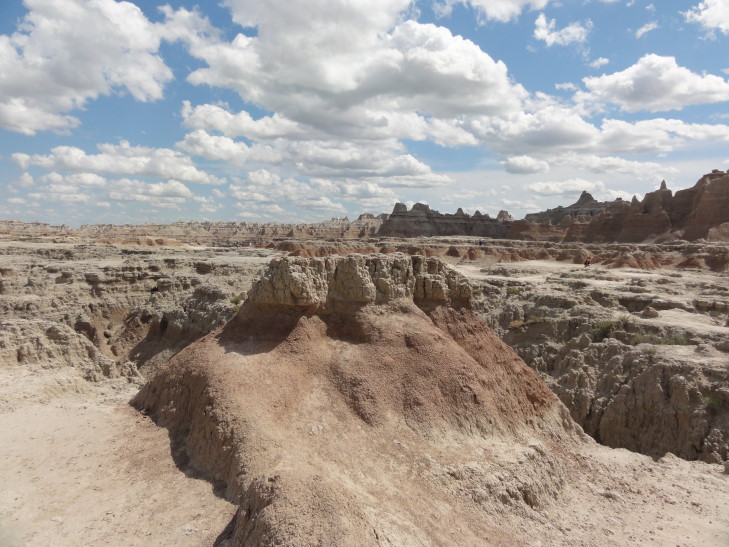
Around the town of Scenic onwards past Interior the scenery changed from rolling prairie and farms to amazing jagged spires and cliffs — the southern expanse of Badlands NP’s North Unit and the northern expanse of the much-less-visited South Unit.

Badlands near Interior, South Dakota

Badlands near Interior, South Dakota

After paying the $15 vehicle fee to enter we proceeded to the visitor center, which contained some interesting exhibits about the formation of the Badlands (about 500,000 years ago) as well as the creatures that inhabited the region.  A Junior Ranger was very helpful and pointed out some trails worth exploring.

We then walked to the adjacent Cedar Pass Lodge to eat.  It was built in the 1920s which explains why I could’ve sworn I saw some flappers still waiting on their food!  Really, while the food was OK the wait time was horrible — as we’re sitting there I’m imagining all of the cool stuff we could be seeing…  Regardless, Michelle didn’t play it safe and had an Indian Taco complete with buffalo meat.  She liked it.

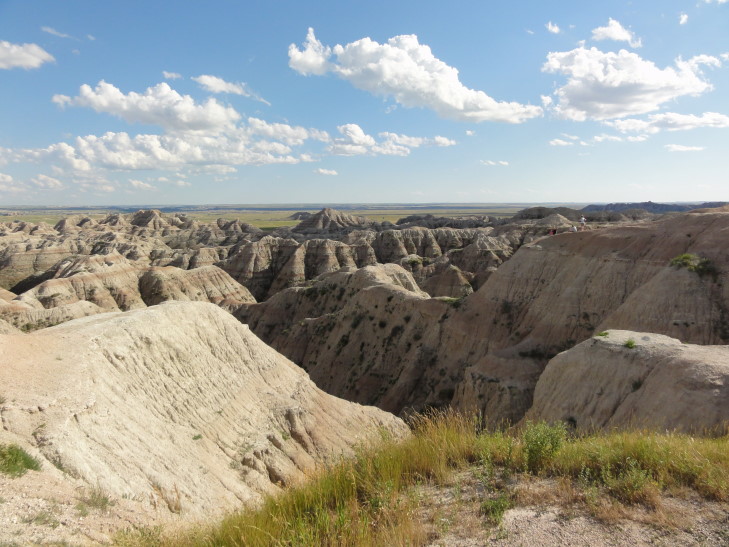
Afterward we drove north from the visitor center and walked both the Cedar Pass trail and the Door trail.  While the Cedar Pass trail, complete with “Beware of Rattlesnake” signs, was enjoyable and afforded views of the valley below the Door trail was stunning.  It started out simply enough as a elevated walkway over some prairie grass but after passing through two spires it opened up to the most amazing area of gulches, spires, and what-not.  Addison and I explored quite a bit but unlike some of the more… dumb?… travelers we didn’t walk into the shady gulches and stick our hands into dark crevasses.  I really didn’t want a rattlesnake bite.

Door Trail, Badlands National Park, South Dakota

Door Trail, Badlands National Park, South Dakota

We decided to quickly check on our other intended destination of the day, Minuteman Missile National Historic Site, to make sure we didn’t miss seeing that as it was nearing 4 o’clock.  It is a good thing we did — the missile silo was only open until 4:30 and was fifteen miles down I-90.  The Rangers there encouraged Addison to become a Junior Ranger and he took the paperwork with him to complete on the way.

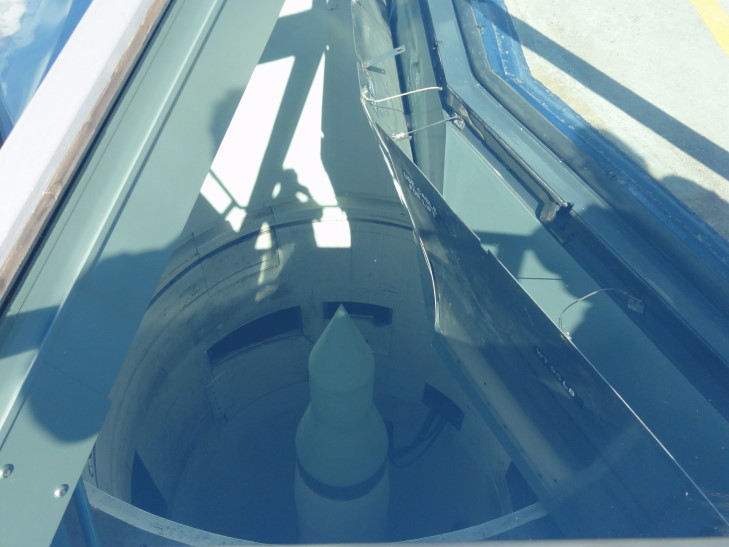
We arrived at the silo and while there wasn’t much to see it was neat to see how the cover to the silo was on rails and would retract when needed.  The cover itself was in this case glass (I’m sure  just for this site, surely it isn’t glass on “real” silos) allowing us to see the (disarmed) Minuteman II inside.  Neat stuff.  Surprisingly the silo itself was within sight of the interstate and didn’t even try and disguise itself.

Minuteman II missile in silo, Minuteman Missile National Historic Site, South Dakota

Minuteman II missile in silo, Minuteman Missile National Historic Site, South Dakota

While the silo location was not Top Secret what was was the destination of individual missiles and the like.  Four people had to complete a process to launch the missile.  There were hundreds of Minuteman II missiles scattered throughout the Great Plains because Soviet submarine-based missiles would have difficulty taking them out and also it was a convenient place to launch missiles that would go over the north pole and strike the central Soviet Union.  Even today there are hundreds of missiles throughout the area.

After visiting the silo we rushed back to the Ranger headquarters 15 miles to the east, arriving right after 4:30.  Despite the doors being locked the Ranger took pity on us and let Addison turn in his Junior Ranger workbook and become an official Junior Ranger of Minuteman Missile National Historic Site, complete with certificate and a nice patch with a missile on it.  Part of the work he had to do was draw a blast bay door (real ones played on Domino’s Pizza’s slogan) and he drew “For service call 1-800-Nukes-R-Awesome” with a missile with “Awesome” written on the side.  That’s mah boy!

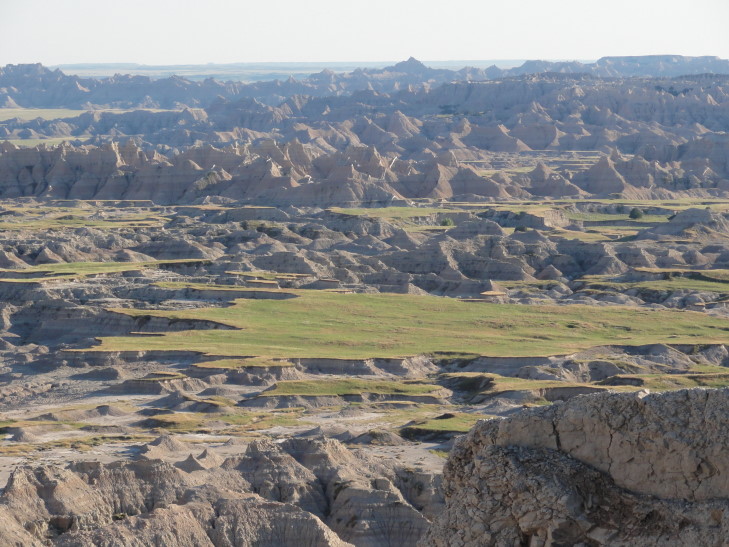
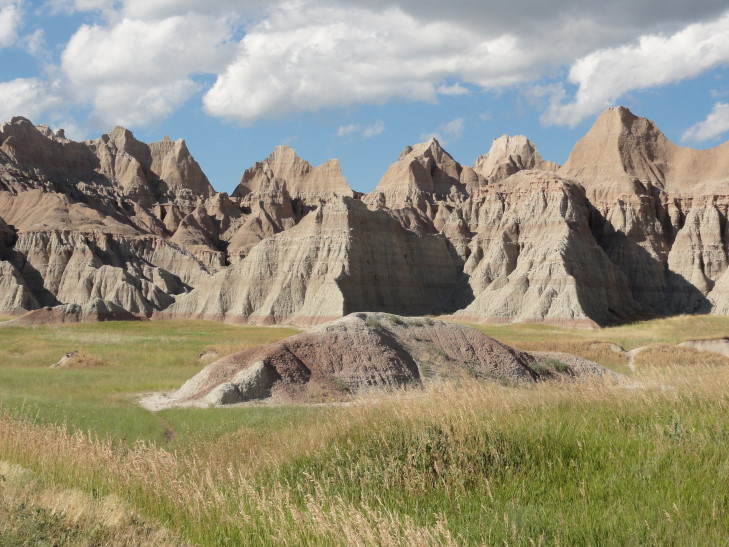
Returned back to Badlands National Park and took the park loop road through the park, stopping at many viewpoints along the way.  Something interesting about the spires was the different colored strata — sometimes gray, sometimes white (volcanic ash from volcanoes to the west), sometimes red or pink.  Also the layers were almost perfectly horizontal, exhibiting none of the lift that we saw in the layers in the Black Hills.  The Badlands are disappearing over time, eroding with each raindrop into the nearby White River.  The geological feature serves as a wall between the lower prairie and the higher prairie to the north.

Though we failed to see any mountain goats / bighorn sheep we did manage to see a few rabbits and some prairie dogs as well as enjoy the sounds of the prairie — the ever present chirping of crickets and grasshoppers and the occasional bird song.

Badlands National Park, South Dakota

Badlands National Park, South Dakota

As dusk neared we headed back to Hill City, South Dakota via I-90 and 16, stopping by the Alpine Inn to eat.  This place had been recommended to us by the kind woman that was manning (womanning?) the visitor center at Carhenge in Nebraska a couple of days back.  She was spot on!  While they server German cuisine for lunch they serve only two things for dinner: filet mignon and hotdogs (for the kids).  That’s it.  So, how much would you figure a lettuce wedge with ranch dressing (again, the only choice), a baked potato, some Texas toast, and a 9 oz. filet would set someone back?  $10.95.  How the hell do they do that?!  They do offer 30 desserts, however, and all at less than $4.  Amazing.  We all had 9 oz. filets and dessert (I had the Cappuccino Ice Cream Pie, which was delicious) , plus two of us had fountain drinks, all for way less than Outback.  While it wasn’t the best filet I have ever had it was darn close — and for $10.95 I certainly couldn’t complain.

Full, we headed to the hotel — the others to bed, me to the blog.  Tomorrow is our heaviest driving day as we head to Cody, Wyoming via Devils Tower National Monument.  Stay tuned!

Route for July 12, 2010

Route for July 12, 2010

http://www.designobserver.com/observatory/entry.html?entry=6697
« Newer PostsOlder Posts »

Powered by WordPress