BigWeather's Blog

July 22, 2010

It rarely rains in Vernal, Utah…

Filed under: Travel — Tags: — BigWeather @ 1:46 am

…except when we come calling.

Woke up at our normal 7 AM, ate our tasty (and free) breakfast, and left Ogden for Vernal, Utah after filling up the car and getting some sweet tea from McDonald’s.  We had originally considered going to Golden Spike National Historic Site, a place we hadn’t gotten to yesterday, but it had a couple of strikes against us going: it was a half hour in the wrong direction and many of the attractions (including the locomotives) are reproductions.  That and the kids just didn’t seem that interested.

So we headed east from Ogden on I-84 then east on US-20 in an effort to avoid having to drive through Salt Lake City and also to see some of the beautiful scenery to the east of the Great Salt Lake.  It certainly lived up to our expectations!  There was a wide variety of mountains — gray jagged rock, red sediments, pillars of stone, tree-covered, shrub-covered, bare, you name it.  Quite a variety of terrain.  We also saw several beautiful lakes in the mountains.  One odd thing is that many of the mountains had a single large white letter etched in them.  At first we thought it must correspond to the first letter of the nearest town but that theory didn’t hold as time went on.  We never did find out the meaning of all of the letters, but Wikipedia has an interesting article on it.  Utah has one of the highest concentrations of these “hillside letters”.
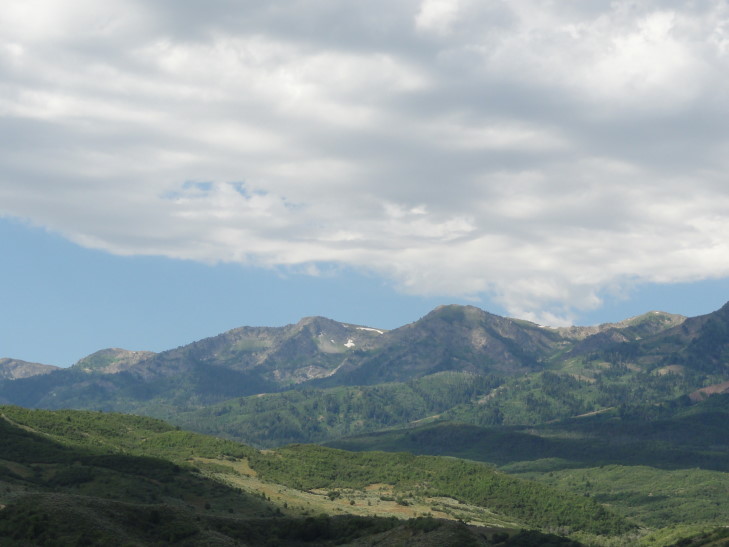
Mountains east of Ogden, Utah

Mountains east of Ogden, Utah

After passing through (and eating a Wendy’s lunch at) Heber, a very charming and “old fashioned” town, we passed just north of the Strawberry Reservoir which reminded me a lot of a Scottish loch due to the complete lack of trees on the green hills and the gorgeous blue water.  East of that the terrain flattened out a bit and the green gave way to increasingly scrub vegetation.  We stopped at a rest area that had a delightful walking loop that offered views of a valley to the north.
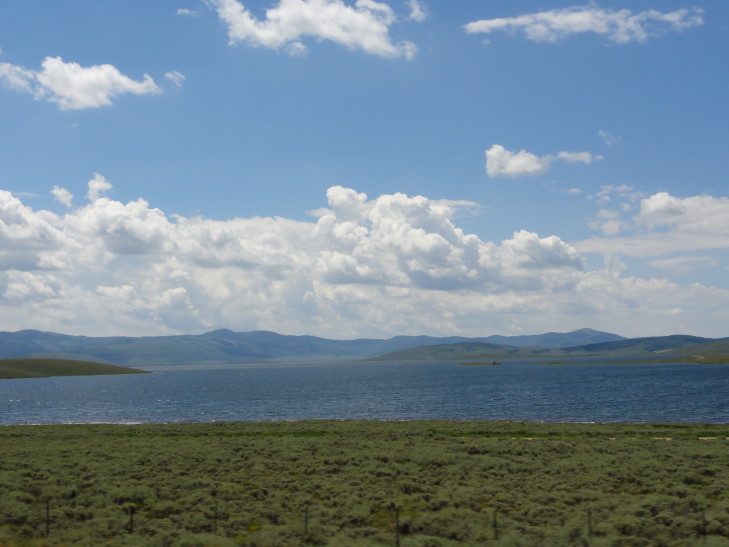
Strawberry Reservoir, Utah
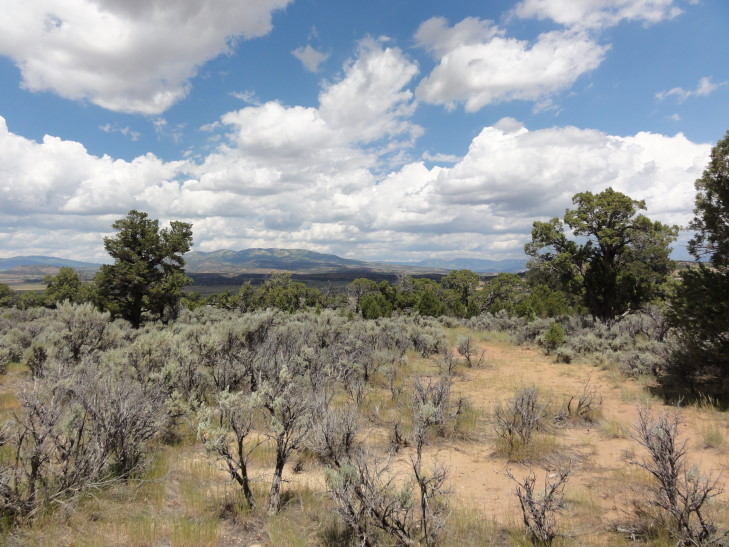
Strawberry Reservoir, Utah

View from a rest stop in northeastern Utah

View from a rest stop in northeastern Utah

A bit further to the east we came upon Starvation Reservoir (charming name, eh?).  Starvation Lake had the most beautiful blue-green water which was accentuated by the sand-colored cliffs that contained it.  There was a marker for the Dominguez-Escalante expedition in 1776 that explored Utah (the explorers were seeking a new way to Monterey, California from Santa Fe).
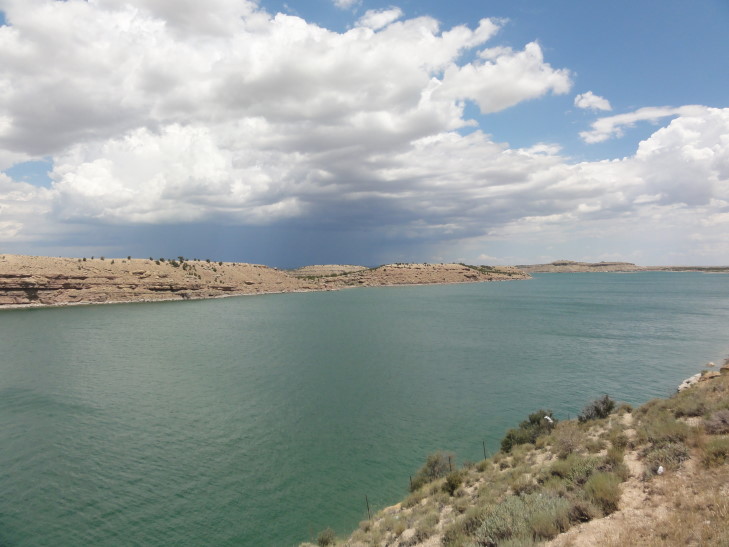
Starvation Reservoir, Utah

Starvation Reservoir, Utah

Shortly after the reservoir a huge storm started blowing up to our left (so, north of us).  At one time I thought that a wall cloud may actually be forming but then I remembered Utah almost never has tornadoes.  Still would like to see one one day, though.  Maybe Greg and I can have a mid-life crisis trip to chase them one year.
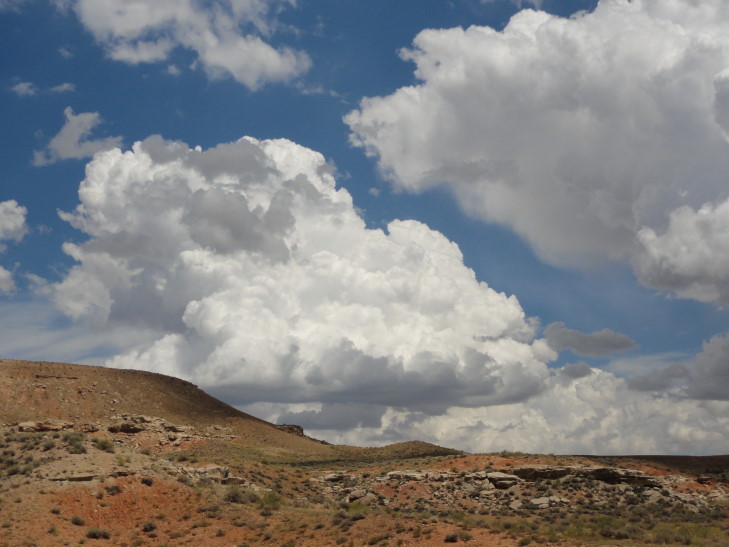
Thunderstorms over northeastern Utah

Thunderstorms over northeastern Utah

Finally arrived in Vernal about 2:30 PM.  While not as charming as Heber it does have quite a bit in the way of places to eat and shop which is nice.  Since we couldn’t check in until 4 PM we decided to head to Dinosaur National Monument‘s temporary visitor center (the real one has been condemned and is being rebuilt).  While there we picked up information about the two auto tours as well as a couple of interesting small hikes.  The only place to see fossils in the park is along the Fossil Discovery Trail.  Unfortunately, the trail was closed due to the visitor center construction but they did have morning shuttles to the trail — something we decided we’d have to do on Thursday.

While at the visitor center the skies finally opened up.  Close lightning, booming thunder, and a torrent of rain.  One of the Rangers had to go outside and sweep the water that was ponding next to the building as best he could.  He said that the area only gets 7 to 9 inches of precipitation a year and storms were fairly rare.  Though he also said the majority of the precipitation is snow in the winter to the tune of “a foot or two” (liquid equivalent of 1 to 2 inches) so I think his math may be a bit off.  Regardless, it was fairly rare and yet… there it was.
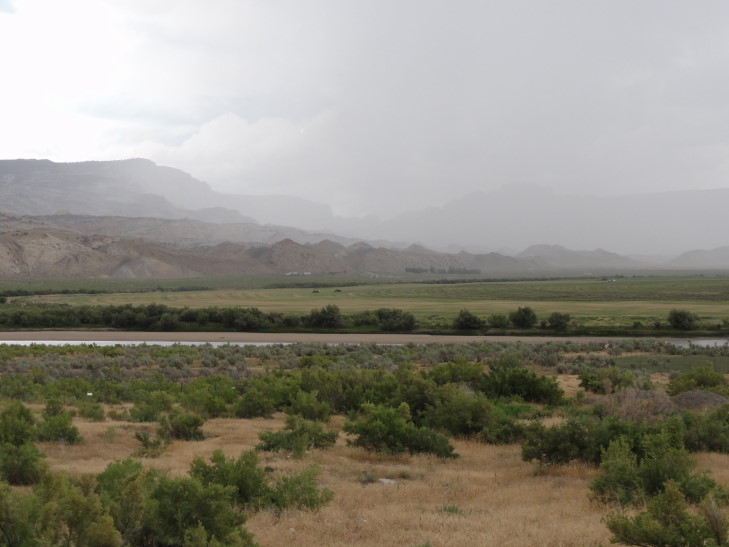
Thunderstorm, Dinosaur National Monument, Utah

Thunderstorm, Dinosaur National Monument, Utah

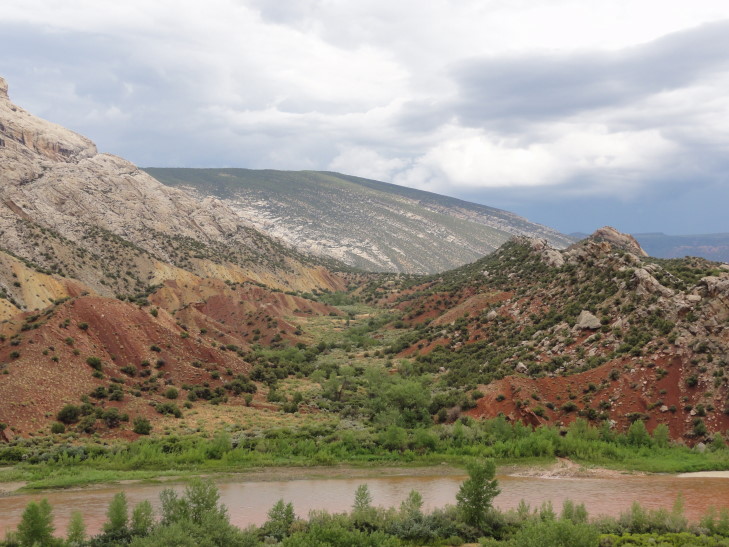
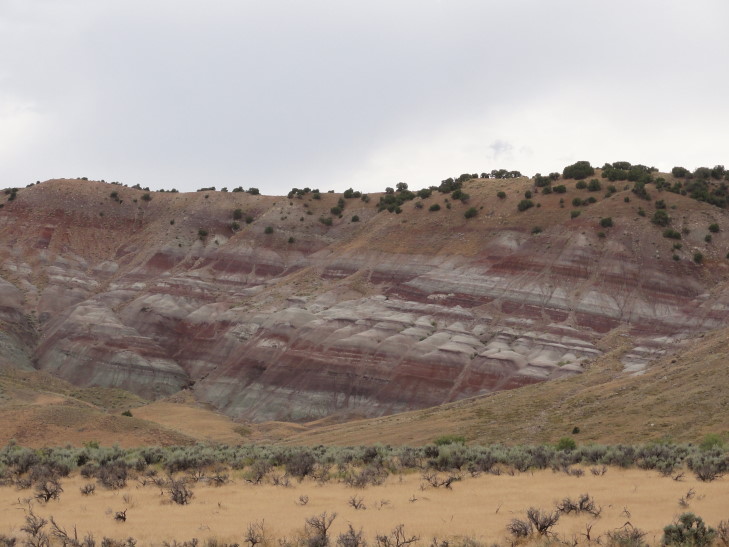
Once the rain had (mostly) let up we set out on the “Tilted Rocks” car tour, an eleven mile drive entirely in Utah (Utah shares the National Monument with Colorado).  We were immediately struck by the distinct layers of rock and their colors: red, gray, yellow.  These layers were laid down during different eras spanning millions of years.  The layer of gray was a marine layer from back when a shallow sea covered the area.  Rather than laying flat the layers had been thrust upward by uplifting and such.
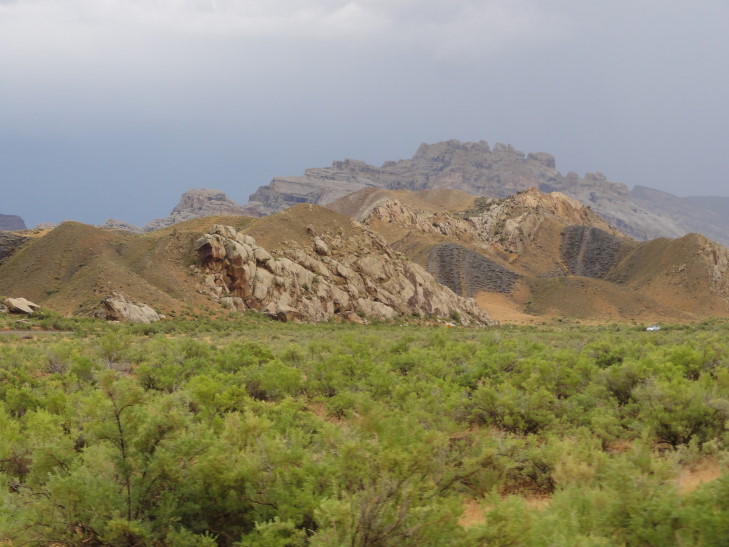
Rock layers, DNM, Utah

Rock layers, DNM, Utah

One of the first stops was called “Swelter Shelter” because when it was excavated in the 70s it was during the summer and blazing hot.  This area of overhanging rock had been a shelter for thousands of years (perhaps back 10,000 years) for humans hunting native species of the time.  It was in use even up until 700 – 1300 AD when the Fremont culture put petroglyphs and pictographs on the rock.  It was quite amazing to see rock art drawn nearly a millennium ago, the kids in particular seemed to enjoy it and kept finding interesting figures.
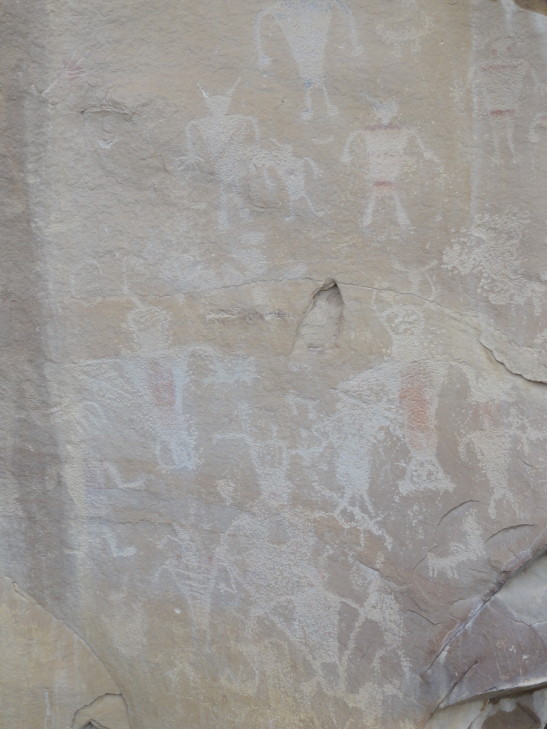
Fremont rock art, DNM, Utah

Fremont rock art, DNM, Utah

We then proceeded to Split Mountain, a mountain with quite a mystery — the Green River actually cut a course through its tough rock rather than around it.  Water is a beautiful thing in that it is 100% predictable — it will always do the laziest, easiest thing.  So why, in this case, did it cut though tough rock rather than flow around it?  Speculation is that there was originally softer rock above what is today Split Mountain that the Green River established a river channel through.  When it hit the Split Mountain’s current hard rock, or more likely, Split Mountain was thrust upward towards the river, it was too established in its bank and it was actually easier to cut through Split Mountain than chart another course.
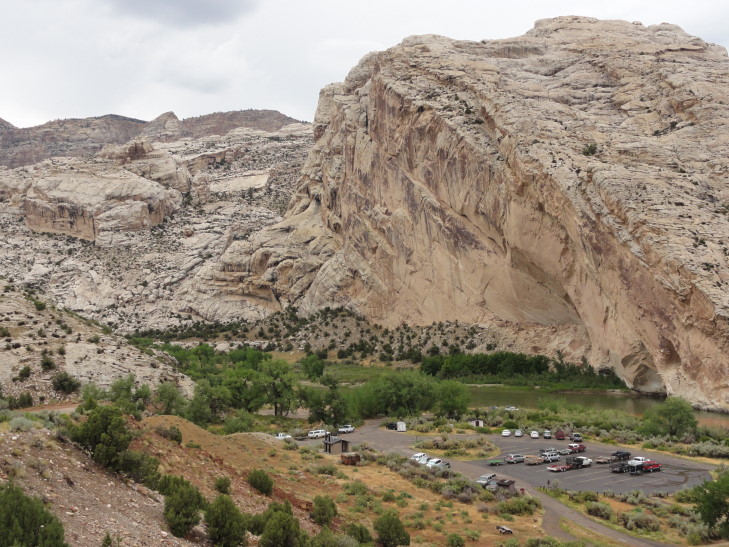
Split Mountain, DNM, Utah

Split Mountain, DNM, Utah

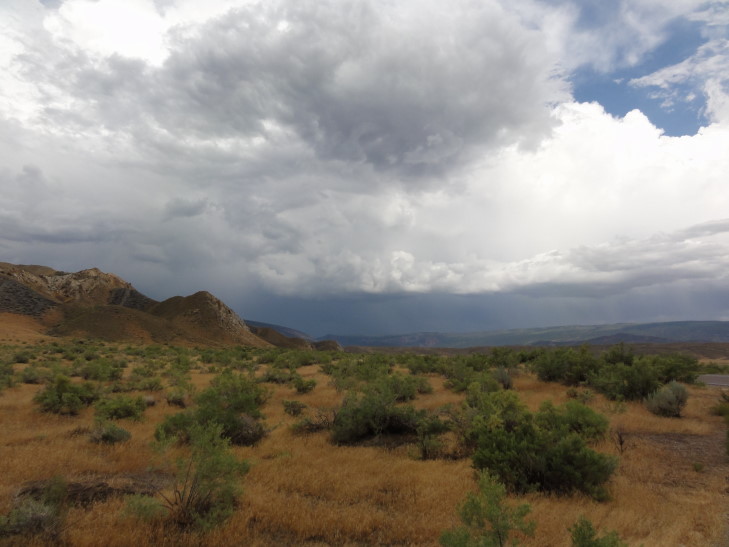
At the entrance to the canyon cut through Split Mountain was a campground.  I felt a bit nervous for those folk as the normally tame Green River was swelling and red with the recent runoff.  After learning a bit about the ranch that the tour passes through but isn’t part of the National Monument we decided to turn around — the road became unpaved and with it having just rained we were concerned about the conditions.
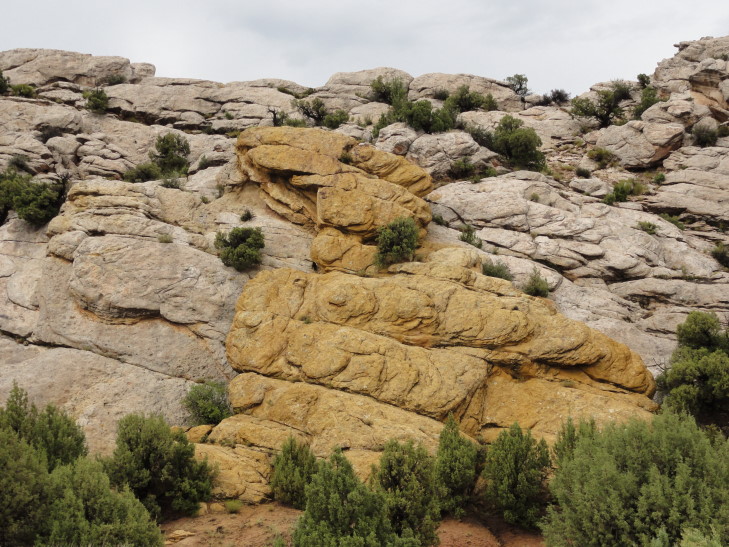
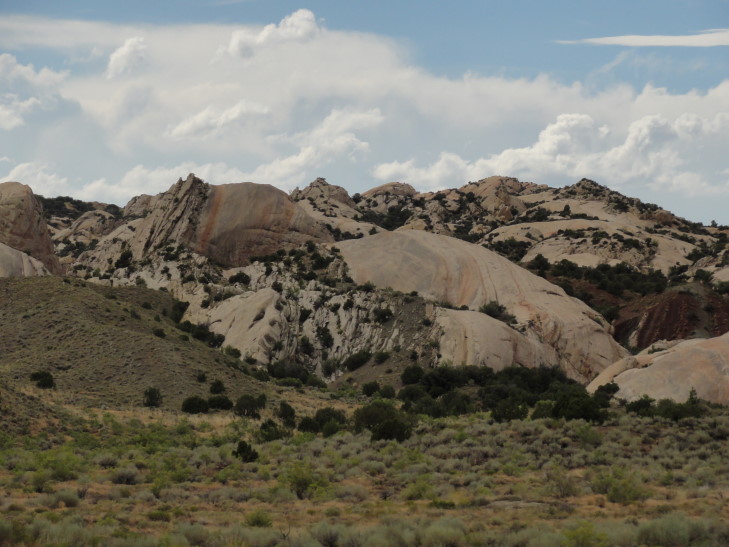
Yellow rock, DNM, Utah
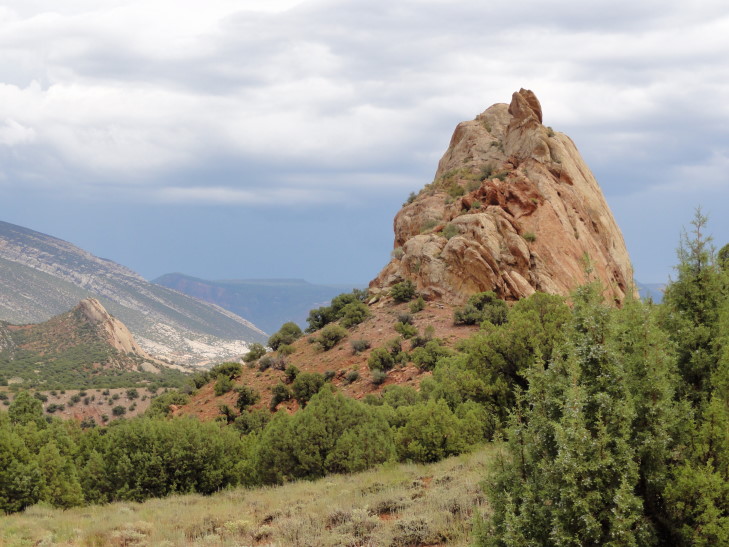
Yellow rock, DNM, Utah

Checked in to our hotel and immediately set out for dinner.  We at Quarry Steakhouse and Brewery.  It was a bit pricey for the quality but we were hungry.  Just as we were about to pay another storm hit with torrential rainfall and frequent lightning.  It knocked out power and they couldn’t run credit cards so we had to pay with cash.  The ride home wasn’t that fun as many people apparently didn’t realize that stop lights become four way stops in the event of power failure.  Watched a new episode of Psych, went swimming, then bed.
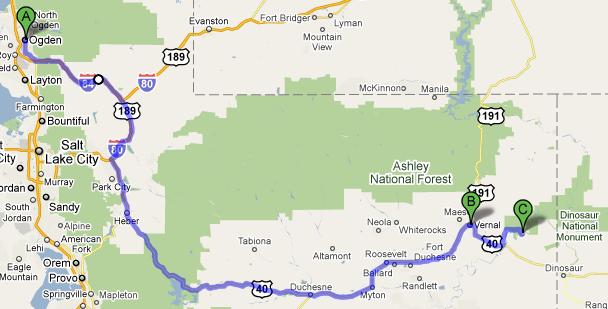
Route for July 21, 2010

Route for July 21, 2010

July 21, 2010
That’s one small step…

Filed under: Travel — Tags: — BigWeather @ 12:16 am

Woke earlier than usual, got breakfast (yay Holiday Inn Express — finally free breakfast again!), and checked out by 9 AM.  Ran to Wal-Mart to pick something up, filled up the car with some gas, and got some tea from McDonald’s for the hour and a half drive out to Craters of the Moon National Monument.  We headed out on US-20 and unfortunately almost immediately encountered construction delays.

Soon after the farmland gave way to sage brush scrub land with several buttes (including Big Southern Butte, which I took great joy in calling Big Southern Butt) in the distance to the south and a range of mountains to the north.  US-20 goes straight through the Idaho National Laboratory, a leading center in nuclear research.  They’ve produced more reactors than any other place in the world, just over fifty.  In addition it is the site of EBR-1, the first nuclear reactor to produce electricity.  INL is also the birthplace of the nuclear navy with the first nuclear reactors to be used in subs and other vessels developed and tested there.  Fascinating stuff.

Lava Flow with Big Southern Butte beyond, Idaho

Lava Flow with Big Southern Butte beyond, Idaho

We also learned that the Lost Rivers ran underground through most of the area, forced underground by the lava fields of Craters of the Moon and not emerging to the surface until just short of merging with the Snake River — a distance of over one hundred miles.

Passed through Butte City (which again elicited quite the chuckle from immature yours truly) and Arco.  Arco became the first town powered by nuclear energy in 1955 with electricity generated in the nearby INL.  Arco is also where the nice retired police chief that we met at Wal-Mart lived — amazing that he has to drive one hour plus to shop — but there truly is nothing between Arco and Idaho Falls in the way of shopping (and nothing in Arco itself, of course).

Just west of Arco on US-20 we really started to see the beginnings of the lava flow (which we later learned to be the Blue Dragon Flow) — a black line on the horizon stark against the pale green of the scrub land with many jagged looking rocks.  The cinder cones also started to come into view.  Stopped by the visitor center and got the customary magnet and some advice on which trails were worth taking.  Learned that the hot spot currently under Yellowstone National Park was under Craters of the Moon six to ten million years ago (or, more correctly, Craters of the Moon was over the hot spot six to ten million years ago but has since drifted southwestward as part of the North American Plate at two inches a year).  The last volcanic activity was a scant 2000 years ago (give or take 800 years) — amazingly recent.

Craters of the Moon NM from space

Craters of the Moon NM from space

We set out on the loop road, first coming to a cinder cone.  It looked like it wouldn’t be that hard a climb but it just kept going up and up.  It is a hill composed entirely of black pea size volcanic rock.  At the top there were some trees and scrub bushes that managed to establish themselves.  The view was magnificent — from the snow-capped Lost Range to the north to the spatter cones nearby (that had produced the cinders that formed the cinder cone we were standing on) to the lava flows and scrub land beyond.  Headed down the hill (the climb was over 160 feet at a 15% grade) and moved on to the next viewpoint, the spatter cones.

Trail up the cinder cone, Craters of the Moon NM, Idaho

Trail up the cinder cone, Craters of the Moon NM, Idaho

View of spatter cones from cinder cone, CotM, Idaho

View of spatter cones from cinder cone, CotM, Idaho

Lost Range viewed from cinder cone, CotM, Idaho

Lost Range viewed from cinder cone, CotM, Idaho

We climbed up and into two spatter cones.  The first was pretty neat with a narrow entrance to the cone itself.  The second, called Snow Cone, was really interesting in that there is snow in the bottom of it year-round.  The cones had originally been in much better shape but early tourism damaged them until a renovation / restoration was started in the 1980s.

Trail up a spatter cone, CotM, Idaho

Trail up a spatter cone, CotM, Idaho

Snow in Snow Cone, CotM, Idaho

Snow in Snow Cone, CotM, Idaho

Spatter cones, CotM, Idaho

Spatter cones, CotM, Idaho

Continuing along the loop road we came to our next stop, the lava flows and the caves underneath.  The top of the lava in the flow cooled and formed tubes that the remaining lava could flow through for miles without cooling.  Eventually the flow stopped getting new lava and the tubes had empty space in them.  The roof of some of the tubes would collapse forming cave entrances and skylights in existing caves.  We went through the one cave in Craters that doesn’t require a flashlight — Indian Cave.  Indian Cave was used by Native Americans years before, possibly for ceremonial purposes based on circular arrangements of rocks found at the site.  Other caves like Dew Drop and Boy Scout aren’t navigable without a light source and are much tighter squeezes.

Blue Dragon Flow, CotM, Idaho

Blue Dragon Flow, CotM, Idaho

Indian Cave, however, is huge — at some points the ceiling is almost forty feet above the floor.  In addition there are many skylights that adequately light the way.  Birds make their home in the cave and there was also some lichen on the rocks and even a drip drip of some moisture (there wasn’t a lot, though, the area is pretty arid) from above.  The rock was very sharp and difficult to walk on, however, and many shifted position when stepped up making it quite treacherous.  Michelle went in a ways but then returned to the entrance while I accompanied Genetta and Addison through to the end of the cave and scrambled over the top of the cave (while avoiding falling into skylights) to the entrance and a reunion with Michelle.

Indian Cave, CotM, Idaho

Indian Cave, CotM, Idaho

Skylight in Indian Cave, CotM, Idaho

Skylight in Indian Cave, CotM, Idaho

Finally I took a small .3 mile trail near some of the crater wall that had been shook loose from the crater (whether by the lava itself or earthquakes associated with the activity is not known) and floated down to rest near some other pieces.  Very picturesque.  Throughout it all I continued to be amazed that in spite of the arid environment, lack of much soil, and much heat reflected from the rock that life found purchase and even thrived.  I especially liked these little white clumps with orange flowers.

Displaced crater walls, CotM, Idaho

Displaced crater walls, CotM, Idaho

The National Monument was established in 1924 and the name came from a National Geographic writer that surmised that the harsh terrain would be similar to that found on the moon.  This turned out to be incorrect, however, but NASA did use the National Monument for training before and during the moon landing period.  In a very odd coincidence we were at the National Monument on the 41st anniversary of the first moon landing (and hence, the title of this entry).

Left the National Monument and headed to Arco to eat.  The town has no chain restaurants or anything but does have several delis.  We ate at one near what is called Number Hill, a hill that high school seniors have been painting their year on the rocks since at least 1928 (the oldest that we saw, assuming 01 – 10 represented 2001 – 2010).  The pastrami Reuben I had was excellent.

Number Hill, Arco, Idaho

Number Hill, Arco, Idaho

Headed back to I-15 via US-26 and through the INL.  Hooked up with I-15 in Blackfoot, just north of Pocatello.  Drove south to Ogden, Utah stopping once to get some refreshment at this place called Arctic Circle.  The terrain gradually became more mountainous and the mountains themselves less scrub-covered and more rocky.  We spied the Great Salt Lake to the west as we pulled in to Ogden.

Checked in and while the halls of the hotel were very hot (they have a busted AC unit) the rooms were fine due to each room having its own unit.  In fact, the room was wonderful — huge cathedral ceiling (at least 12 feet), bigger than the others we’d stayed at, and nicely furnished.  Ate at a restaurant within walking distance called Cactus Reds that was decent enough — I had the chicken fried steak, scalloped potatoes, and some mocha pie for dessert.  Genetta had quesadillas, Addison fajitas, and Michelle barbecue chicken.

Route for July 20, 2010
Route for July 20, 2010
July 20, 2010
An actual rest day

Filed under: Travel — Tags: — BigWeather @ 2:03 am

You know how on Saturday we let the ladies sleep in until almost noon and the thought was that that was our rest day?  Well, it turns out that today was our first true (and unintended) rest day.  Saturday we ended up going to Norris and Lower Geyser Basin and didn’t get back to the hotel until quite late so it ended up not being so restful.

Woke up, checked out, ate breakfast at Ernie’s, got gas, went to buy something I failed to buy on Saturday and Wham!, 11 AM by the time we left West Yellowstone.  Not too late, but still a bit late.

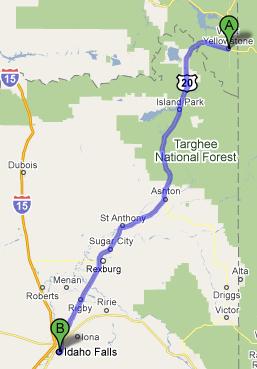
Having visited Grand Teton National Park the day before there wasn’t a need to take the long cut through Yellowstone and Grand Teton to get to Idaho Falls (an almost five hour drive) but rather the more direct route on US-20 (a two hour-and-change drive).  The drive wasn’t hilly but there were mountains and hills and, for a long stretch, the amazing Tetons, off in the distance.  One mountain had what looked to be an observatory on it but the trusty Rand McNally atlas was no help at all figuring out what it was.

Woods gave way to farmland.  We saw hay, alfalfa (only because it was labeled), and I imagine potatoes but honestly I don’t know what those look like “in the field” — some Irish I am!  Michelle was amused that the “watch for wildlife” signs quickly transitioned to “watch for game” signs — the perils that any animal that leaves the National Park system faces are quite dire.

While crossing over the Snake River I saw a huge, white pelican with black on its wings.  I was surprised because I had no idea that pelicans’ range included Idaho but it turns out (after a check with Wikipedia) that the American White Pelican does.

Despite several single-lane parts of US-20 where we had to wait to follow a lead car we made decent time to Idaho Falls, arriving about 1:30 PM.  We hadn’t eaten lunch yet, however, meaning we wouldn’t set out for Craters of the Moon National Monument (one and a half hours away) until 2:30 PM, putting our arrival at 4 PM.  Given that Craters is treeless and waterless we figured it best to wait until Tuesday.

Soooo, in Idaho Falls (a pretty small town) with the afternoon and evening to kill.  We ate lunch at Famous Dave’s Barbecue.  I think it was trying too hard or something, and the portions were smaller than we’d have liked, but at least it wasn’t too expensive.  We then went to GameStop to buy Genetta a new Nintendo DS — her existing DS was having a row of pixels give out, it started as a single pixel and now was almost all the way across a row of the top screen.  Since her DS was originally mine and at least five years old I decided it was time to perhaps get a new one (and now I get the busted one all to myself again).  Also picked up Dragon Quest IX for the kids to play.

Went to Wal-Mart afterward to get an oil change for the rental car — we’d already been over 2,000 miles and the change oil reminder had come on.  Since we have about another 1,000 miles to go (and the rental company said they’d reimburse us) we figured we’d change it to be safe.  The store employees were having issues with management and it took way longer than it should have.  As with many things on this trip, however, the delay provided an opportunity to talk with a gentleman who was a former police chief and lived in Arco, Idaho.  He asked us about our trip, told us a lot about the area and his love of Seattle (which we hope to travel to someday), etc.  Generally a great conversation.  While at Wal-Mart we also picked up bottled water as the trips to Craters of the Moon and Dinosaur National Monuments would be quite arid.

Checked in to our hotel and decided to go see a movie.  We went to Inception at the Grand Teton Stadium 14.  Decent theater (neatly decorated with neon and painted murals of movies past) and an interesting movie.  Ate at Sol Rio, a Mexican restaurant that managed to be affordable and tasty.  Quite the feat!  Returned to the hotel to prepare for a very, very early (I’m hoping to get out by 8 AM)  checkout and trip to Craters of the Moon.

I may update this later with a few of the pictures I took out of the window during the drive through eastern Idaho but honestly they aren’t that grand.  Maybe we’ll just give my hosting provider a rest for the day as well in the form of no photos eating bandwidth!

I’d also like to wish my parents a very happy 41st anniversary!

Route for July 19, 2010
Route for July 19, 2010
July 19, 2010
Huge tracts of land!

Filed under: Travel — Tags: — BigWeather @ 2:03 am

We awoke fairly early (for us) and ate breakfast at Ernie’s, that deli we ate lunch at the day before.  The food was quite good and we also ordered four bag lunches for the day ahead.  Set out for Grand Teton National Park by entering Yellowstone.

Unfortunately there is no easier way to get to Grand Teton from West Yellowstone.  We chose the wrong entrance line to queue up for (we have a knack for it) and got stuck behind every yahoo that wanted to use a credit card to pay the entrance fee.  We also encountered several delays due to people stopping to watch elk.  While we had already ridden the stretch between West Yellowstone and West Thumb Geyser Basin we had not taken the road leading to the south entrance of Yellowstone, so at least we got to enjoy some new vistas.  The Lewis River canyon, Lewis Lake, and some low-lying marsh were interesting but sadly yielded no moose sightings.  I’ve been obsessed with seeing a moose since coming up empty-handed in Maine in 2007.

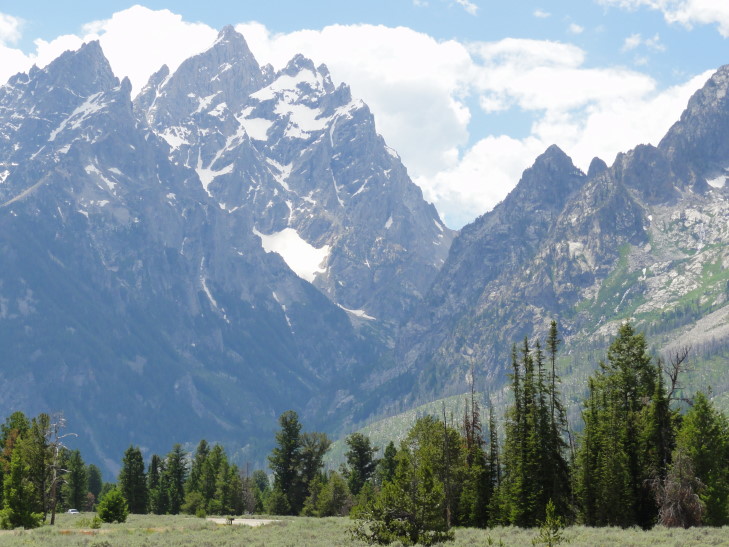
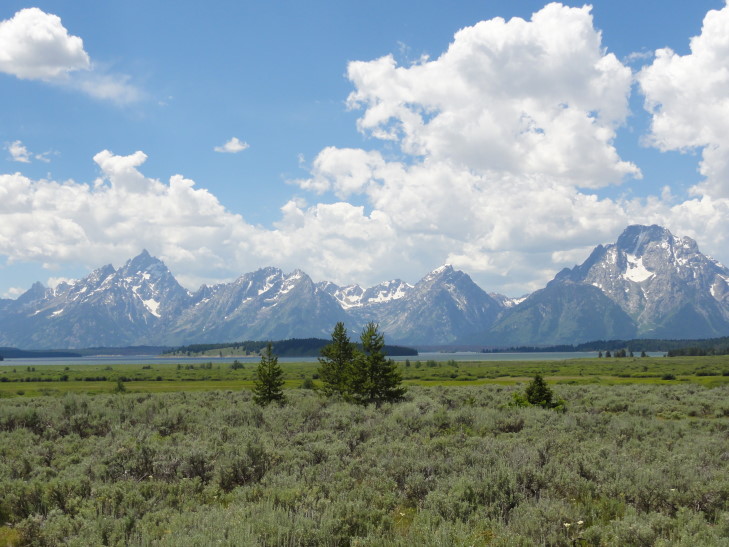
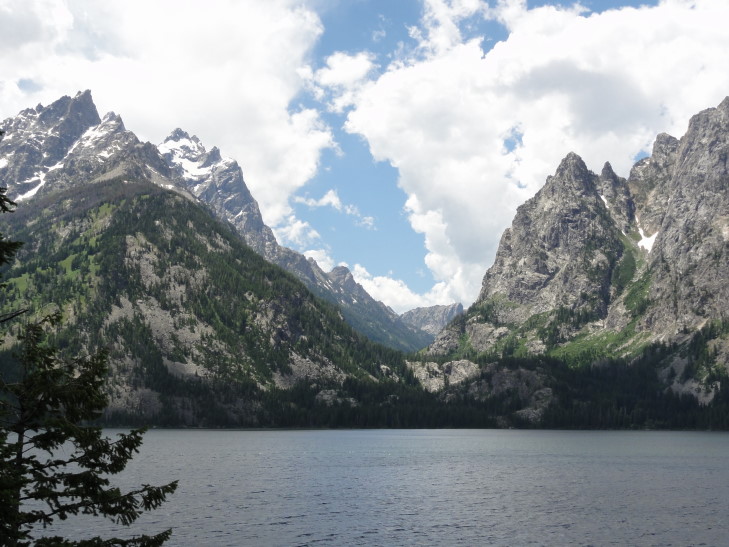
So, after more than an hour in Yellowstone we finally left the south entrance and, after a small stretch in a National Forest, entered the north entrance of Grand Teton.  A few miles in we got our first view of the Tetons.  WOW.  Following in this blog will be many pictures of them but I’ll come out and say it — there is no way my photos and no way in heck my words can possibly describe them adequately.  The only similar mountains I had seen were in the Swiss Alps back in 1988.  What makes them so unique is that you have a flat valley that, on its western edge, gives way to beautiful clear lakes.  Then, on the other side of the lake the mountains rise straight up from lake level of about 7,000 feet to their height of 13,000+ feet (Grand Teton is 13,770 feet).  No foothills what-so-ever.  Also due to the dozen glaciers in the Tetons there is plenty of snow / ice cover on the top.

Grand Tetons, Grand Teton National Park, Wyoming

Grand Tetons, Grand Teton National Park, Wyoming

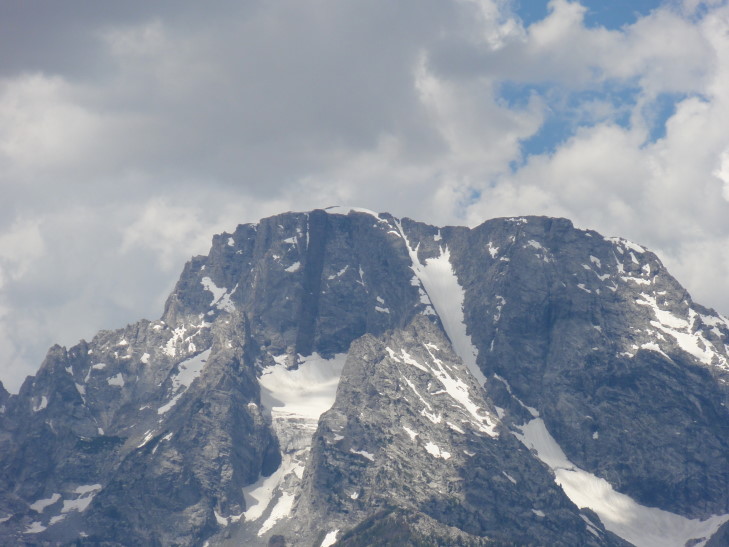
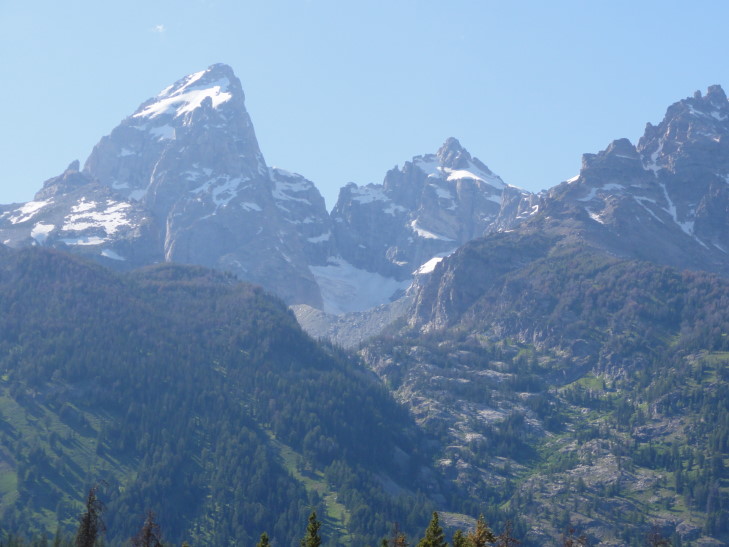
The Tetons have a fascinating geological history.  The area was (relatively) flat nine million years ago.  The west side of a 40 mile long fault rose 6,000 feet and the east side sank 24,000 feet (yeah, this surprised me too).  Over time some of the west side eroded into the valley to the east and several glacial periods greatly aided in that process.  On top of Mount Moran there is a basalt intrusion named the Black Dike that corresponds to similar rock 24,000 feet below the current Jackson Hole (the valley to the east) floor.  Mount Moran is also home to five of the dozen glaciers in Grand Teton.  Grand Teton itself, along with some of the surrounding mountains, has a classic horn shape.  Grand Teton also has a glacier that flows (not advances, however) thirty feet a year.

Mount Moran and the Black Dike, GTNP, Wyoming

Mount Moran and the Black Dike, GTNP, Wyoming

Grand Teton and Teton Glacier, GTNP, Wyoming

Grand Teton and Teton Glacier, GTNP, Wyoming

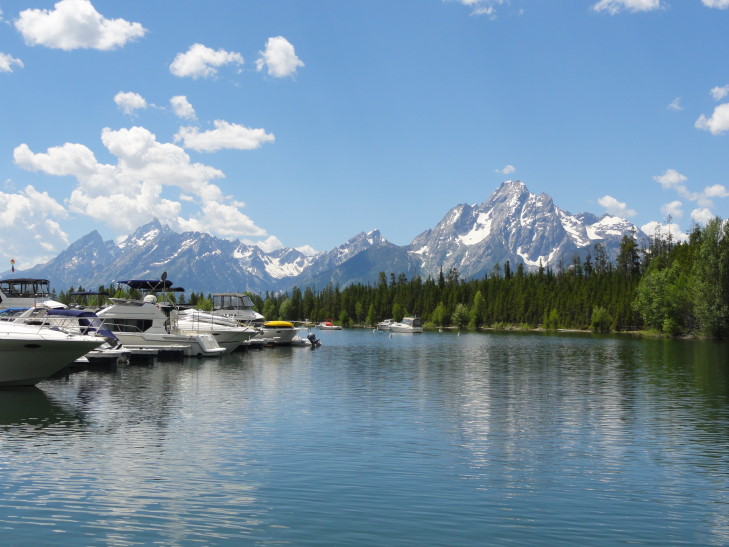
We first drove along Jackson Lake and stopped at the visitor center to get our bearings.  We learned that the one hour scenic cruise we had intended to take on Jenny Lake only ran once a day at 6 PM and required reservations so that was out of the question (for both reasons).  The quick shuttle across Jenny Lake, however, required no reservations so we aimed for doing that.  Behind the visitor center were some nice views of the Tetons towering over Jackson Lake that I took delight in photographing.

Grand Tetons over Jackson Lake, Grand Teton National Park, Wyoming

Grand Tetons over Jackson Lake, Grand Teton National Park, Wyoming

We stopped at several turnouts for photographs on the way to Jenny Lake.  One was particularly beautiful — a small dirt trail led down to a lowland with the ever present Tetons beyond.  As Grand Teton is far less visited than Yellowstone it was possible to listen to the wind blowing through the shrubs and distant bird calls and just enjoy the amazing vista.  Unfortunately Addison slipped while coming to meet me and really banged up his knees.  A fire in the area a few days before closed the fifth one I wanted to visit — lucky for Michelle, who had long since tired of the constant stopping (but unlucky for the forty acres it burned, I suppose).

View of Grand Tetons from Willow Flats, GTNP, Wyoming

View of Grand Tetons from Willow Flats, GTNP, Wyoming

Finally arrived at Jenny Lake which was more crowded than I expected and had very few picnic tables.  A friendly Ranger, however, pointed us to a little used trail that had two tables, one of which was not being used.  We ate our Ernie’s lunch under the shadow of Grand Teton and soaked in the cool Wyoming breeze.

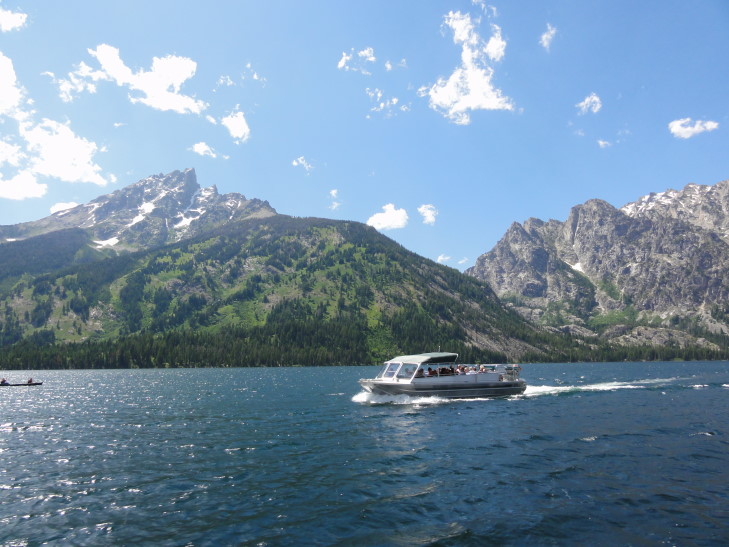
After making sure that we didn’t leave any food or wrappers lying around to attract bears we headed to the boat dock and took the short (10 minute) shuttle over to the Hidden Falls and Cascade Canyon trail head on the west side of the lake.  The lake water is so amazingly clear and we could see many small trout swimming about.  The shuttle itself was a twin-engine powered pontoon boat.  Due to the wind we got a bit of spray but nothing too bad.

Jenny Lake Shuttle, GTNP, Wyoming

Jenny Lake Shuttle, GTNP, Wyoming

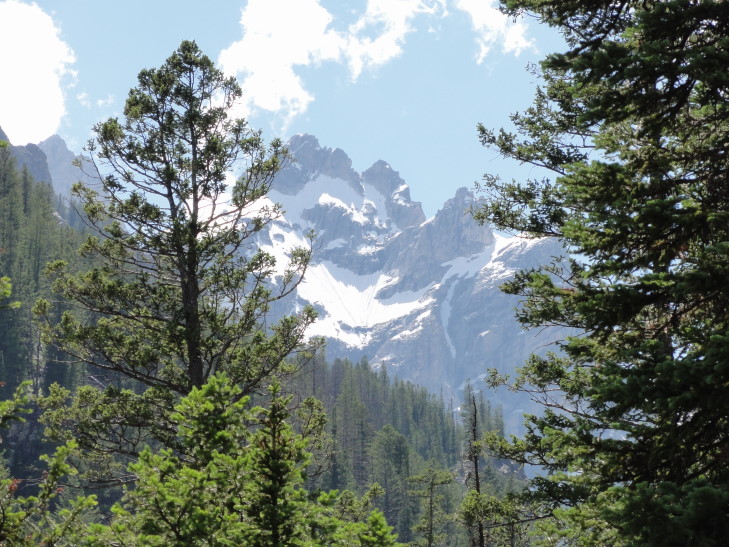
Cascade Canyon, GTNP, Wyoming

Cascade Canyon, GTNP, Wyoming

The original intent was to just ride the shuttle back.  The words “Hidden Falls” intrigued me, however, and I convinced / cajoled / conned the family into taking the .5 mile hike (each way) to see them.  The trail was a bit rough — lots of roots and boulders to scramble over.  There is also no way it was only .5 miles.  I was certain at one point that we had somehow missed the falls altogether and were nearly to Inspiration Point, the next stop on the trail.  Michelle and Genetta ended up turning back at what turns out to be shortly before the falls but Addison and I carried on.

Along the trail to Hidden Falls, GTNP, Wyoming

Along the trail to Hidden Falls, GTNP, Wyoming

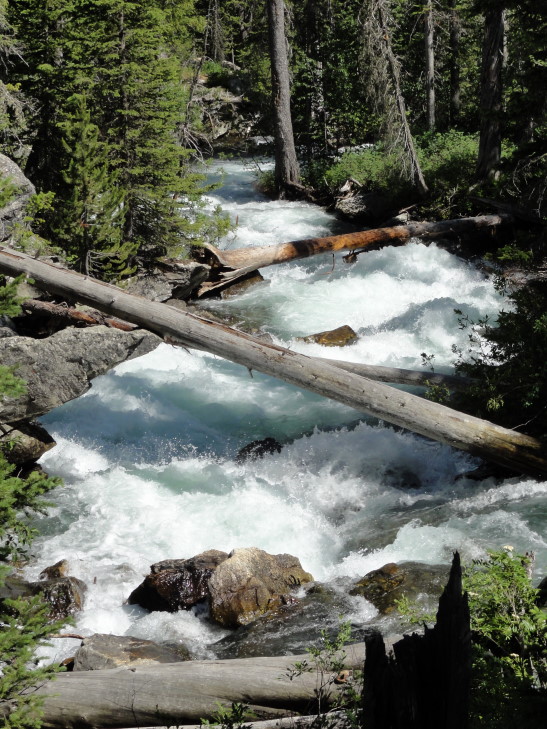
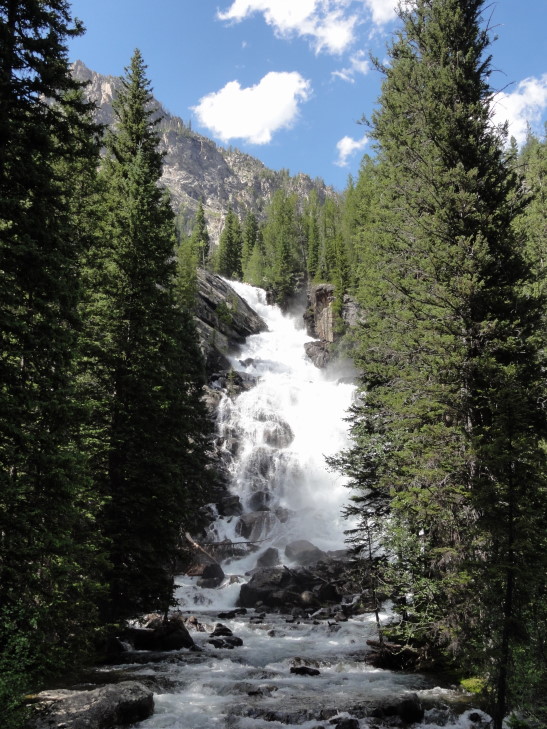
While the cascading rapids below the falls and all the way to the lake had been impressive the falls themselves definitely amazed, especially since they were backed by the mountains behind and their snow cover.  We also saw some people climbing among the cliffs above.  At first I thought it was the continuing trail to Inspiration Point (to which I said, forget us doing that nonsense!) but it was a group of rock climbing students.  Met back up with the ladies and caught the shuttle back to Jenny Lake.

Hidden Falls, GTNP, Wyoming

Hidden Falls, GTNP, Wyoming

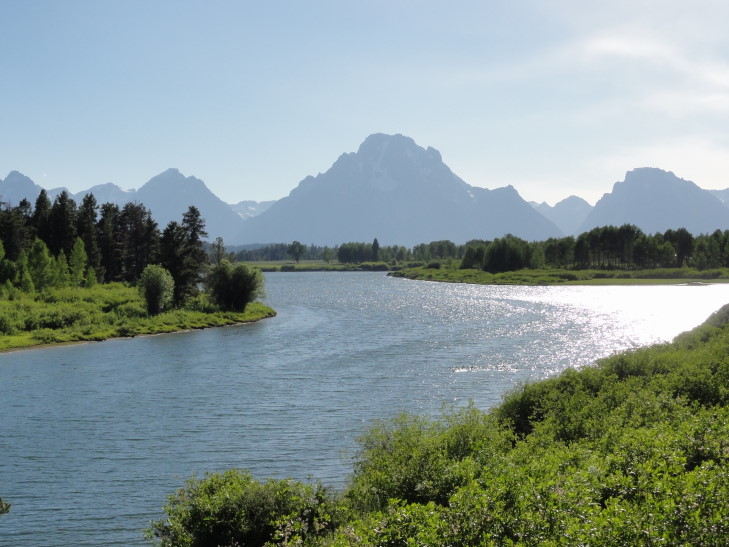
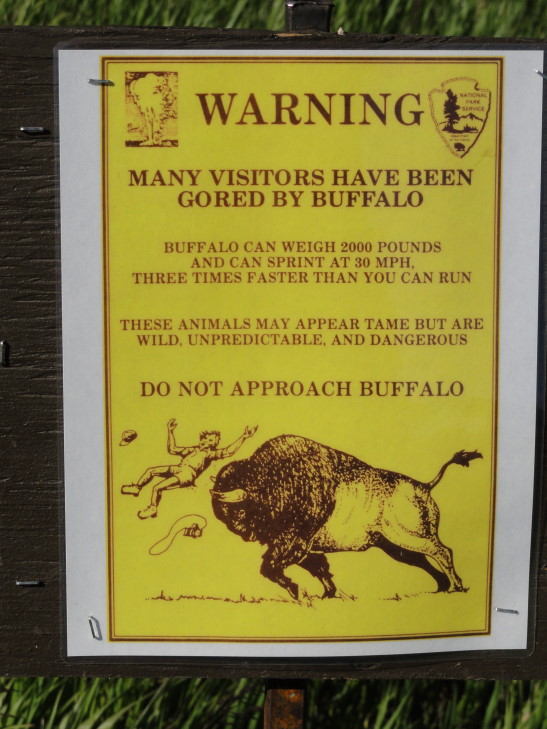
Drove further south to the town of Moose (and, no, still no dang moose sightings!) and caught the eastern road of the park back north.  The scenery was very different from the western road in that it drove across sage brush-dotted prairie with the Snake River valley our constant companion to the west (and the Tetons beyond that).  I particularly enjoyed a turnabout called Elk Flats Ranch which had a wonderful sign of a person being tossed in the air by a bison.  In the picture of the sign below note two things: I wasn’t the basis for the claim that a bison running 30 MPH is three times faster than me as there is no way in heck I can run 10 MPH and also the poor tourist looks to have been gored in the butt.  Ouch!  No bison around, though, sadly.  I rather like seeing them.

Snake River, GTNP, Wyoming

Snake River, GTNP, Wyoming

Oh No, Buffalo!

Oh No, Buffalo!

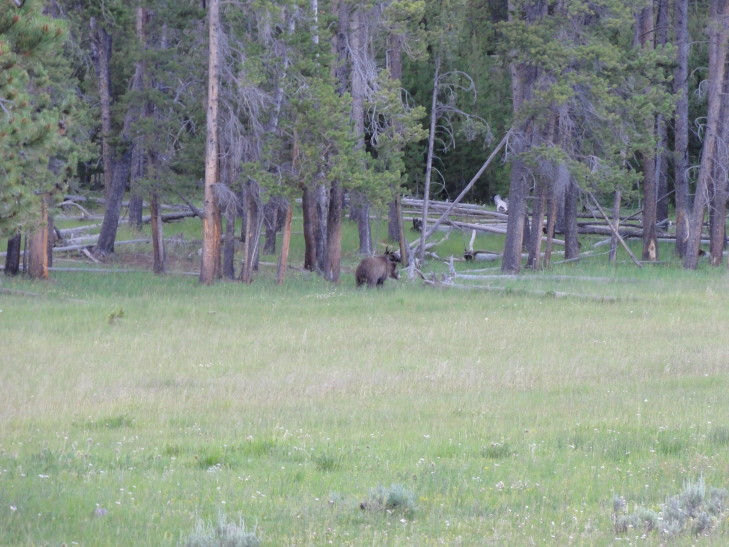
The eastern road merged with the western road right at Jackson Lake so we retraced our drive back to West Yellowstone, Montana through Yellowstone National Park.  We encountered a “bear jam” — people clogging up the road trying to see a bear.  It was a young grizzly, my fourth (well, if you count a fleeting sighting of a grizzly butt) of the trip.  A fellow tourist was even kind enough to let Addison use his binoculars.  One thing really annoyed, however — a tourist two cars in front of us actually stopped his car in the middle of the road and got out to take pictures along with his whole family.  Nope, no pulling over.  I couldn’t believe it.  Wildlife makes people stupid.  Or maybe makes already stupid people more stupid.  I mean, it was like something out of a R.E.M. video.

Worst bear picture ever...

Worst bear picture ever...

Made it back to West Yellowstone fairly late and ate dinner at Chinatown, a Chinese restaurant.  I had the pork with scallions and it was very tasty (and reasonably priced, especially for West Yellowstone).

As for this entry’s title a knowledge of how the Grand Tetons got their name and Monty Python and the Holy Grail is needed.

Route for July 18, 2010

Route for July 18, 2010

July 18, 2010

Wrapping up Yellowstone

Filed under: Travel — Tags: — BigWeather @ 3:32 am

Despite having a wake-up call at 7 AM we decided to just go back to sleep and let everyone recharge.  I woke up at 9:30 AM to work on the blog while Addison woke up shortly thereafter to watch some TV.  We let the ladies sleep in until almost noon.  While part of me was “man, what are we doing wasting a day we paid dearly for?!” the reality is that though we usually don’t get out until 9 AM or 10 AM we run hard until 10 PM or 11 PM each night.  We needed a break.

Skipped breakfast as it was lunch time and on the recommendation of the hotel staff we went to Ernie’s Deli in West Yellowstone, Montana.  Decent sandwiches, reasonably priced for the most part, and they had some chocolate donuts and maple bars (YUM!) left over from breakfast that we snarfed up for later snacking.

Shortly after arriving in Yellowstone I found a site that listed the top ten things to see in the park.  Their list jibed with other sites so I have been using it as a yardstick to determine if we’re doing OK in trying to get the most out of Yellowstone.  I had four full days set aside for Yellowstone with the hope that I could do it in three and do Grand Teton National Park on the fourth day rather than on the way to Idaho Falls, Idaho on Monday.  Through yesterday we had seen six of the sights: Old Faithful Geyser and Upper Geyser Basin, Grand Canyon of the Yellowstone, Mammoth Hot Springs, Yellowstone Lake, Tower Fall, and West Thumb Geyser Basin.  I had already written off two more: Lamar Valley and Hayden Valley because the former was too far to drive back out to that part of the park and the latter just didn’t sound that promising.  That left Norris Geyser Basin and Lower Geyser Basin / Fountain Paint Pots to wrap up.

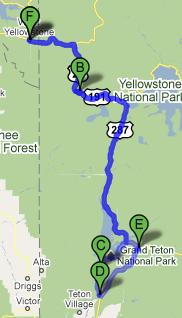
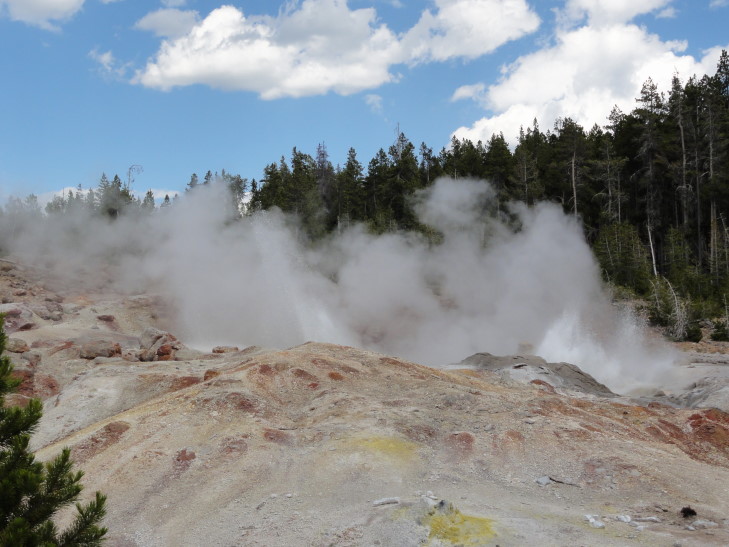
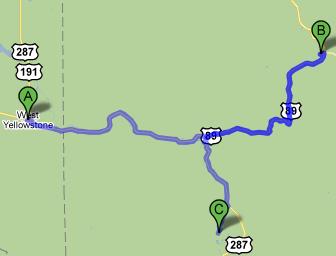
Headed into the park a bit after 2 PM and headed to Norris Geyser Basin (B on the map below).  Norris Geyser Basin is the hottest point in the park (with a reading of well over 400F at one time just a mile or so below the surface) and has many interesting thermal features including the tallest geyser in the world, Steamboat Geyser, at 300+ feet.  Unfortunately it is not very predictable, going through dormant periods of up to fifty years, though the last one was in May 2005.  There is also an old visitor center with some basic exhibits about the thermal aspects of the park as well as some interesting things to say about geothermal energy’s impact on thermal features (basically, it harms them and has killed many geysers in Iceland, for example).

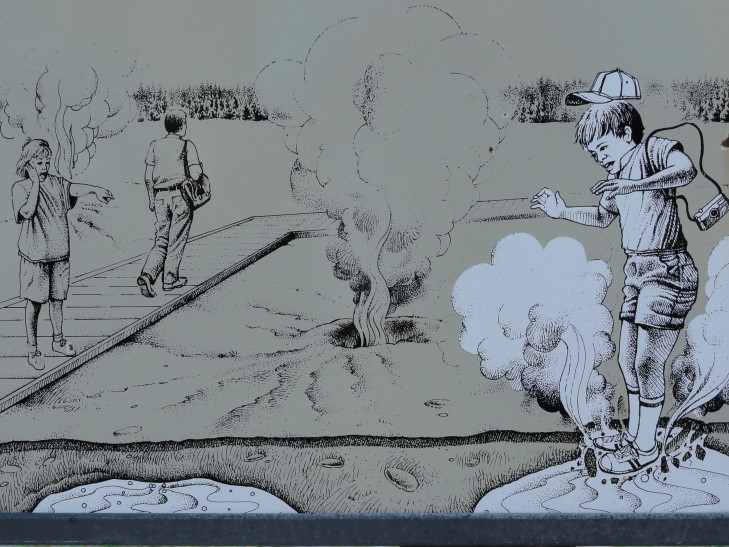
One thing I love about all of the active sites is this lovely diagram warning about the dangers of thermally active areas.  Look how little Timmy has strayed off the path and his foot has broken through the thin crust and into certain scalding danger.  What I presume is the mother is pointing, helpless.  What really takes the cake, however, is what can only be the dad walking away unaware or uncaring — parent of the year!

Thermal Area Warning sign, YNP, Wyoming

Thermal Area Warning sign, YNP, Wyoming

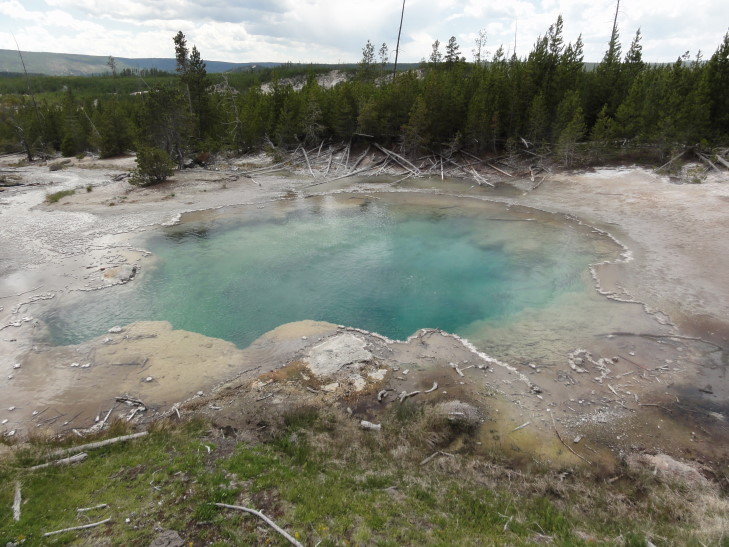
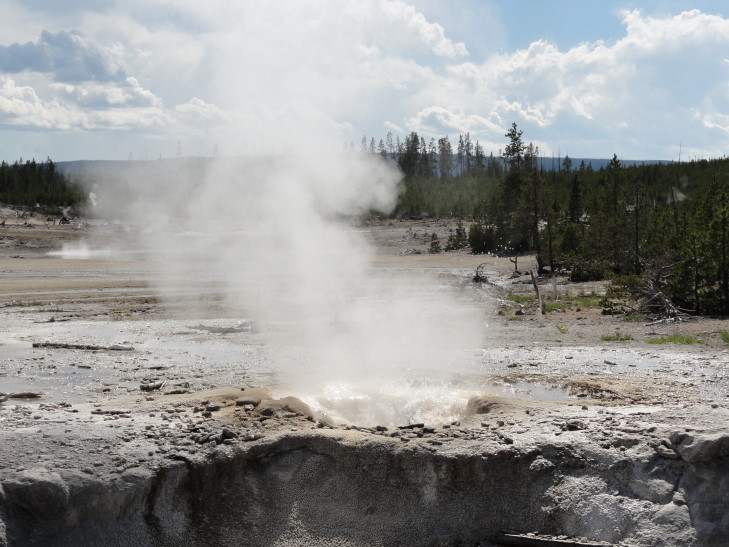
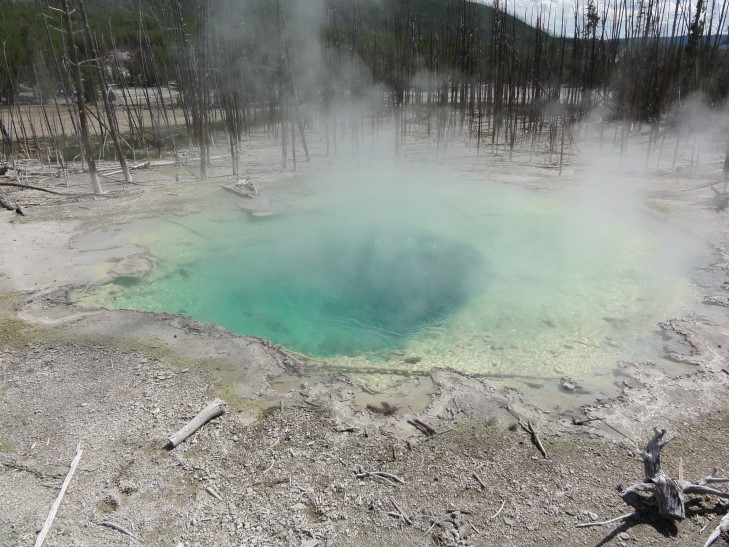
Anyhow, we started on the 1.5 mile trail around the first of two basins in Norris Geyser Basin, Back Basin.  First up was Emerald Spring, a very pretty light green hot pool.  Next was Steamboat Geyser which I discussed at length above.  No, it didn’t explode while we were there, though it was still pretty active with steam coming out and minor eruptions of water a couple of feet into the air occurring.  Echinus Geyser was next, once predictable but now no longer so.

Emerald Spring, Norris Geyser Basin, YNP, Wyoming

Emerald Spring, Norris Geyser Basin, YNP, Wyoming

Steamboat Geyser, YNP, Wyoming

Steamboat Geyser, YNP, Wyoming

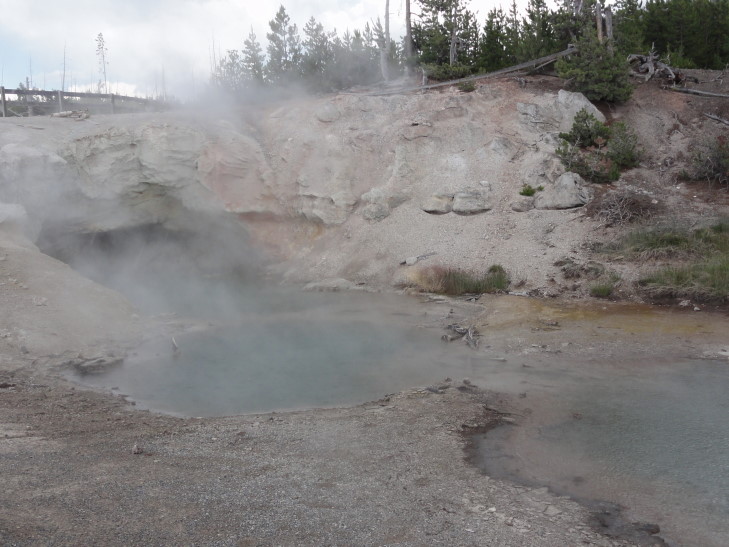
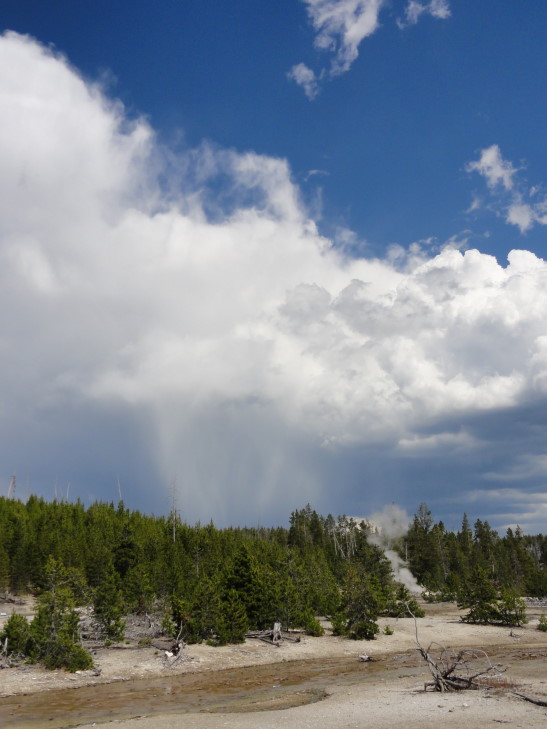
It was at about this time that it started to rain.  Other than having to protect the camera it was quite pleasant.  It nicely cleared most of the tourists out of the basin and cooled things off a bit.  The lightning was a bit disconcerting what with myself being one of the tallest objects but it never got bad enough that we were significantly worried.  Pressing on in the rain we next checked out Green Dragon Spring.  Green Dragon Spring is really cool because there is quite a bit of bubbling water that looks like it is coming out of a small cave.  A bit further down the 1.5 mile path was Porkchop Geyser.  Porkchop has a fascinating past — for a long while it was a hot spring with infrequent eruptions then its vent narrowed to the size of a garden hose by 1985 leading it to continuously erupt.  Pressure continued to build up until 1989 when it exploded sending rock up to 200 feet in all directions.  Despite some small activity since it is now mainly considered a hot spring again.

Green Dragon Spring, YNP, Wyoming

Green Dragon Spring, YNP, Wyoming

Porkchop Geyser with thrown rock, YNP, Wyoming

Porkchop Geyser with thrown rock, YNP, Wyoming

Veteran Geyser was interesting in that it had a very smooth cone.  It also gurgled loudly from other holes near it and would splash out water every couple of seconds that would over spill the cone and run downhill in a neat trickle.  Cistern Spring is also nearby, notable mostly for emptying after Steamboat Geyser has a major eruption and taking days to refill.  It was full for us, of course, considering that Steamboat hadn’t had a major eruption in five years.  Minute Geyser finished up Back Basin and has a sad tale to tell.  It used to erupt almost continuously but people kept tossing crap into it to the point that it has been damaged beyond repair (it would require heavy equipment to clean out its vent and that would damage it more) — it is now an extinct feature.  I’ve said it before and I’ll say it again — humans!

Veteran Geyser, YNP, Wyoming

Veteran Geyser, YNP, Wyoming

Cistern Pool, YNP, Wyoming

Cistern Pool, YNP, Wyoming

Next we intended to walk around the other basin, Porcelain Basin.  The rain (and lightning) was picking up, however, so the wife and kids decided to stay at the museum.  Lacking the same sense I decided to go a bit into the basin and at least see Black Growler Steam Vent and Crackling Lake.  While pretty, and wishing I could see some of the other features (like the intriguingly named Whale’s Mouth”), the weather just wasn’t working with me so I headed back to the family.

Rain from above, steam from below, YNP, Wyoming

Rain from above, steam from below, YNP, Wyoming

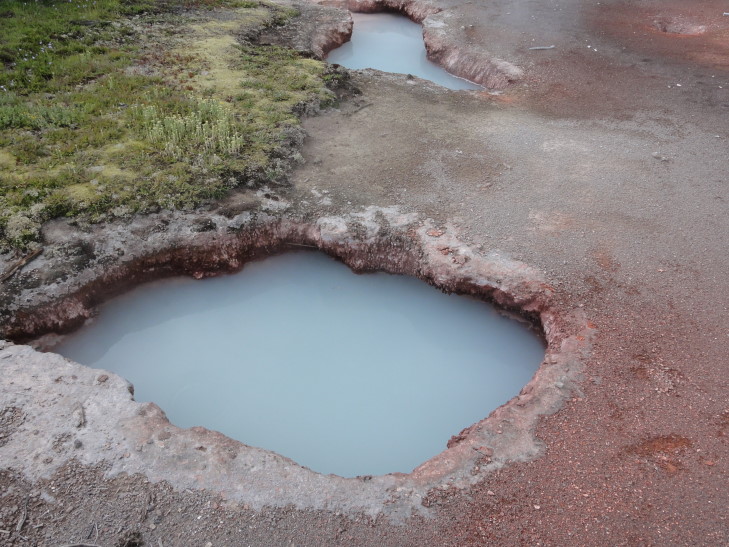
We then drove a short distance to the Artists’ Paintpots.  We were told this was an area of beautiful hot pools and springs in a more woodsy setting.  They lied, it was instead a 1/3 mile walk to a low-lying mosquito deathtrap.  There were some pretty things I guess, and the flora was quite nice to look at (and photograph), but the weather forced yet another hasty retreat (though the mosquitoes would’ve forced it if the rain hadn’t) before we could fully explore the feature or climb up the hill to the observation platform.

Thermal features at Artists' Paintpots, YNP, Wyoming

Thermal features at Artists' Paintpots, YNP, Wyoming

I sure as heck didn’t want to end Yellowstone on such a dud so I cajoled the family into one last stop — the Lower Geyser Basin.  We had already done Upper Geyser two days before (that’s the area surrounding Old Faithful) as well as Midway (that’s the Basin containing the Grand Prismatic Spring) but hadn’t gotten around to Lower Geyser.  I had read that it was quite spectacular and since it wasn’t far from the road back to our hotel I convinced them to go.

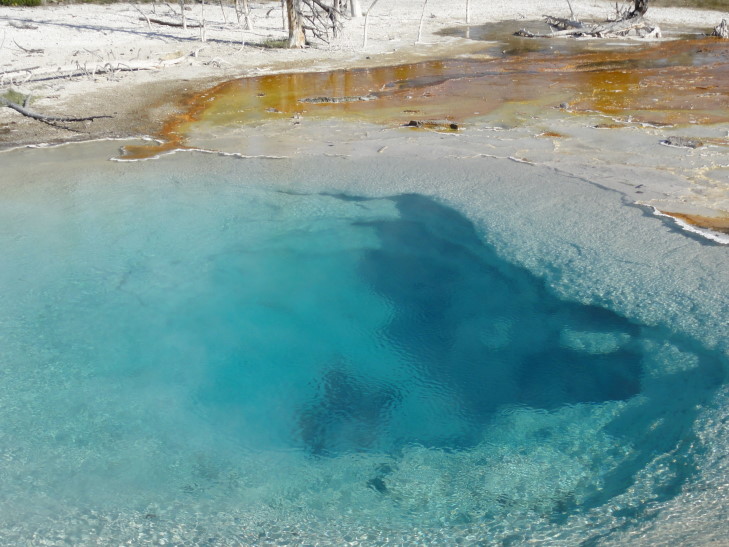
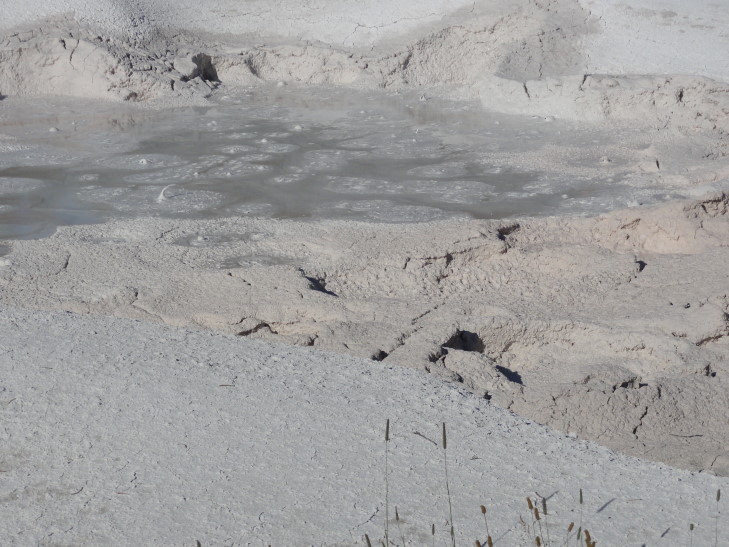
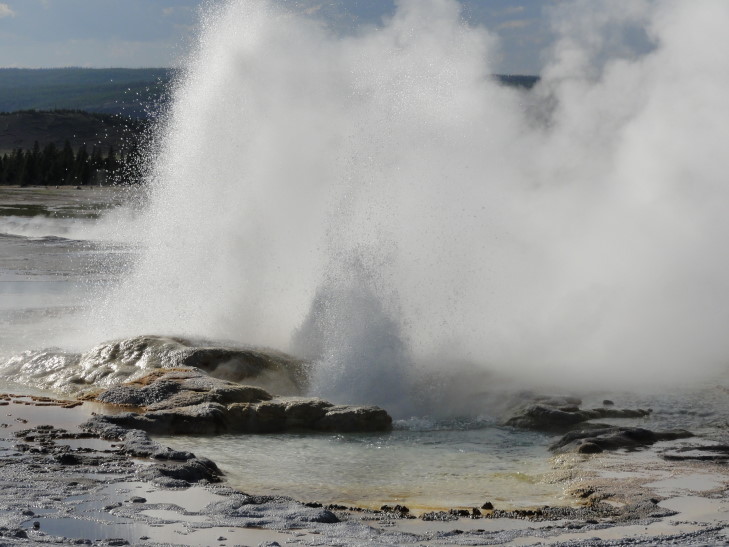
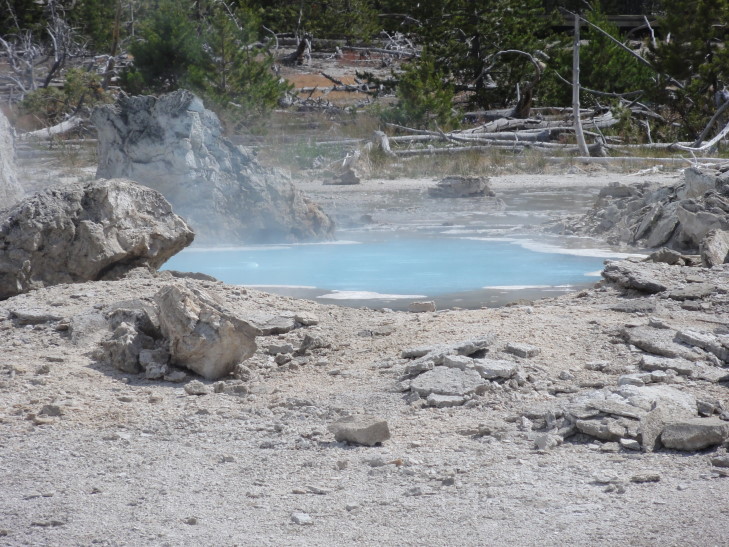
I’m really glad I did.  Not only did it have several beautiful hot pools but it also had a mud pot called Fountain Paint Pot.  It was basically a cauldron of bubbling mud that sent the occasional mud blob soaring a few feet.  The gurgling sound it made was awesome.  In addition to the mud pot it also had Fountain Geyser.  While Fountain Geyser didn’t have an eruption while we were there it almost continuously spews steam and some water so it’s fun to watch.  Also in Lower Geyser there was Red Spouter, a geyser that opened up with the 1959 earthquake.

Silex Pool, YNP, Wyoming

Silex Pool, YNP, Wyoming

Fountain Paint Pot, YNP, Wyoming

Fountain Paint Pot, YNP, Wyoming

Fountain Geyser, YNP, Wyoming

Fountain Geyser, YNP, Wyoming

Done with Yellowstone we headed back to West Yellowstone, Montana.  We ate at Gusher’s, a pizza place.  It wasn’t bad and was reasonably priced.  Like many establishments in West Yellowstone it had some casino machines but also had a Ms. Pac-Man / Galaga combo cabinet.  Afterward Addison and I got some Dairy Queen and the ladies got some ice cream at another place.  We then shopped and returned to our hotel.  The four of us went swimming and called it a night.

Route for July 17, 2010

Route for July 17, 2010

« Newer PostsOlder Posts »

Powered by WordPress