BigWeather's Blog

October 12, 2010

Introducing Passage to the Indies

Filed under: Game Development — Tags: — BigWeather @ 11:06 pm

Today being Columbus Day I figured it’d be as good a time as any to introduce the game I’m working on, Passage to the Indies (name likely to change at some point, but it is good enough for now).

Passage to the Indies is a game of exploration, both of the historical New World as well as random maps.  I’m very aware of prior art in this genre (what little of it there is, sadly, as it is a very underrepresented genre in gaming) and seek to draw on their strengths as well as bring a few new elements to the mix.

First it is helpful to define Passage to the Indies in terms of what it is not:

  • It is not a military-oriented game.  There won’t be tactical battle screens or managing soldiers of different types.
  • It is not a city builder.  While the player will be able to found settlements, forts, missions, and trading posts they will not actively manage them thereafter.
  • It is not an economic strategy game.  No trading beaver furs for buffalo hide or setting up trade routes.
  • It is not a total representation of history.  No smallpox wiping out whole populations nor slavery.  Yes, it happened.  Doesn’t mean it would enhance a game that is based on exploration at a fairly abstract level.

What, then, is Passage to the Indies?

Passage to the Indies is a game that places the player in the role of an explorer during the late fifteenth to early seventeenth centuries.  In addition to the historically accurate New World the player will be able to explore randomly generated hemispheres with realistic topography, biomes, climates, and native populations.  Native populations will vary in strength, organization, technological advancement, and wealth.  The disposition of the native populations can be affected positively or negatively through the direct and indirect actions of the player.

The player can sail for Spain, England, the Netherlands, or France.  Exploration goals that all four powers share in common include uncovering new territory, discovering natural wonders, and documenting the flora and fauna of the New World.  Other goals are conquest, religious crusade, settlement, and trading in nature with the four powers favoring a subset of these.  The player’s renown and fortune will be heavily influenced by the goals he or she completes, how competently they were achieved, and how they aligned with the sponsoring power.  Forts, missions, settlements, and trading posts help achieve these goals and provide passive bonuses as well as a renown boost or hit for the player depending on their long-term success.

The player will be managing a number of men and ensuring that they are fed.  In addition to food these men can carry Old World goods (for trade with the natives), gold and other precious resources, and New World flora and fauna (accompanying the player on the voyage back home).  Players can secure gold and other precious resources through trade or conquest.  While conquest may be faster it is not always the most prudent route.  Food is not only brought over from the Old World but can also be plundered, traded for, or foraged.  In addition to the common man the player also has two “slots” open for specialists.  Specialists include academics (documenting flora and fauna and providing a greater renown boost on return to the Old World), cartographers (more accurate maps, reduced chance of getting lost), officers (increased fighting capability), native guides (increased travel speed, better foraging), and more.

Combat will not be a very complex affair.  It will factor relative strengths, account for the explorer’s often overwhelming technological edge, terrain, morale, and the like and inform the player of likely success or failure (accuracy of which is helped by having an officer specialist).  The engagement will be resolved automatically (no tactical battle maps).

The player’s success is measured by an overall metric of their renown, wealth, and longevity.  The game begins with the player in their youth and continues until their death or retirement due to age.  Some reflection of the player’s success should be available while in the Old World, perhaps their home or their trophy-laden study.

In addition to the player there will also be computer-controlled explorers (representing both the player’s power and the other powers) exploring the New World.  Their actions can affect the world as well and could serve to help or hinder the player.  The powers will go to war from time to time changing relationships between the computer-controlled explorers and the player.  There is the potential for other human-controlled explorers but that may be a bit too ambitious initially.

I believe the key to representing the Age of Exploration is to focus on the experience of being a member of a very small band in an unknown and (sometimes) hostile land.  The desire to see what lies beyond the ridge on the horizon tempered by the knowledge that returning home is not a given.  There is an inherent risk / reward that is very appealing.  Discovering the Grand Canyon doesn’t mean much if the player doesn’t make it back to the Old World to spread the word.  It is also important to represent the odd things that happened as well — explorers deciding to live with the natives, explorers of one expedition caught by natives only to be freed by another expedition years later (see Juan Ortiz), returning to find ones ships have decided to, or been forced to, move on.  These would likely be handled through random events that occur infrequently.  I’d also like to see an option to populate the New World with some of the fantastic places sought by those early explorers — El Dorado, the Fountain of Youth, etc.

The presentation will be a 2D top-down view of the New World at a large scale with line-of-sight and fog of war limiting player vision.  I’m not a huge fan of tons of dialogs so as much of the game play will be kept in the main window as possible.  While I expect to hire an artist late in development initially it’ll be programmer (i.e., me)-generated assets.  I’ll probably go the route of licensing some period appropriate tunes and some sound effects rather than contracting out the sound design (and as I have almost zero capability in this area the early phases of this project will be sound-free, unfortunately).

I must be realistic, however.  While I have outlined what I believe is a fairly reasonable design this is a hobbyist effort on my part.  Though I am often working on the game (which is implemented in XNA and will be available on the PC and XBL Indie Games) and will update this blog regularly I can’t commit to a firm release date at this point.  More details (and hopefully some pictures at some point!) as they become available…
September 16, 2010

Happy 25th Anniversary Ultima IV!

Filed under: Gaming — Tags: — BigWeather @ 12:43 am

Today marks the anniversary of the release (for the Apple II, at least) of one of the most unique and influential CRPGs in history.

Ultima IV: Quest of the Avatar has a very unique plot. After the trials of the Age of Darkness (Ultimas I – III, in which the player defeated Mondain, his consort Minax, and their “spawn” Exodus) the land of Sosaria was remolded as Britannia. The people, longing for peace and a bit of prosperity, need a champion willing to study the eight virtues (Honesty, Humility, Justice, Valor, Honor, Sacrifice, Compassion, and Spirituality) and earn the right to bring the Codex of Ultimate Wisdom from the depths of the Stygian Abyss where its truth can be revealed.

Beyond the player’s main goal being to better him or herself the game is also notable for having no villain, bosses, or the like. There are hordes of monsters to fight but they have no grand purpose for evil or anything.

Also interesting was the character creation — the player answered a series of moral questions (with two choices for each) to determine which of the eight classes the (future) Avatar would be. The player then collected a party of seven other adventurers, each of a different class representing a virtue each, throughout the quest.

The magic system was unique, 26 spells represented by A(waken) to Z(down — don’t ask!), that were prepared in advance with the use of reagents. Combat was along the four compass directions and turn-based. Combat occurred mostly in a dedicated battle screen and the dungeons had many custom rooms (one with graves and skeletons at the bottom of — I think — Shame stands out). Conversations consisted of the name / job / health / bye variety with up to two other keywords and the possibility of yes/no queries.

The music was superb, as always. The graphics were (for the day) state-of-the-art and even in 2010 hold up well (as they made no great attempt at realism). Packed in the box was a metal ankh, a cloth map, the game disks, a reference card, and superbly illustrated books introducing Britannia and describing the magic. Among the best documentation / feelies in CRPG history. The cover was of a wizard standing on a rocky promontory with a staff topped by a glowing ankh while the back was a shield with the silver serpent. Absent was any suggestion of conflict.

While later games added day and night and NPC schedules (Ultima V) as well as a more fleshed out magic system (8 circles of 8 spells each), Ultima IV laid the foundation for much of the golden age of Ultima (Ultima IV through Ultima VII: Serpent Isle). It also built upon the very solid foundation of Ultima III, a game that was (along with Wizardry) very influential in the evolution of the JRPG. It presented a remarkably (for the time) alive world and encouraged the player to explore (and without level scaling that exploration could prove deadly).

Ultima IV was the beginning of the Age of Enlightenment in the Ultima saga, easily one of the best RPG arcs. While Ultima IV was a quest of for virtue and the recovery of the Codex, Ultima V was a cautionary tale about the perversion of those virtues. Ultima VI dealt with xenophobia and its plot is rooted firmly in the consequences of the recovery of the Codex and setting the situation right for all.

I could ramble forever about Ultima IV but I just wanted to post something to recognize one of the all time greats, 25 years old today!

July 25, 2010

Home again, home again, jiggety-jog

Filed under: Travel — Tags: — BigWeather @ 2:17 pm

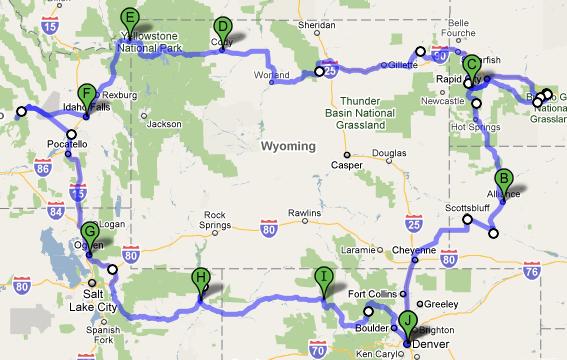
Woke up at our customary 7 AM, packed, ate our free hotel breakfast, went back and relaxed until 10:30 AM or so.  We didn’t want to get to the airport too early.  Packed the car and returned it to the rental place with 15,823 miles on the odometer.  We started at 12,701 — a difference of 3,122 miles!  That is slightly longer than the trip from Boston to San Francisco which, according to Google maps, is 3,106 miles.  We visited seven states (in order of first visit: Colorado, Wyoming, Nebraska, South Dakota, Montana, Idaho, Utah) a pickup of six for Brian and seven for everyone else.  We visited twelve National Parks / Monuments / Historic Sites (Scotts Bluff NM, Chimney Rock NM, Wind Cave NP, Mount Rushmore NM, Badlands NP, Minuteman Missile NHS, Devils Tower NM, Yellowstone NP, Grand Teton NP, Craters of the Moon NM, Dinosaur NM, Rocky Mountain NP).  Non-National stops were Carhenge, Mammoth Site, Custer State Park, Deadwood, and Buffalo Bill Historic Center.  We stayed in nine hotels over the journey.

Got to the airport and went through security.  They do have a beautiful airport in Denver — three separate terminal concourses separated from the check-in / ticketing / baggage claim area, all linked by an underground train.  Above this open-air atrium with cool stonework and stuff they had suspended the first private jet to land at Denver International — the same jet that flew around the world in 49 hours.

Ate some McDonald’s (will be glad to take a break from them for a bit!) at the food court, Genetta had some pizza.  Hung out at the gate eating Skittles and playing Dragon Quest IX.  Hopped on the plane on time and the flight seemed to go very quickly (didn’t hurt that I had DQ9 keeping me busy too).  Landed in Raleigh 15 minutes ahead of time and scooped up the luggage while Michelle got the car from daily parking (Chad and Don had parked it there earlier in the day on their way to Myrtle Beach, thanks guys!).

It was hot, even at 9 PM.  Addison asked if we could get back on the plane and go back to Denver for another couple of months (though, to be fair, on Friday Denver was about 99F — though we did spend most of Friday at 12,000+ feet and 65F temperatures).  Stopped by Torerro’s on the way home for some Mexican before ending our trip.  Got home and played with the cats — they seemed happy to see us.

Michelle’s favorite sights:

Brian’s favorite sights:

Addison’s favorite sights:

Genetta’s favorite sights:

Below is the actual route we took on this trip:

Route for July, 2010

Route for July, 2010

Note: I just realized that the map doesn’t show our jaunt down to Grand Tetons.  We went there too, promise!

July 24, 2010

Rocky Mountain high

Filed under: Travel — Tags: — BigWeather @ 2:13 am

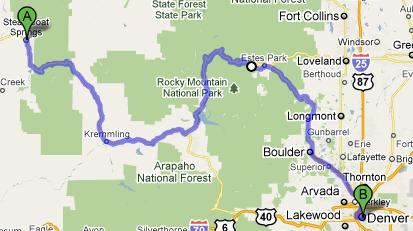
Woke up a bit later than normal and, just as I was doing my final “don’t wanna get out of bed” stretch I pulled my calf muscle.  I hate that!  As the hotel we were staying in did not have free breakfast we packed, checked out, and headed to good ol’ McDonald’s.  Next we gassed up and a woman responded to my “how are you?” with “another fine day in the boat!”  We later heard Steamboat Springs referred to as “the boat” on the radio so that was good to get cleared up.

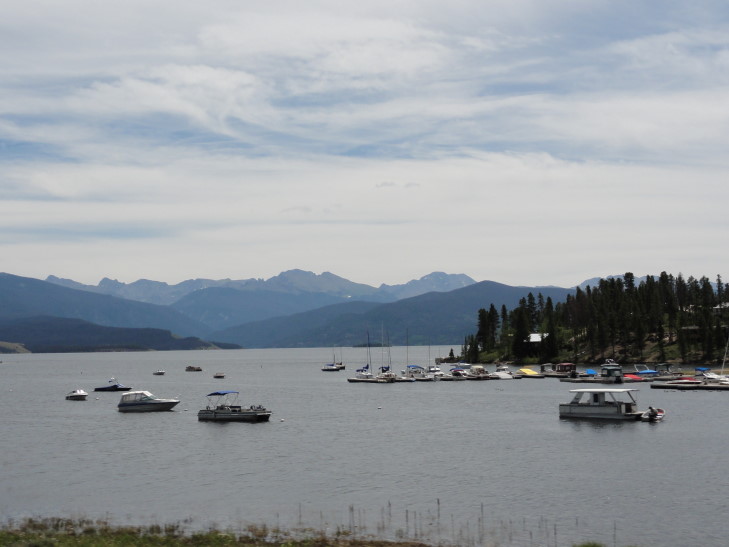
Headed east on US-40 over a very pretty pass called Rabbit Ears Pass just east of Steamboat and then settled into a nicely wooded valley for quite a few miles.  That eventually gave way to a canyon of the Colorado River (sourced just twenty miles or so from there) with steep dusty brown rock walls and a railroad line clinging on for dear life.  Turning left onto US-34 we passed both Lake Granby and Grand Lake.  Both lakes convinced us of the great need for our country to protect natural wonders (through National Parks and the like) — while the lakes were beautiful the amount of build-up on the shores, both low- and high-dollar, really impacted the place.  As with all things it is a balance between allowing people to enjoy the nature around them and protecting it, I suppose.

Lake Granby, Colorado

Lake Granby, Colorado

Shortly passed into Rocky Mountain National Park and visited the visitor center to pick up our customary magnet.  I knew we wouldn’t be in the park long so we just picked up a guide to the one thing we’d be doing that day — driving along the amazing forty miles of Trail Ridge Road.

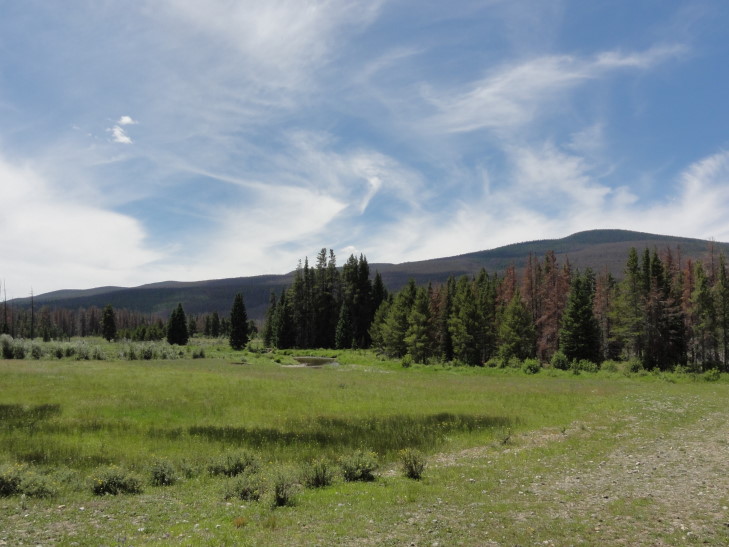
The road starts out flat enough, traversing through lowlands with willows that moose supposedly love to hang out in.  No, I didn’t see a moose today — the streak continues.  It soon starts gaining elevation and there is a series of five or so hairpin turns.  The birches and aspen give way to evergreen give way to tundra.  Trail Ridge Road is the highest through road in the United States with a peak elevation of 12,183 feet.

Western lowlands, Rocky Mountain National Park, Colorado

Western lowlands, Rocky Mountain National Park, Colorado

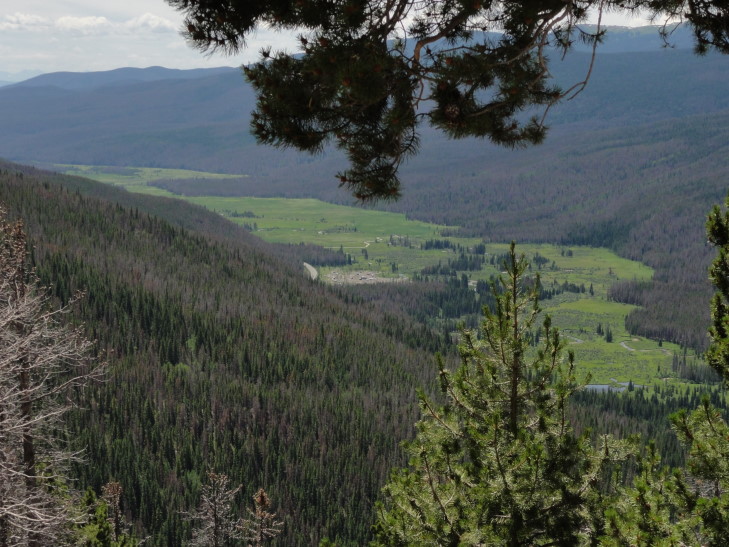
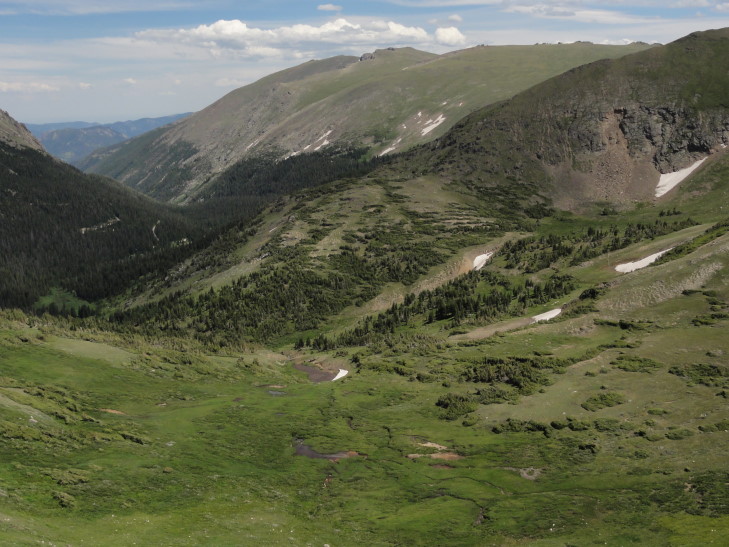
Lowlands from up on high, RMNP, Colorado

Lowlands from up on high, RMNP, Colorado

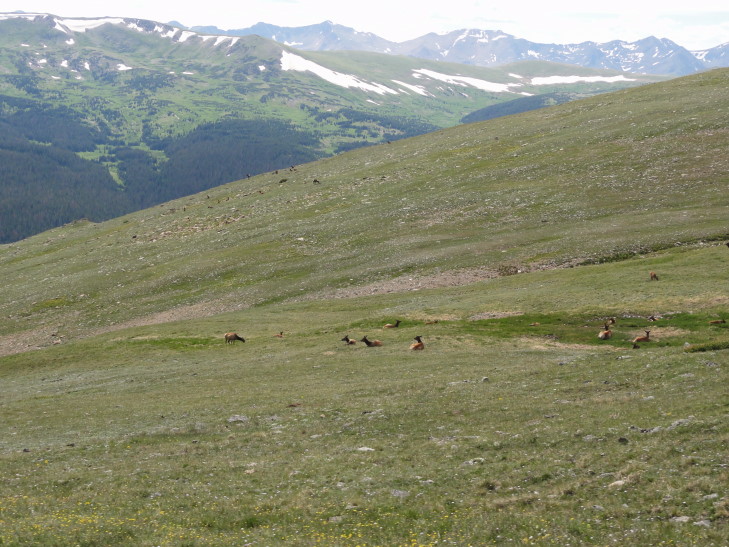
We stopped by the Alpine Visitor Center at well over 11,000 feet.  There we did some quick shopping (bought nothing) and ate a pretty decent lunch of hot dogs, chips, and a cookie.  We learned that the road is only open four to five months a year.  It takes six weeks to clear it after the winter as it is not uncommon to have 35 foot drifts!  All along the road were lodge pole pine trunks that help the clearing crew find the extent of the road under all of that snow.  The visitor center is located at the head of an ancient glacial cirque and, even today, there was quite a bit of snow up there in the shadier areas.  In addition to snow we also saw a herd of elk grazing on the tundra plants.  Also we saw a wall of cooled lava with snow at the bottom.  The lava was the result of an explosion about 28 million years ago.

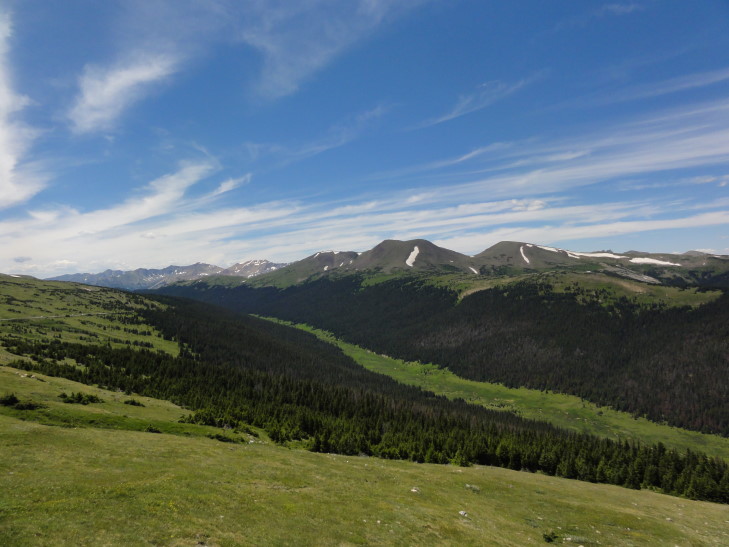
Cache la Poudre river valley, RMNP, Colorado

Cache la Poudre river valley, RMNP, Colorado

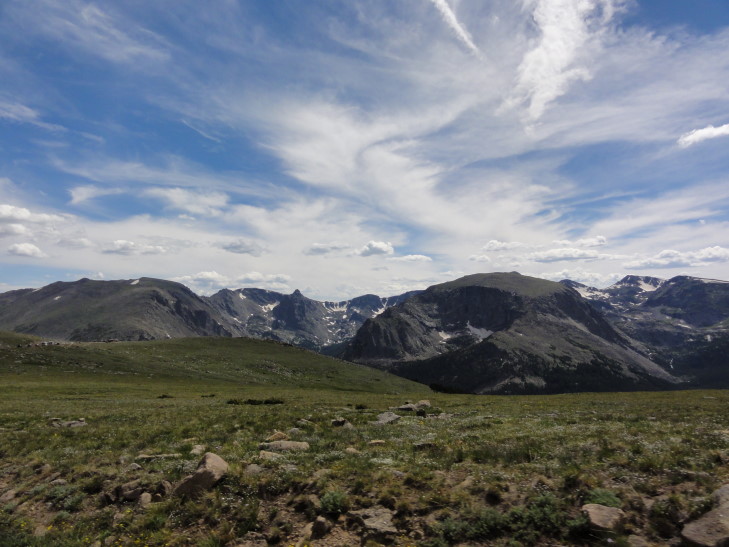
View of the cirque near the Alpine Visitor Center, RMNP, Colorado

View of the cirque near the Alpine Visitor Center, RMNP, Colorado

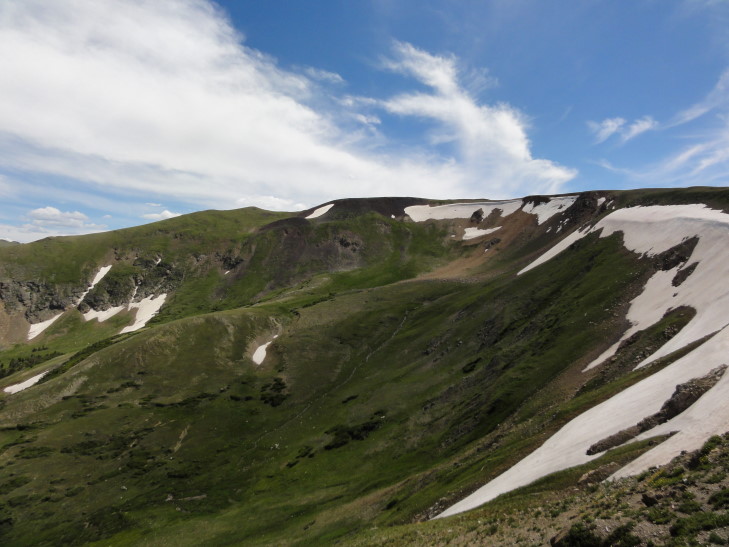
Snow in the cirque, RMNP, Colorado

Snow in the cirque, RMNP, Colorado

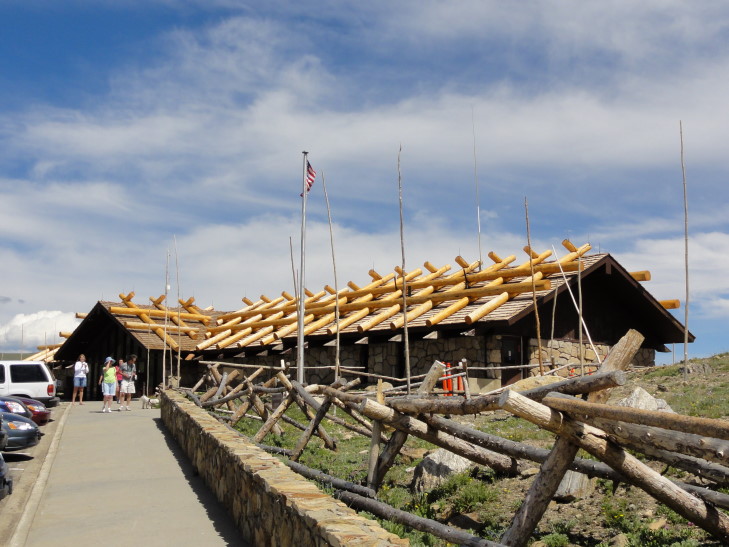
Alpine Visitor Center, RMNP, Colorado

Alpine Visitor Center, RMNP, Colorado

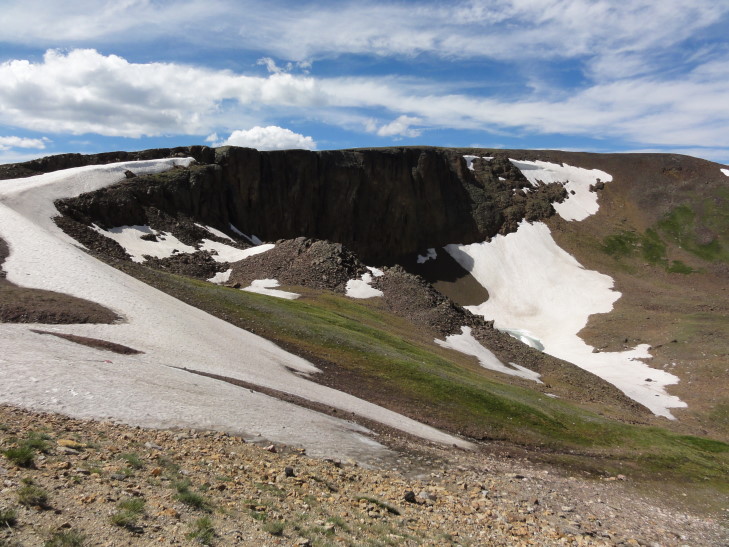
Lava wall with snow below, RMNP, Colorado

Lava wall with snow below, RMNP, Colorado

Elk lying on the tundra, RMNP, Colorado

Elk lying on the tundra, RMNP, Colorado

Shortly after we started the descent in low gear.  We got decent views of Longs Peak, at 14,259 the tallest peak in the National Park and the only “fourteener” (mountains over 14,000 feet) in the park — Colorado has 54 fourteeners in all.  Descended further and back beneath the timber line and eventually the grade lessened.  I took a short walk into another low-lying stream bed hoping to see moose but no dice.  Did have a conversation with a nice older lady who had been hiking for a week in the park looking for wildflowers.  She informed me that moose just aren’t seen on the east side of the park despite conditions being decent for them.  Oh well.

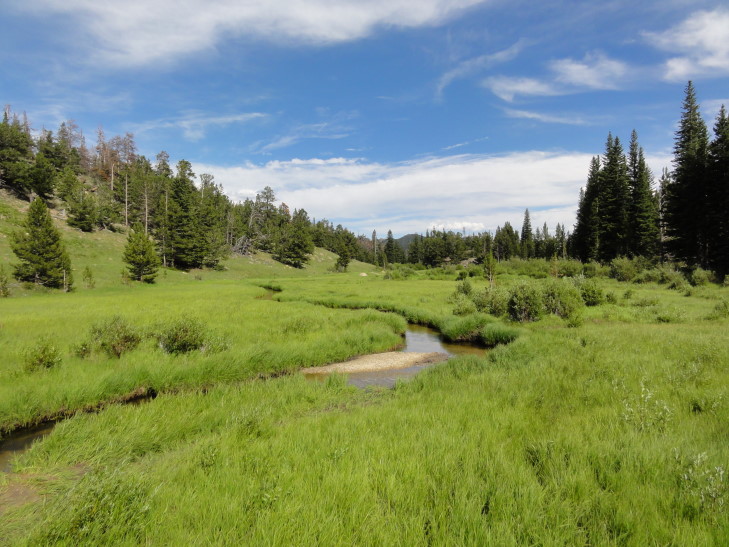
Lowlands in the eastern part of the park, RMNP, Colorado

Lowlands in the eastern part of the park, RMNP, Colorado

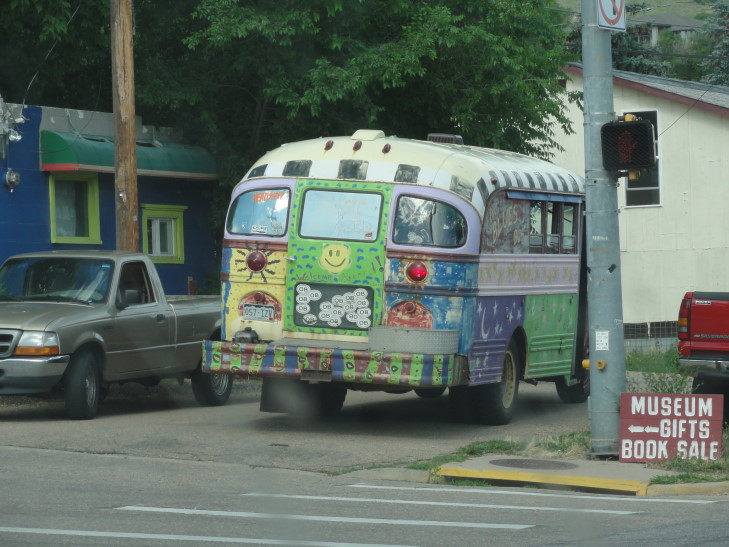
Headed out of the park on US-36 through Estes Park.  I had hoped to see the Stanley Hotel, the hotel that Stephen King stayed in that inspired The Shining, but was unable to find it and time was running out.  Note that the hotel used in the movie was not the Stanley but rather one built on the lot in England (though some secondary footage of a hotel in Oregon was also used as needed).  The mini-series, however, did use the hotel.  We next passed through Lyons, a town that was hosting Rockygrass, a bluegrass festival, over the weekend.  All sorts of interesting characters including a neat bus.

Bus near Rockygrass bluegrass festival, Lyons, Colorado

Bus near Rockygrass bluegrass festival, Lyons, Colorado

Hit Boulder and Denver at rush hour but eventually got to our hotel shortly after 6 PM.  I spent the better part of an hour emptying the car of all of the trash and stuff while Michelle took the bags to the room and started preparing for departure tomorrow by re-packing them more efficiently.  We decided to go to Outback that night to celebrate the end of this long trip.

On the way our constant companion through most of this trip, the Rockies, decided to grace us with the sight of the sun setting behind them, standing stark blue to black against the reddish-orange sky.  We’ll miss them, but we decided it was time to move on.

Route for July 23, 2010

Route for July 23, 2010

July 23, 2010

I resisted a two pound burger

Filed under: Travel — Tags: — BigWeather @ 1:37 am

After our free breakfast we checked out, gassed up, and headed to the Utah side of Dinosaur National Monument.  Got to the visitor center around 10:30 AM and caught the next shuttle to the Fossil Discovery Trail.  The trail is not reachable by private vehicle due to the construction on the new Dinosaur Quarry visitor center.  As we were shuttled to the trail head we saw mud on the road as a result of the two rare storms that hit the day before.  No such danger this morning, however.  Just some popcorn clouds.  Despite temperatures in the mid-80s it was hotter than Hades.  Luckily we had our dorky Tilley hats and bottled water to see us through.

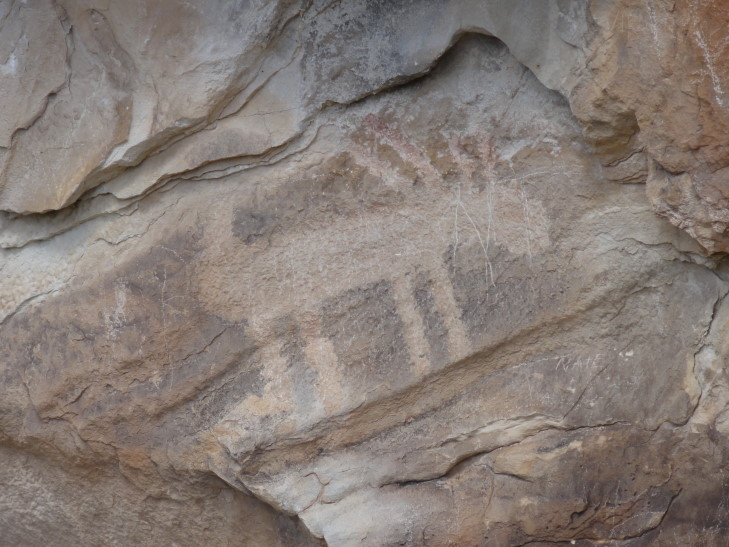
The first stop, Mowry Shale, was disappointing.  While we were supposed to see a fossil of some sea critter we couldn’t find it.  We did see, however, two pictographs just prior to entering that part of the trail so it wasn’t a total loss.  There was this shape that looked kind of like a crown or people or something and another that was a four legged critter.  I know it wasn’t a horse (because horses weren’t introduced from Europe yet) but beyond that I have no idea.  These artists weren’t exactly Vermeer.

Horse (?) pictograph, DNM, Utah

Horse (?) pictograph, DNM, Utah

Next moved on to the Morrison layer, the layer where the dinosaur fossils were found first in the early 1900s.  Carnegie sent a guy to “bring back something big” for his museum.  And how!  The quarry was excavated for 83 years and yielded many new species and much greater understanding about dinosaurs.  In the (now closed) visitor center there is a wall with 1,500+ bones — hate that we missed it, maybe we’ll get up there again.  In the cliff face we were walking along were several bones left in situ for visitors like us to get a sense of what it would’ve been like to come upon them the first time.  The paleontologists aren’t bothering to excavate more of the layer (despite there being bones that could obviously be excavated) because they’ve learned such a tremendous amount from that layer that they’ve moved on to other ones.

A Ranger pointed out a humerus, a femur of a large plant-eater (think Brontosaurus), three metatarsals from a large meat-eater (probably an Allosaurus), a pelvis (which was very shiny and easier to spot than many of the other bones), a small rib, and several vertebrae.  Michelle was amazed, as were the kids and I, because many of the bones were hard to spot — I suppose that’s what going to Paleontological State University will get you, the ability to spot them.  The Ranger also told us about a skull they found six inches below the surface with basically a super Geiger counter (detecting uranium 235).  Talk about a jackpot since the instrument could only detect less than a foot under the surface.  One scary moment when I almost backed off the cliff and had to pinwheel my arms to stay standing — it wouldn’t have killed me but it would have hurt for sure.  Whew.  Finished up the layer by having Addison point to a fossil and Genetta look surprised like she had just found it — fun times.  Yes, those white arrows are painted on the rock to make the fossil easy to spot for us tourists making the trick for the “Look, I just found a fossil!” picture to cover it up with your hand.

Dinosaur vertebrae, DNM, Utah

Dinosaur vertebrae, DNM, Utah

Plant-eating dinosaur femur, DNM, Utah

Plant-eating dinosaur femur, DNM, Utah

Finally we skipped the Stump layer.  Not only was it very muddy but the Ranger said that it wasn’t impressive at all — just some tiny things barely recognizable as ancient clams.  Woooo-eee!

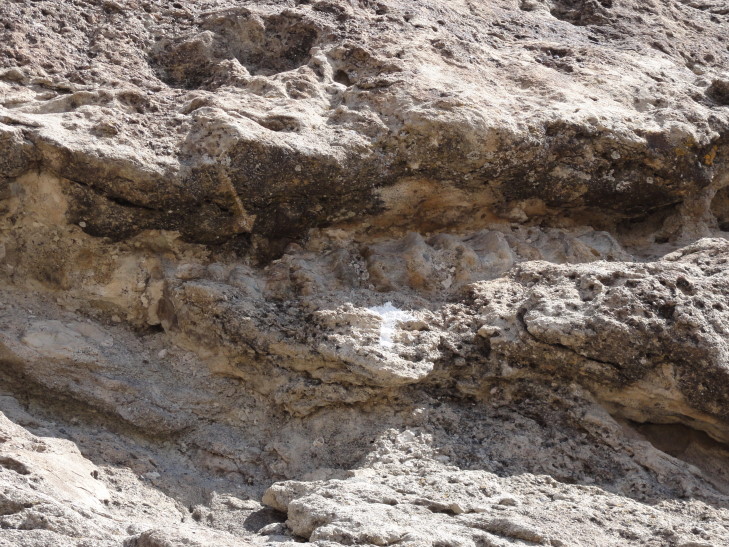
Rocks, DNM, Utah

Rocks, DNM, Utah

Back at the shuttle depot while waiting for the shuttle a man asked what size feet I had (you’d be amazed how many people ask that).  It led to a great conversation about both our groups’ travels.  He recommended going to the Chaco Culture National Historic Park when we do our southwest trip in a few years time.  He also said that the 31 mile drive in Dinosaur National Monument on the Colorado side was disappointing and a much better drive was to go about 20 miles towards Flaming Gorge National Recreation Area (just north of Vernal, Utah).  He also recommended going down to Grand Junction and the Colorado National Monument but when we told him we were doing Rocky Mountain National Park instead he agreed that was better.

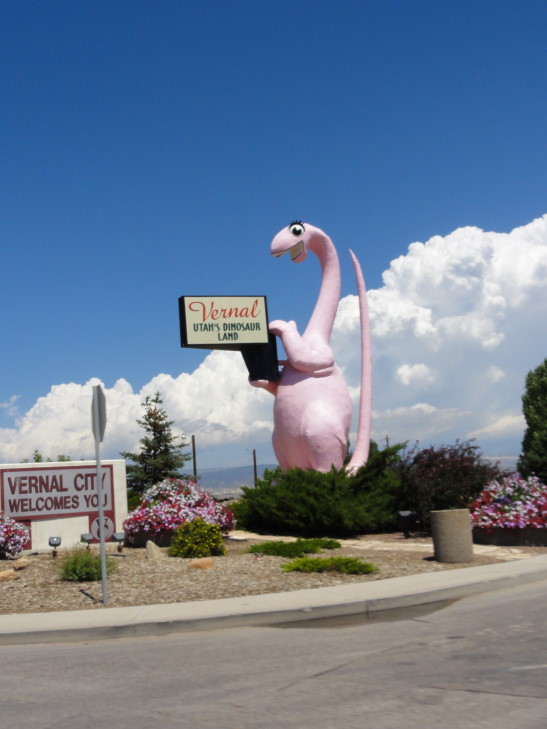
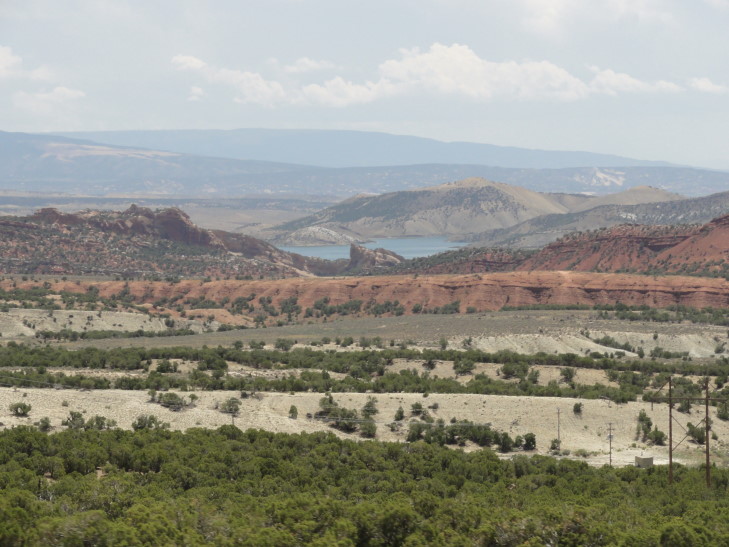
After returning to the visitor center we drove back to Vernal (and past the pink dinosaur statue with the odd eyelashes), got some money from the ATM (having to pay cash for dinner last night wiped us out), and headed north towards Flaming Gorge.  The guy was right, what a beautiful drive!  Lots of beautiful colored layers (yellow, gray, red) and helpful signs like “Produces Oil”, “Dinosaur Remains Here”, etc.  There was also a very nice reservoir that Addison and I took photos of.  We passed through a mining operation and a stretch of road with 8% grade and ten switchbacks with a gain of 4,000 feet.  A storm was gathering, however, so we turned around and headed back down.  The terrain was getting less interesting anyhow so it was just as well.

Pink dinosaur statue, Vernal, Utah

Pink dinosaur statue, Vernal, Utah

View from the road to Flaming Gorge NRA, Utah

View from the road to Flaming Gorge NRA, Utah

Headed east into Colorado, stopping at the welcome center at Dinosaur, Colorado for a free map and lunch at the adjacent B and B Family Restaurant.  The place was a bit run-down but the food was good and very reasonably priced and the people were very friendly.  Their menu was had Flinstones / dinosaur motif and they had a Brontosaurus Burger — a two pound burger.  Now back in college I could eat a Pizza Hut Pan Supreme in a single sitting and I might have been stupid enough to try to eat a two pound burger.  Being older I’ve grown to realize that maybe eating that wouldn’t be the smartest thing so I settled on the one-third pound burger instead.  Yeah, I’m a wimp!

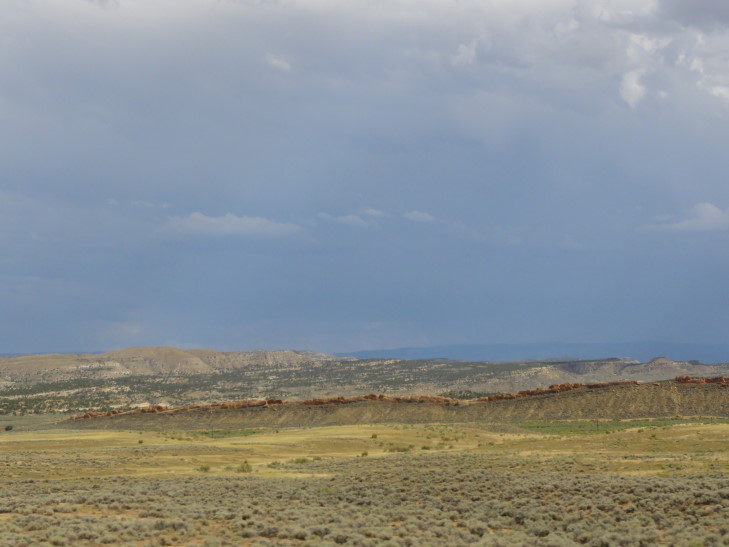
Left Dinosaur and cruised across northwestern Colorado towards the night’s rest stop in Steamboat Springs, Colorado.  The terrain was desert that gradually gave way to increased scrub then finally prairie and even some trees.  I was a bit sad at this transition as I knew we wouldn’t be seeing the arid landscape again on this trip.  The sparseness of the land was amazing — at one point we were sixty miles from the nearest gas station and there was almost ninety miles between towns.  Could you imagine a stretch from Winston-Salem to Raleigh with not a single house?

Arid landscape, Western Colorado

Arid landscape, Western Colorado

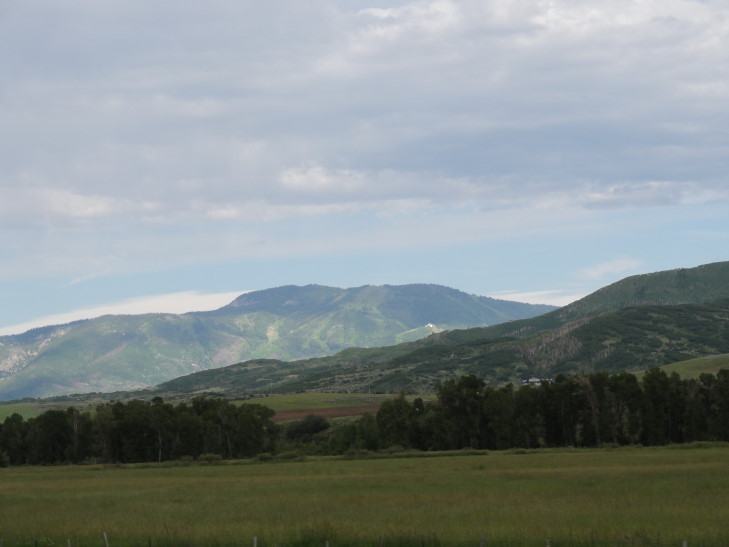
Finally got into Steamboat Springs about 6 PM though we saw the mountain with its ski runs (of course not covered with snow, it being July) long before.  Steamboat Springs is a nice town with lots of up-scale shopping and such.  Heck, even the McDonald’s and Wendy’s look very much like chalets.  Checked in to our hotel and relaxed a bit.  Michelle kept dropping interesting tidbits about the town from the welcome information: 300+ inches of annual snowfall (almost 30 feet!), the mountain can handle 33,000 skiers an hour, their real estate market had completely cratered since the 2007 peak, that sort of thing.

Steamboat, Colorado

Steamboat, Colorado

We went to the Smokehouse for dinner.  We had “bleu balls” as an appetizer — basically ham and cheese wrapped in chicken meat and fried — not bad.  Michelle loved her pulled pork sandwich and Genetta loved the smoky flavor of her ribs.  Addison didn’t care for his as much.  I had beef brisket and, while tasty enough, was disappointed by the serving size.  Still, not that bad a meal, if a bit pricey — but hey, Steamboat Springs, right?

Afterward we window shopped some though most stores were closed.  There was a store selling Western attire that was open, however, and Genetta got some boots — Michelle had promised her some long ago.  Headed back to the room, watched some TV, and went to bed to rest up for our last full day of our Western USA trip.

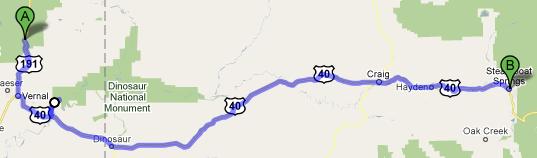
Route for July 22, 2010

Route for July 22, 2010

« Newer PostsOlder Posts »

Powered by WordPress