I’d be remiss if I didn’t post that today is the 10th anniversary of Diablo II‘s release. What an amazing game, one that is still going strong a decade later. I’m really looking forward to Diablo III’s release sometime in the next couple of years. Until then I tide myself over by listening to the superb Matt Uelman soundtrack at least once a month or so.
June 29, 2010
Western USA Trip July 2010 Map
This is the first of many (hopefully!) posts about our trip to the Western USA this July 2010. We’re all very excited about the two weeks we’ll be spending out there. The route itself is about thirty-nine hours but considering we did thirty-six on our trip to Saint Louis in only one week in March 2009 this should be cake (says the person that mostly navigates, not drives). We’ll be covering at least 2,100 miles. Without further ado, the map of our journey:
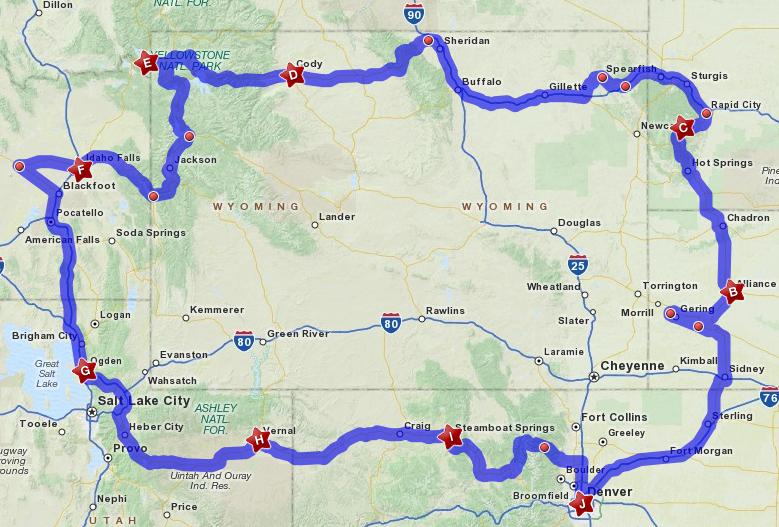
We’ll be staying one night in Denver, CO (J on the map, was also an A but since we ended there too the J won), one in Alliance, NE (B), three in Hill City, SD (C), one in Cody, WY (D), five in West Yellowstone, MT (E), one in Idaho Falls, ID (F), one in Ogden, UT (G), one in Vernal, UT (H), one in Steamboat Springs, CO (I), and finally a final one in Denver, CO (J) where we started. Whew! This map can also be seen interactively at this MapQuest link.
Along the way we hope to see:
- Scotts Bluff National Monument, NE
- Carhenge in Alliance, NE
- Mount Rushmore, SD
- Badlands National Park, SD
- Deadwood, SD
- Minuteman Missile National Historic Site, SD
- Devils Tower National Monument, WY
- Yellowstone National Park, WY
- Grand Teton National Park, WY
- Craters of the Moon National Monument and Preserve, ID
- Dinosaur National Monument, UT/CO
- Rocky Mountain National Park, CO
I’m sure some will fall by the wayside and we’ll discover others we’d rather visit but that is the plan so far. More to come!
Comments Off on Western USA Trip July 2010 Map
June 1, 1994
Treasures along the Nile
Michelle writes:
Got up very early ~3:30. We got on a flight to Abu Simbel with a stop in Cairo [ed – should be Aswan, will correct here on out]. Sahar stayed on board until we got to Aswan. In Abu Simbel, we got on buses to get to the temples. There were two temples: Temple of Ramses II and the Temple of Queen Nefertari. When we got there Brian & I bought tickets. Our guide said he would meet us in front of the temple. We walked around the mountain. You could see Lake Nasser. The water was very pretty. As you came around the road, you suddenly came upon the temples. They were truly amazing, imposing, etc.
The first temple was Ramses II. He is in the mummy room at the Egyptian Museum. There are 4 giant figures. One was damaged in an earthquake and the face had fallen off. All the statues were of Ramses. Around his feet, and between his legs were statues representing his family. These are truly amazing temples when you consider that all were moved here when the Aswan Dam was built. Man made mountains were built to support the statues. There are 3 halls in the Ramses Temple. The first one was for the public. It also had huge statues of Ramses posed like Osiris with his arms crossed. On the walls, from ceiling to the floor were pictures. Many were of the gods & Ramses praying to them. Sahar said that they would build ramps to do the pictures at the top. The next room was for the priests. There were decorated store rooms leading off of this hall. The next hall had 4 statues of gods. The sun came into this room 2 a year. On Ramses birthday & his coronation. Since they moved it, it only shines one day later then before. The sun never touches the god representing death. In the Nefertari temple there were only 2 halls. The first was decorated like the Ramses one. The second had 1 niche with a statue which had been damaged. When we left the site we walked thru the mountain where the statues were. It is huge and hollow inside. Then we got on the plane & went to Aswan. In Aswan we got on the boat. 6 other tourist met us there. 4 are from Minnesota & 2 are from Richmond Va. After lunch ~3:00, we went on a felucca ride. A felucca is a type of Egyptian sailboat. It was very tranquil riding on the Nile. Sahar said that there were no crocodiles in this part of the Nile. Sahar pointed out sides along the way. There was graffiti from ancient times. Elephantine Island had a Club Med, and is a famous old site. We saw the Hotel Cataract where Agatha Christie wrote Death on the Nile. We rode the feluccas over to the Aga Khans Mausoleum. It was way up on the hill. We climbed up. Inside was all marble. The view from the top was beautiful. We rode the feluccas back. Brian is not feeling well. We met with Sahar at 7:30. There she gave us details about the rest of the trip. She will handle tipping for the rest of the excursions. At one we will go by carriages. Then we had dinner. Shishkebabs.
Brian writes:
Woke up at 3:30am (ugh!), Michelle at at 4:00am while I checked over our room. She left her night gown on the bed!!! I got a small bite of food, we left at 4:30am for airport with Mohammed. Streets were almost deserted, it was nice. Passed street with flags of lots of Islamic countries, made it to airport. Met Sahar’s husband, I’m much taller, contrary to what she says. Got a 6:00am flight to Aswan. No leg room, annoying Japanese which in front trying for many moments to back her seat up on top of my knees, unsuccessfully of course. Michelle puts a stop to that! At Aswan, Sahar gets off, we go on to Abu Simbel on same Egypt Air flight. Same stupid [ed – people] in front of me. Had orange juice & some weird half vanilla ([ed – illegible]) half chocolate pound cake. Terrain below us marvelous — all sorts of desert mountains, canyons. Occasionally see a dark black road pierce the desert in a stark line or the beautiful blue-green waters of Lake Nasser, created by the waters behind the High Dam at Aswan. Amazingly stark & beautiful. Land at Abu Simbel — small airport. Leave camera bag, Brenden bag in a nice, A/C room.

Lake Nasser, Upper Egypt

Lake Nasser, created by damming the Nile at Aswan
Go by Egypt Air bus through Abu Simbel (quaint village with sprinkler-bred trees — it only rains once every five years or so) to the ruins. As expected, a slew of Bazaar shops in front of entrance gate. Once inside, meet our guide. Walk around and down back of prefabricated hill to front of Abu Simbel. BEAUTIFUL! with Lake Nasser behind and Abu Simbel in front, we were in heaven. A smaller temple was to the right in its own prefab. hill.

Entrance to Abu Simbel on the shore of Lake Nasser

Temple of Nefertari, next to Ramses II’s temple

One of four Ramses II Colossi that sit in front of Abu Simbel
The temple was built by New Kingdom Pharaoh Ramses II. It originally stood 60m below, but was saved by UNESCO from the rising waters of Lake Nasser. They cut it into blocks, moved it, reassembled, then built a mountain for it.
The temple’s front has four statues of Ramses II, 2 on each side. His family in between and beside him. Other, various statues are about, including dancing baboons on the top, b/c they were thought to worship the sun god (b/c of [ed- illegible]) their excited cries in the morning. Each statue, 65 ft. high wore a different crown [ed – diagram of the front of the temple].

Two more Colossi

Remains of the Colossi that was heavily damaged in an earthquake

Statues of hawks at Abu Simbel
The second statue from the left has cracked (in an earthquake in ancient times) and the chest on up toppled on the ground. Go in entry way to Hopostyle (sp?) hall, where there are eight (?) or so statues of Ramses II as Osiris. You see, the whole purpose of Abu Simbel was for Ramses II to say he is a god. Osiris was the most popular god, so Osiris [ed – I think I meant Ramses II] represented himself as Osiris with eight pillars of him with hands folded on chest and dark painted eyes [ed – picture of a right eye]. This hall, the Hopostyle hall, was for the public, as they could not go into the other two prayer rooms [ed – diagram of a hall showing the positions of the eight statues, four on each side of the entry hallway]. On the walls, finally saw engraving of Ramses II on his chariot during the battle of Kadesh [ed – picture of the Pharaoh on the chariot]. Though historically a draw, with neither side wishing to fight and ending the war with the first recorded peace treaty (and Ramses marrying daughter of other king), Ramses wished to depict this as a great victory for him. It was a cool figure because the horses leap, Pharaoh’s arms, etc. were repeated a couple of times to give a blurring, motion sensation. NEAT! Went to the next hall, had King same size of gods, because he is trying to be like a god. From the first hall, from which the common people prayed, were many cool storerooms. These storerooms were eerily lit and stretched off the main hall [ed – diagram of storerooms going off of main hall].
Finally, saw the sanctuary, or “Holy of Holies,” where only the high priest (who wears a leopard skin) and pharaoh can go. It had 4 seated statues. One of Horus [ed – I wrote “Amon-ke, Hekaton-ke” above this, no idea why — hope it doesn’t summon a mummy!], Hathor, Ramses, and lastly, on the far left Osiris [ed – though I note the “yellow book says Ptah”]. In the old location, on February and October 21st, the Pharaoh’s Birthday & Coronation Day, the sun during sunrise shone all the way down 100’s of feet of halls to illuminate the right three statues — the only statue unilluminated was Osiris, god of the Underworld! In the new location, the date is the 22nd of Oct. and Feb. Extraordinary engineering feat!

Pharaoh Ramses II killing his enemies

Four statues in the inner chapel of the Temple of Ramses II at Abu Simbel

Pharaoh Ramses II in his war chariot
Next, went outdoors and saw his wife’s, Nefertari’s, tomb. It had four statues of her in front [ed – picture showing the front]. Inside, lots of references to Hathor, the Earth goddess. Much smaller, only two rooms.

Side of a statue at Abu Simbel

Ramses II Colossi at Abu Simbel

Entrance to the Temple of Ramses II seen from near the entrance to the Temple of Nefertari

Entrance to the Temple of Nefertari at Abu Simbel

Statue of Ramses II from within the Temple of Nefertari
Finally, went through prefab. mountain. It was spectacular! Huge, hollow, concrete, with steel stairs all over. Could see the temple outlines cased in concrete. It’s funny, while in the temple you never know the difference! 11:00 = Back to plane, arrive in Aswan at ~12:00pm. Get on a bus, goes through Aswan’s west bank suburbs — lots of sand. Crossed the old British dam (1898 – 1902) over the Nile. Went down into Aswan, boarded boat, MS Queen of Sheba. Got room 313, our luck! It is a nice room, with a bath, entry, bedroom, and a sitting area. It has, unfortunately, two single beds instead of a double bed. Had lunch 12:30pm, then releaxed (slept) until 3pm. I was not feeling that well. At 3pm, went down to the docks to get a felucca ride, all 15 of us. You see, we picked up 4 from Minnesota — Mike, Sheila, Dan, and ?. In addition, 2 from Richmond, Va., but really transplanted New Yorkers — Jerry and ?. With the original nine — Michelle and I, Sharon, Mr. Bob and Pat Hart, [ed – illegible] and Patsy, and Rose and Fred, makes 15. The felucca was marvelous [ed – crude diagram of a felucca showing rudder, covered area, mast, and keel]. Staffed by Nubians.

Boat on the Nile River at Aswan
Go by felucca past the Old Cataract Hotel, where Agatha Christie wrote Death on the Nile. Also saw some spectacular Pharaonic graffiti made by quarry workers in ancient times. Saw Elaphantine Isle, with its Nubian villages and ruins from ancient (particularly Ptolemaic to Roman) times. This was the town of Sylene (sp?), where Eratosthenes used the shadows (or lack thereof) in the wells here and in Alexandria to calculate the circumference of the Earth. Landed at a small bazaar right on the west bank of the river nestled among vegetation. Had twisting streets of mud, shops on all sides. Dogs laying about, with flies. Weave through bazaar, start up to Agha Khan Mausoleum. Spectacular views of city, sand hills, fertile valley, river, and islands. Can see people with camels. Long climb up (~15 minutes), no shade. Pass winter residence of Aga Khan. Aga Khan died in 1950’s, leader of Pakistan. 42nd shiek of Ismaili Muslim sect. Got his weight in gold every year for birthday. His son, Ali Khan, married Rita Haywood and gambled all the wealth away. Mausoleum marble inside, beautiful, take off shoes inside. Guard wants baksheesh, but not supposed to ask for it! Leave, return to boat by felucca. Rest, eat dinner shish-kabob. Sleep.

Felucca on the Nile River

Nile River scenery from the felucca

Ancient graffiti

Nile River bank from the felucca

The Old Cataract Hotel, where Agatha Christie wrote _Death on the Nile_

Reeds on the Nile River

The Nile at Aswan
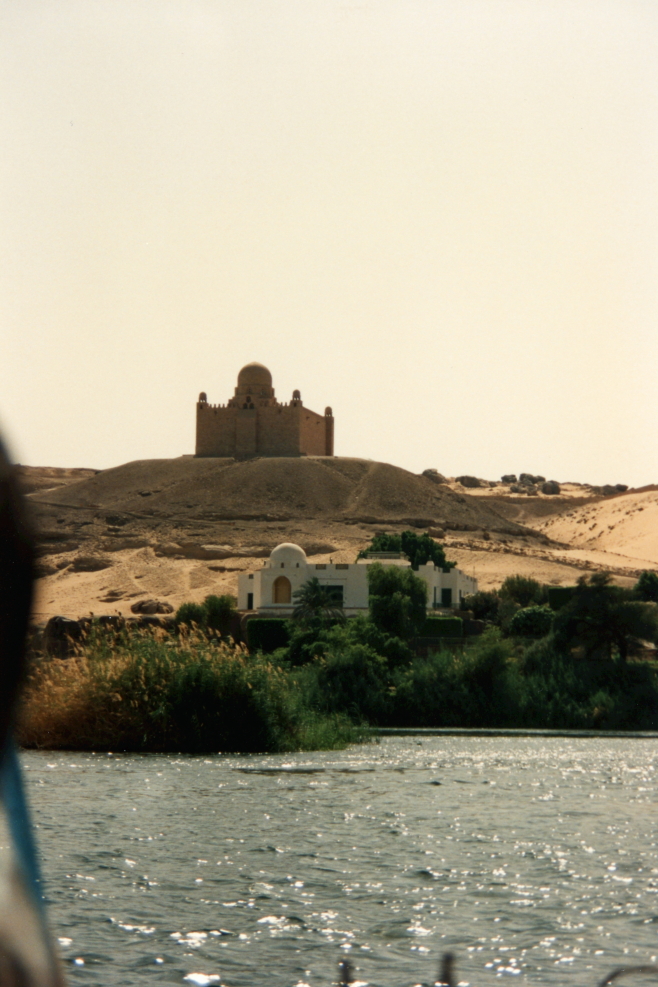
Mausoleum of Aga Khan from the Nile River

Another felucca sailing on the Nile

View of the Nile from the Mausoleum of Aga Khan

Another view of the Nile from Aga Khan

Building below Aga Khan

Yet another view of the Nile

The Nile near Aswan has many islands
P.S. The felucca fast became my favorite way to travel — it is so peaceful on the river, only the pitter-patter of waves and a very cool breeze snapping the sails [ed – crude drawing of a felucca]!

A very tired tourist gets well earned rest!
Comments Off on Treasures along the Nile
May 31, 1994
Houses of Worship
Michelle writes:
The “salesmen” here can get trying. We just tried to go for a walk and every 10 feet or so someone tried to get us to take a taxi, take a horse carriage ride, etc. The pollution here is pretty bad. But with so many people and cars, what is to be expected?
We left at 9:00 again today. First we went to the Islamic Museum. This collection began in 1880’s. Sahar said that you could see the differences in style due to influences of other cultures. We saw a portable niche. This niche must be placed in the direction of Mecca. We saw some beautiful glass oil lamps. There was a beautiful saddle. There was a room of weapons, including arrows. There were also beautifully done manuscripts. Then we went to the Ibn Toulon Mosque. Ibn = son of. This mosque had the fountain in the middle and was open air. There was not a room in which to pray. They prayed outdoors (well under cover). The mosque had a nice minaret. Next we walked next door to see the Gayer Anderson House. This is 2 16th century houses joined by an elevated bridge.
Mashribiyya balconies were where women would sit. There were rooms here where only women or only men could sit.
There was a crocodile instrument. The bedrooms were very nice. The Persian one had inlaid work on all the walls and ceilings. The chairs were the folding up kind. Afterwards we went to visit the Coptic churches. We saw two of them. One was Al-Muallaka (The Hanging Church) -> it lies suspended across Roman towers that guarded the water entrance to the fortress. Oh, also at the G-A house, they had a room with birthing chairs. Back to the church. The marble pulpit was nice. It had 7 pairs of columns each different. They were suppose to represent the disciples and 2 gospels.
Next we went to Aba Serga (Saint Sergius). This is supposedly where the Holy family lived while Joseph worked at the fortress. There is a crypt which houses remains of the church where Jesus, Mary, & Joseph supposedly lived. But the crypt is now under water.
The last place we visited today was Keenest Eliahu (Ben Ezra Synagogue). This was build in 12th century. Americans helped to restore it, which set off a discussion between Brian & Mr. Hart. We got back to the hotel about 1:30. Mailed post cards.
Brian writes:
Weather: 90’s – Hot
Woke up at 6:15, ate breakfast – croissant and honey, and met the group at 9am. Went first to the Islamic Museum. Saw many objects from Islamic times — a fountain like the one in Manial Palace, but smaller (shorter), illuminated books (amazing – gold illuminations on blue – very detailed), swords, shields, and helmets and armor, like chainmail [ed – accompanied by simple illustrations]. Saw lots of inlaid boxes. Saw a travelling box that used to be used for food, the Islamic leaders have servants who taste everything before the leader does. Saw beautiful stained glass and the hanging lanterns used by the mosques. Also saw some very incredibly detailed gold jewelry – gold is considered only for the woman in Islam and many males even today wear silver bands. Also, many of the early Islamic designed (7th – 10th c.) are only floral or geometric, no animals or people. Later, animals and people are used. Also saw a portable niche that could be pointed towards Mecca while traveling. Saw some gorgeous rugs, and a saddle too. Saw a compass & astrolabe, and awesome map of the world (ancient). Saw examples of chandeliers and of wood work. Sahar said that mosque originally had wood roofs, but during the Mameluk times, when mosques of previous rulers were burned, wood roofs burned too easily.

Cairo street vendor

Cute Egyptian kitty cat
Next went to Ibn (= son of) Toulon Mosque, not far from the Islamic Museum. Its plan is like this [ed – map showing a fountain in the middle of a courtyard with a minaret on the side and covered sides]. This one is very old, ~8th c (?). During Mameluk times one rule was revolted against and went to Ibn Toulon for protection. They hid him in the minaret, and when the revolution was over he covered the mosque’s roof in wood work for them. Shortly thereafter, however, the practice was stopped. This, like the Mohammed Ali Mosque, also had a pulpit and a niche. The mosque, however, had no separate, indoor prayer area, it is all outdoors, on the left side. The open courtyard has lots of stones, not a good place to stand if people are pissed at you! The columns of the mosque were combined four-into one. A nice mosque, but Mohammed Ali was nicer.

Mosque of Ahmad Ibn Tulun (876 A.D.)

Michelle at Ibn Tulun, wearing the booties one must wear

Minaret at Ibn Tulun mosque

Fountain at Ibn Tulun mosque

Covered walkway surrounding Ibn Tulun’s courtyard

Lamp at Ibn Tulun mosque

Spiral minaret at Ibn Tulun

Ibn Tulun mosque
Next went to the adjacent Gayer-Anderson House. It is two 16th c. Arab houses connected by a suspended walkway. Beautiful courtyard. Each room has a theme, exterior mainly sandstone. Narrow, steep stairs. There was a room with replicas of Egyptian Antiquities like Nefertiti’s bust in the Berlin Museum. His bedroom (Anderson’s) was in “Syrian” style – very dark, lots of wood and red curtains – up a flight of stairs. He also had a Nubian maid who helped him. Anderson was a [ed – illegible] in the 1800’s or 1900’s and was a painter. Parts of the house, like the outdoor terrace with big folding tables and chairs, were for men. Others, like the [ed – illegible] room, were for women. The women’s rooms had wooden work all over the windows that allowed them to see vaguely what is going on outside without revealing self. Or, they could also open up little shutters in the woodwork to peep out of on to the street or room below. People below, however, can only see their eyes. No big deal [ed – illustration of a wood design window covering with a small open window shutter]. In main entertainment room, women’s chambers on second floor peer in, but are also covered w/ wood work. In entertainment room, there is the sunken fountain, area for dancers, musicians, then an area for the master of the house’s chair (in a corner) and other couches. Throughout the house are comfortable window seats and neat shelves in stairways [ed – illustration]. Saw a musical instrument – looked like a carved alligator, but on belly [ed – sorry Mom, I know you hate that word!] were strings. Clever. Finally, saw birthing chairs [ed – accompanying top-down diagram with handles pointed out]. Also a candle assembly. The showers, which is after the birth, is when a name is chosen. Everyone who wants to submits a name, and lights a candle the last candle to go out is the name chosen. Eliminates lots of family fights. All this in a separate room.
Next rode over to Old Cairo, where there was originally a Roman fort. On the two towers that used to guard the water entrance to the fort, a church was built [ed – illustration of church perched over two towers]. This Coptic church was called the “Hanging Church” b/c it “hung” over the Roman fortress. In Arabic it is El-Mallaqah (or somesuch). It was really cool. You entered, then went down a ramp into a courtyard then into the church itself. From the church, you could see the remains of the rounded Roman towers below – neat. The church was beautiful! Pillared inside, with Coptic cross ([ed – illustration of a Coptic cross]) banners in orange all about. Had light filtering on from high above, very beautiful. Pictures of the Saints were all about, and near icon was a painting of the Virgin Mary w/ Jesus and had eyes that followed you around. They also had 14 (?) pillars, each one a different shade of white in the church. One was black, however, for Judas. 12 were the apostles, plus 2 gospels. St. Antorius (?) and St. Peter brought Christianity to Egypt (Aegyptus to the Greeks and Romans) early in the 1st c. A.D. Then, Christians were heavily prosecuted [ed – should be persecuted]. Finally, after Christianity accepted in Empire, El-Mallaqah built in Roman Times. Christians in Egypt were called Copts, from Aegyptus, and has nothing to do with their religion, which is Greek Orthodox. The Coptic seat was in Alexandria a while too. Later, after the Muslims moved in, they demanded Copts pay higher taxes for “protection” since they are a minority. Those who cannot pay must convert to Islam or leave the country. Many Nubians, consequently, are Islamic, as could not afford to pay and were [ed – illegible] converted. Had pews like other churches.

Old Cairo alleyway

Al Muallaka, the Hanging Church

Pulpit in Al Muallaka Coptic church

Ruins of one of the Roman towers upon which the church is built
Next, weaved through twisting alley of Old Cairo to Abu Serga Coptic church. Fred actually asked “Why don’t they clean up, how can they live with all this dirt?” I was embarrassed, but he means well. It really wasn’t that dirty. The alleys were narrow, no wheeled traffic, about 6 feet across. Couple story buildings, dirt roads, numbers for houses painted in green on the side of the wall.

Another scene from Old Cairo

Our guide Sahar walks through Old Cairo
Not much to Abu Serga itself, just like any other building in Old Cairo. In need of repair, was encased in some scaffolding. Significant because this is where the Holy Family (Mary, Joseph, Jesus) stayed when Jesus was young and they were in exile. Stayed in a tiny cave beneath the church, which was built afterwards. Originally could go down to cave, where there is a tiny chapel, but the damming of the Nile has raised the subterranean water level so that the cave, and most of the flight of steps down to it, are submerged. Still Amazing!
Lastly, went a little farther to Ben Ezra Synagogue. Ben Ezra was built on the spot where Moses was supposedly found in the river (Nile) floating. It is beautiful, marble and wood throughout. The government, though, would only let the synagogue be built if it incorporated Islamic style art, which it does beautifully in its woodwork and geometric designs. The marble altar, with some of the Ten Commandments reproduced above, stands over an earlier, buried altar where Moses was found. There are only 120 Jews in all of Egypt, all Embassy workers [ed – Wikipedia says that as of 2016 there are six remaining, all women over 65, I’m assuming in addition to the Embassy workers]. Rest left after wars (1967 & 72). Our government funded the rebuilding of Ben Ezra which Bob Hart [ed – one of the people in our tour group] argued was stupid. I argued for historical preservation.

Interior or Ben Ezra Synagogue

Jeep Grand Cherokee in Cairo
Left Ben Ezra, went back to hotel ~2:00. Ate. ~4:00 – attempted to walk across bridge and Gezhira Island [ed – simple map], but had taxi drivers honk, carriage drivers bug us, and finally a guy who seemed to want me to vouch for his entry into U.S. Yeah, right! We aborted the mission. Mailed post cards, had dinner. Bed ~9:00.

View from the Cairo Sheraton

Cairo Tower on Gezira Island

Boats on the Nile

Yet another view of the Nile and boats

The Cairo Sheraton Cleopatra and Nefertiti towers
Comments Off on Houses of Worship
May 30, 1994
Ancient and Islamic Cairo
Michelle writes:
Left at 9:00 this morning. The new person, Sharon, joined the group. Today was a little less hectic.
First we went to the Egyptian Museum. There were so many things there to see. Sahar showed us around but she could not go into the King Tut part. We saw some wall fragments. These had been filled in with different colors. We saw a lot of statues. One thing, if the beard was curved it meant the king was dead. Straight beard meant the king was still alive. Also learned about dwarves in Egypt. Also how the statues of husbands and wives were arranged indicated what type of relationship the couple had. When the women had the arm around the back of the husband – this meant she liked him. We also paid to see the mummies. There were about 10 mummies. They had just reopened this about 3 months ago. Sahar said they are going to build a new museum near the pyramids.
Then we visited the Manial Palace. It was built in 1901 by Mohammed Ali. The house was very lovely. Each room had a different ceiling. We also saw the throne room. Then we went to lunch at a felfala house. The food was very interesting. We had Egyptian salad, pita & sauce, shish kebab and yoghurt for dessert. Then we went to the citadel & saw the Alabaster Mosque. Then we went to see the gates & gatehouses that were left from the original.
Brian writes:
Weather: 90s – Hot – duh!
Wake up at ~7:15, this time without the headache! Shower, eat at 8:30am. 1 1/4 croissants with honey, tip of 2.00LBE at breakfast. Get more water, meet guys at 9:00am. I get 20LBE worth of change in ones.
Go first to the Egyptian Museum at Tahrir Square — what a zoo of a square! Egyptian Museum on the north side of the square — it is red with a courtyard in front. The courtyard has plants and a few statues, and there were workmen working on a very rickety, all wooden scaffold. Went into British [ed – oops] Museum, left camera behind. First saw some tops, tic tac toe, game pieces from 3000BC (Dynasty I). Then looked at New Kingdom statues. They are colossal, because they had stone tools at that time to work with. The kings have a smile on their face and are portrayed as muscular. They hold stuff in their hands to emphasize muscles. Throughout the kingdoms, if the statue has a straight beard the statue was carved while the pharaoh was alive, if it is curved then it was carved after he/she died.

Egyptian Museum (low red building with dome) from near Tahrir Square, Cairo
Saw a tablet from Karnak of Menes, ruler from the south (who had the white crown of the Upper Egypt) conquering his enemies on one side. Hathor the Earth goddess (who is represented as a bull, or with horns) watches over him, while Horus protects him and crushes his Lower Egypt enemies and their symbol, papyrus and vulture. Lower Egypt is the red crown. Upper Egypt’s sign is the lotus and the cobra. On the other side of the tablet was Menes celebrating. He was barefoot, as the tablet is to be put in a temple, he must be barefoot. A servant carries the sandles behind, along with oil. The pharaoh is carved larger than anyone else. To the right are many enemies with their heads between their legs. Below, two beasts had their necks intertwined — Lower and Upper Egypt were united! Saw some walls where they carved in what they were drawing, then filled in with a color mortar, unfortunately, this tended to fall out when it cooled. Saw many statues of man & wife, man was painted red, wife yellow. If the wife has both arms around man, she really likes him. Statues supposed to be representation of what they will be in the otherworld, so many dressed in ceremonial official robes. Saw Old Kingdom pharaoh statues — small (no metal tools — HAD to be small b/c stone tools take forever) but with smiles on face. Saw Middle Kingdom pharaoh statues – no smile, larger, more serious — b/c country just been through civil war pharaoh cannot be complacent. Also hair is curled. Also start using sphinx in Middle Kingdom with whole head of a lion except face of a pharaoh, Old Kingdom had whole head of pharaoh. Egyptians liked (respected) lion, etc. b/c of strength they symbolize. Go to New Kingdom, huge smiling statues!
See a tomb or temple to Hathor with a huge bull statue in it. The tomb was to the first queen (who dressed like a man, statues like mans) and the [ed – illegible] sheltered her son (indicating he has the right to rule) and her son drinks her milk (he must rule too). See wooden (sycamore) statue of mayor, he is carved as corpulent with inlaid eyes. Very spooky, very lifelike! Saw statue of servants that were in tombs, supposed to secure pharaoh in afterlife. Saw statue of Akenaten, he is very feminine like, or is at least portrayed that way. Came up with first monotheism. His wife was Nefertiti for 12 years. When that didn’t work out, he married his oldest daughter, who also married his son (?) or nephew (?) Tutankhamen (King Tut) later. They were trying to keep royal blood in their line. First portrayal of whole royal family together, and use of cartouche for other than pharaoh.
Next, saw King Tut’s treasures!!! First, saw the four wooden-with-gold-leaf shrines that fit one inside the other and contained his three sarcophagi. Saw beautiful gold chariots (5) and the alabaster jars that held his viscerals (internal organs). These were in an alabaster box in a solid gold shrine, which has four Isis statues guarding it — absolutely beautiful. My favorite piece! Go into the room with the mask, Sahar cannot give narrative. Try our best not to see mask until end, see the outer sarcophagus (wood and gold), inner sarcophagus (lots of gold — 495 lbs solid!), famous shepard crook and might flail, lots of amulets, rings, bracelets that were on the body. The middle sarcophagus is still in his tomb, with the mummy. Finally see the mask! It is so neat, so beautiful, shiny, gold and blue. The back (which you never see) looks like [ed – illustration of back]. It is tied back in a braid! The blue inlay is coming off in back — a pity. Beautiful nonetheless! See Tut’s chairs, throne, his foot rest has Asiatics and Nubians painted on it, as he is always subduing his enemies. Also, one of the thrones contains only reference to both names at same time — Aten and Amon [ed – sp?]. Saw beds, gold and hinged too. The hinged bed was for traveling. Silver was much more valuable than gold then, used sparingly. See bust of him as a kid, and ostrich feather fan. Many statues of him, one for each day of the year to serve him that day. See Anubis cabinet. Painted black with real jackal legs! Saw a shower — metal bowl with holes in it.
Next, paid 60LBE to see the royal mummies — about 10 in a well air conditioned room. Guards wanted silence and no touching of glass cases holding mummies. Saw Tuthmosis II & IV, some queens, etc. mostly all blackened skin, empty eye sockets, though look at peace, hands are twisted. Biggest shock was Ramesses II was in there!!! The man with all the statues. Old, wizened man, but tufts of red hair still evident. A real honor. Leave mummy rooms (which was only recently opened) about 11:30. Look for guide. See some Greco-Roman artifacts, finally find book for 100LBE. Well worth it!
Next went to the Manial Palace on Rhoda Island in the Nile, below the Gezira Island across from the hotel. The Manial Palace had beautiful gardens around it. The residence was built by Mohammed Ali in 1901 because he thought he would rule Egypt in place of Farouk, the young king-to-be. He thus needed a residence and throne room. To make a long story short, he never was ruler and ended up fighting (verbally) with Farouk for the rest of his days. He never married, but did have a French girlfriend. Inside the palace each room had a different theme in the ceiling. These were the most beautiful woodwork — carving and painting I have ever seen! Absolutely amazing! They had archways with sayings from the Koran above them, and much of the tile work was blue, the Turkish color for royalty. The upstairs was closed for renovation after the 1992 Cairo quake. They had a huge silver serving place and lots and lots of medals for the different countries. Manial Palace also has an entryway with a beautiful fountain sunken in the floor. His throne room was in a separate building — it had several red benches with his name. The ceiling was white with a beautiful gold plated sunburst design. Also had a humongous birdcage and pictures of all the Khedives (?).

Grounds of Manial Palace, Cairo

Sunken fountain in Manial Palace

Note the geometric patterns everywhere

Throne room of Manial Palace
~1:30 = get to our lunch stop, a felfela restaurant. Felfelas are apparently spread all over Egypt. It was a neat building, in the front they had a counter on the right with hot coals (and flies), as well as a pot with boiling oil, where they were cooking something. Lots of carved wood work, yellowish clear ceiling, hanging lamps. Sit at long split table on uneven floors, they first bring out salad, Sahar says “Don’t Eat!” We don’t! Don’t want Tut’s trots. Later brings out lots of sauces & eggplant. Cheese, sesame, etc. sauces. Also brings out falafels which are fried foul [ed – ?] bean patties filled with green stuff and covered with sesames. Good! Put falafels in pita with sauce. Yummm. Have Pepsi, and Egyptian beer with lunch. Beer tastes just as bad here as in US, just cheaper — 5.00LBE/litre, or $1.75/litre. Now comes main meal — shish kebob — veal or lamb, don’t know which. Great smoked taste though. They bring Michelle some 7Up w/ice, we have to send back due to ice. Dessert was yogurt w/honey. Needless to say, I had none. During our meal two cats on the roof really got into fighting! Meowing all over! [ed – Twenty years later I still remember cat hair drifting down to the table from the trellis above — ick!].

Gas station in Cairo
Next drove past the Necropolis, or City of the Dead. Muslim graveyards look very much like the rest of the city, with above ground crypts , or mausoleums. The city’s very poorest live in the City of the Dead, about 2 million. Also drive past trolley lines, police academy, and military academy.

Necropolis, City of the Dead, where the poorest live
Come to the citadel, a medieval fortress on a bluff overlooking cairo. All desert around, very desolate. It was built by Saladin (?) [ed – yes, Saladin, in the 12th century AD — it is formally called Salah El Din Al Ayouby Citadel]. Few of the interior buildings remain, only towers and walls. There is, however, a military and police museum inside, as well as the Muhammad Ali mosque (or Alabaster Mosque). We were just walking along in the citadel, when Sahar points in one direction, to our right, and says “This is a good photo!” Boy, was it! The mosque seemed to shimmer in the afternoon heat, as if it were very far away — yet it was very close.

Walls and towers of Salah El Din Al Ayouby Citadel

Large tower at the citadel

Mosque of Muhammad Ali, or the Alabaster Mosque

Square tower at the citadel
Entered, took off our shoes to walk in the mosque. First, an outer courtyard with colonnaded border. In the middle, you could see the fountain where the faithful wash their arms, feet, and face before praying. Originally served by an aqueduct, it is now served by Egypt’s sewer and water system. Across the courtyard was the minaret, which in earlier times a person would climb up and do the call to prayer. Now it’s done by loudspeaker. Went into mosque main room, off of courtyard. Cover was red carpets, Persian design. Lots of elaborate woodwork, ceiling very beautiful. Light provided by lanterns hanging from very high wires. Lots of pale green, gold, red. There is a niche in the wall that faces Mecca, praying is done toward the niche. There is also a pulpit, reached by stairs, on the right, which is used by the sheik on holy days. Sahar sat us down and told us about Muslims and Islam. They fast during a month, Ramadan. By fasting, they do not eat during the day. Egypt is a lot more liberal than many countries. In Egypt, many places of work have miniature mosques, or shrines, to which a worker may go and pray. The employer cannot stop them from doing so. In Saudi Arabia, though, everyone is required to pray during prayer time. In addition all women, including foreigners, must wear black w/ veil in Saudi Arabia. In Egypt, it is only tradition, and some women who wish to show they are true believers will wear the black with veil and sunglasses. Though prayer should be everyday, most Egyptians come to the mosque on Friday, the holy day. A man may have up to 4 wives and divorce is easy — he just says “I divorce you.” He may then remarry her, in case it was a fit of rage, instantaneously. But, he may only remarry two times, if he divorces her three times it is nearly impossible to remarry. The remarriage, however, is a whole new ceremony. Yikes! $! Women usually ask the husband for a divorce and he can do it instantly, but she cannot. She can, however, go through the courts to get a divorce. On divorce, she gets home, children, etc. and he must support them. As we leave [ed – ?] a guy pointed out the tomb of Muhammad Ali — behind woodwork, in what looked to be alabaster or ivory casket. Put shoes back on, left citadel.

Closer view of the mosque, note the so-very-90s outfit the lady wears!

Fountain and Gingerbread Clock in the mosque’s courtyard
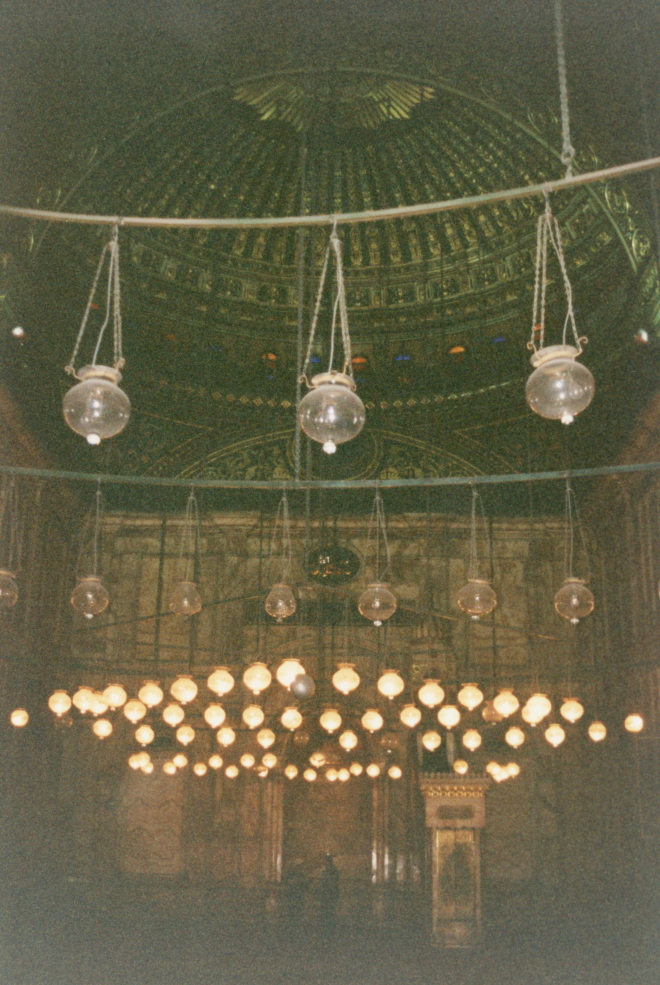
Light globes in the mosque

Islamic pulpit in the Alabaster Mosque

View of the courtyard from inside the mosque
Went through poor section of town, saw old city wall — sand stone. Saw two gates Bab Al Futuh and Bab An Nasr. One of these gates was having square exit, square towers, was the gate the army went through to leave city. Other was the victory gate, similar to first, what soldiers came through on way back from war. Really whacked my head on the van’s door roof after stepping off curb. Scalp was bleeding, dizzy, had knot. Saw guy urinating in the street, trash everywhere. Yet, totally safe for us — amazing.

Another Necropolis

A view of Cairo’s Old City

Bab Al-Futuh gate in Cairo’s Old City

Another Cairo Old City scene

Bab al-Nasr gate in Cairo’s Old City
Back to hotel around 4pm, took nap until 7:30. Ate late, after sitting out on balcony and watching traffic go by. Heard the call to prayer — beautiful! Dinner was steak (not so good), fries, had ice cream (fantastic!) chocolate and strawberry for dessert. Stay up late, work on journal, go to bed.

Cairo street scene

Corner store in Cairo
Comments Off on Ancient and Islamic Cairo