BigWeather's Blog

August 4, 2013

All Along the Watchtower

Filed under: Travel — Tags: — BigWeather @ 11:59 pm

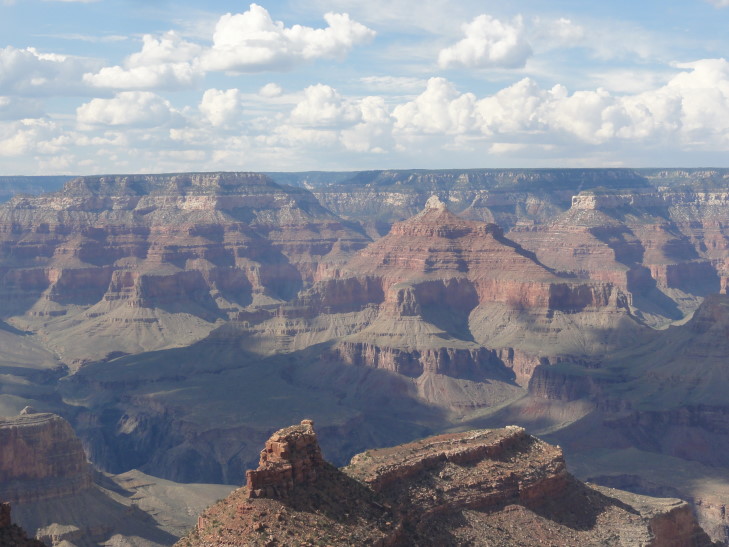
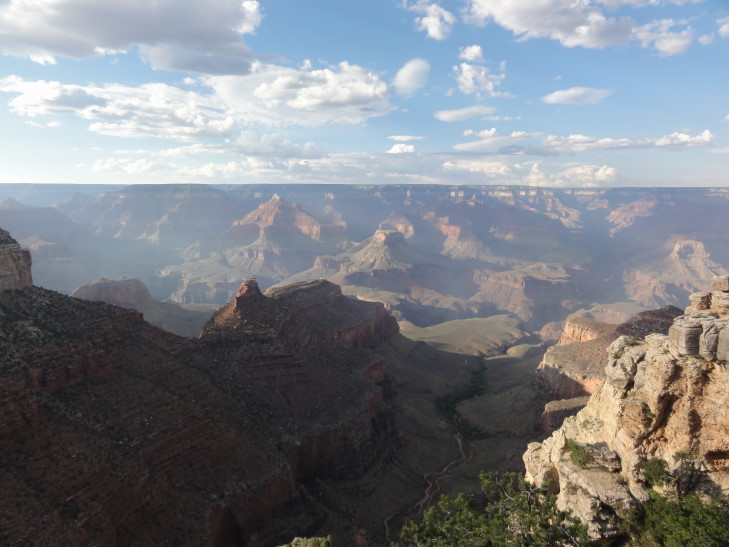
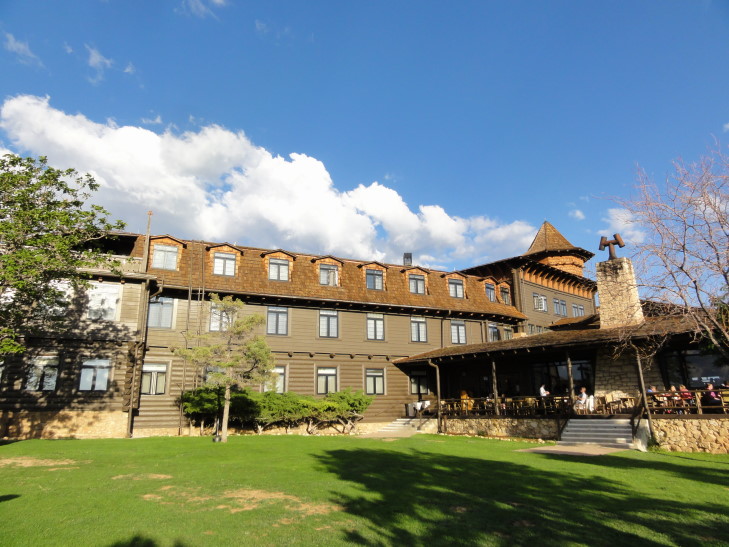
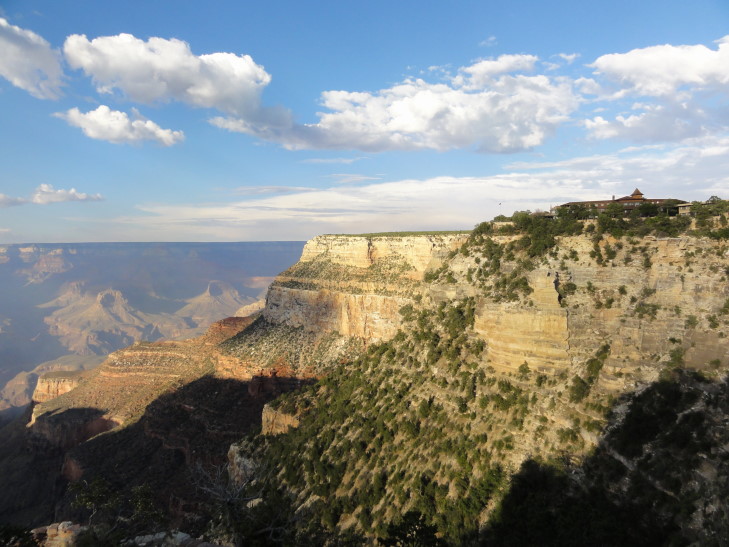
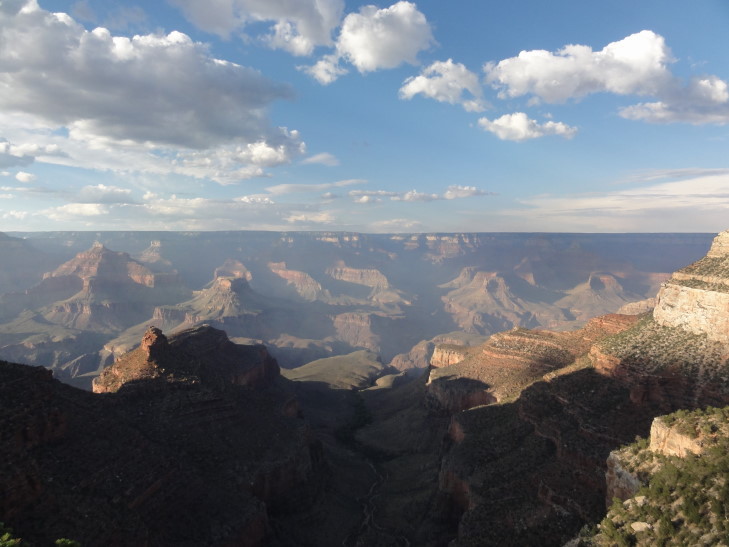
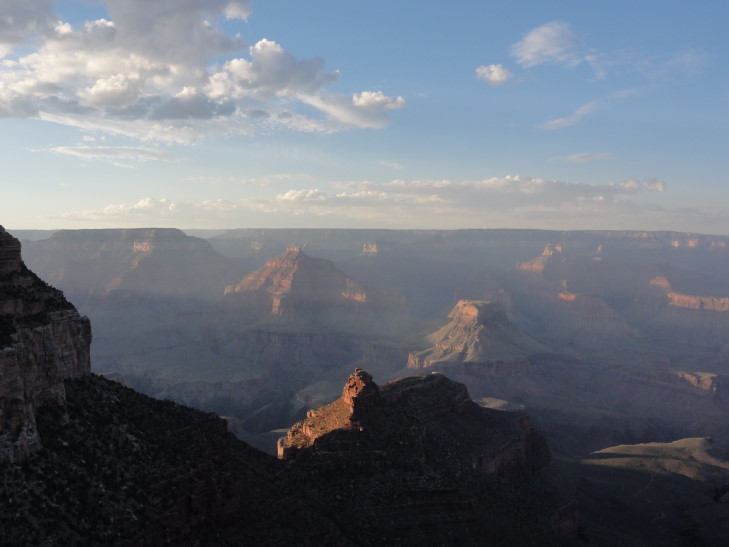
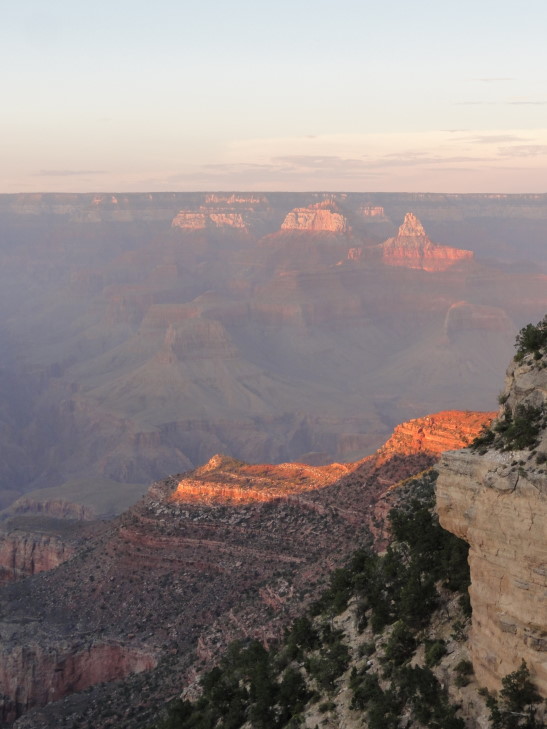
Michelle woke me up shortly after 6a so that we could go watch the dawn over the Grand Canyon.  I’d love to be able to say that we were out before dawn and walked miles to the best spot to see the dawn but we didn’t — we got out shortly after dawn and camped out in front of El Tovar.  Though I prefer sunset more, I think, the dawn was still spectacular.  It was amazing how minute to minute the light changed the way the canyon looked.  After about thirty minutes or so we went back to our rooms.

Grand Canyon at sunrise
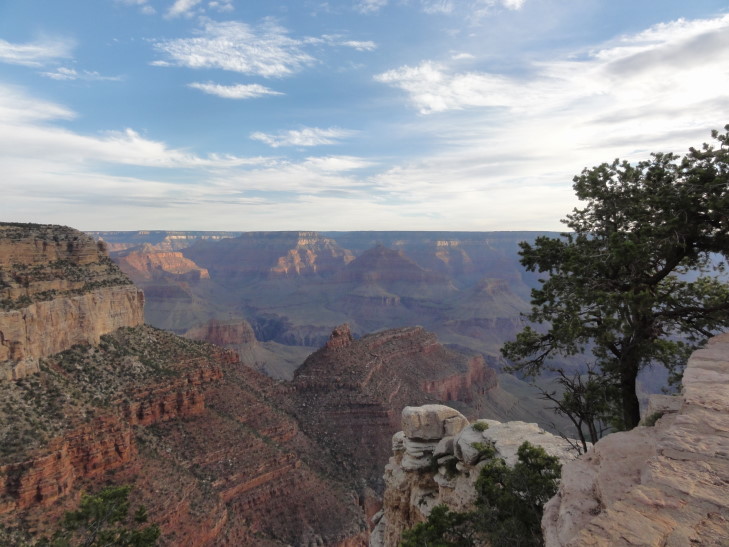
Grand Canyon at sunrise
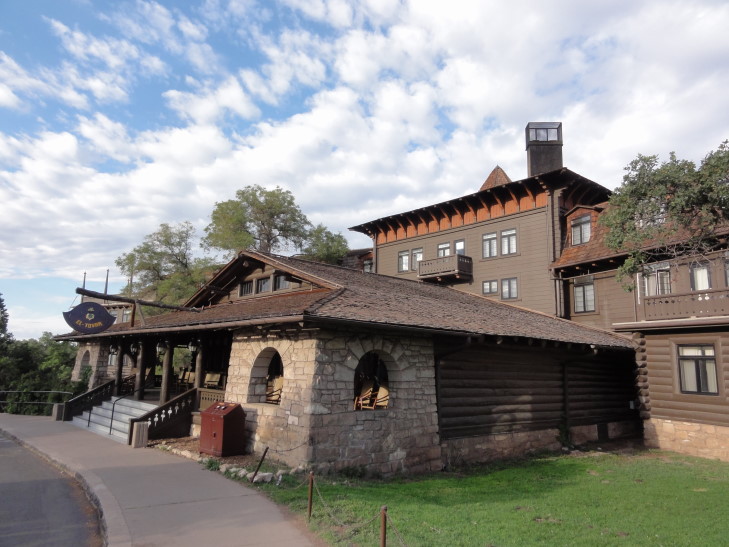
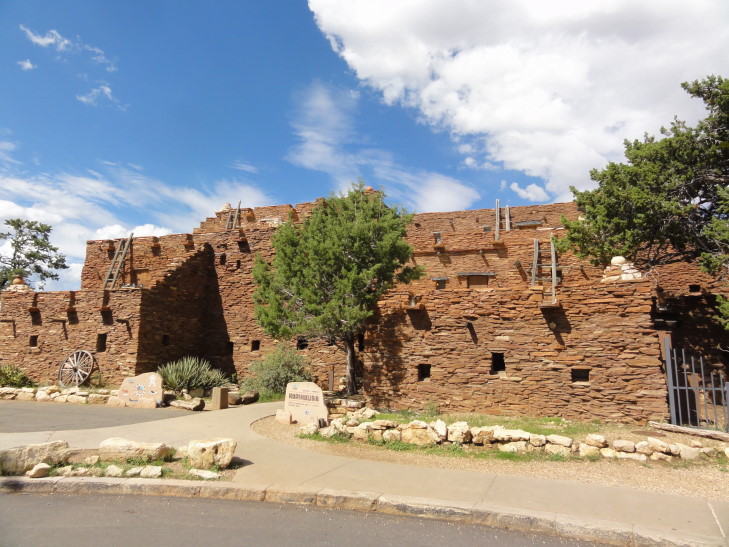
El Tovar's entrance

A bit later we woke the kids and headed to breakfast at the Bright Angel Lodge.  It was not bad at all, and reasonably (for Grand Canyon Village, at least) priced.  Afterwards we checked out the some of the history of the lodge including a fireplace with stones retrieved from the different layers of the canyon and stacked up in the same order, so that the bottom of the fireplace were the oldest rocks (about two billion years old) and the top was the most recent type of rock.  We also learned about the architect of many of the distinctive buildings in the park, Mary Jane Colter.  She designed the Hopi House, The Lookout, Hermit’s Rest, and the Desert View Watchtower (more on that below) for the Fred Harvey company.

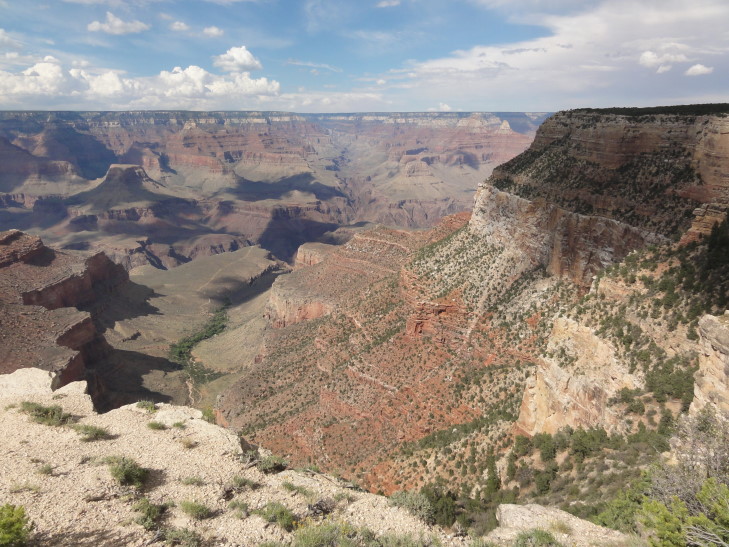
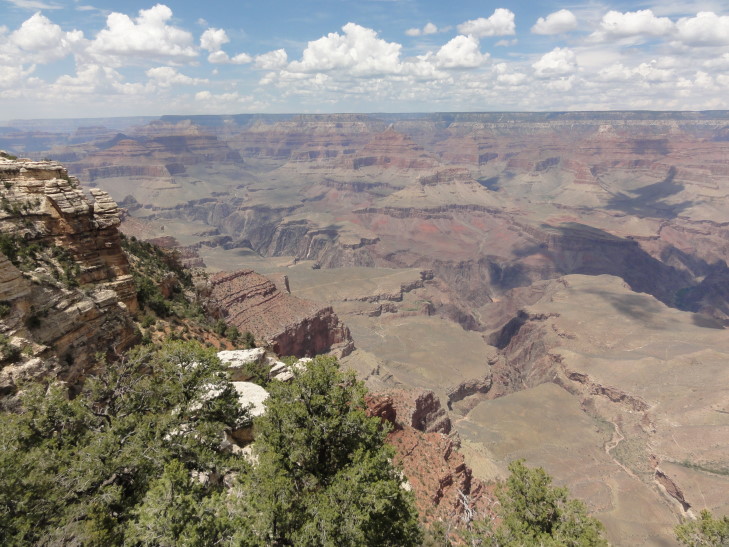
Grand Canyon at morning

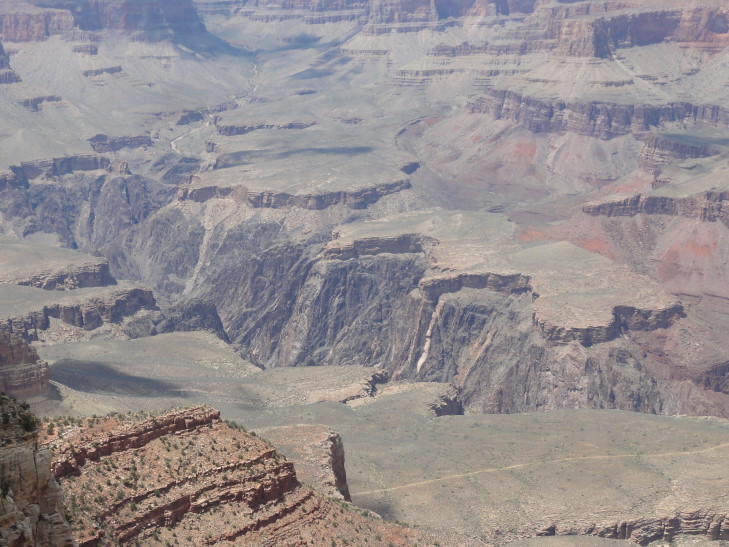
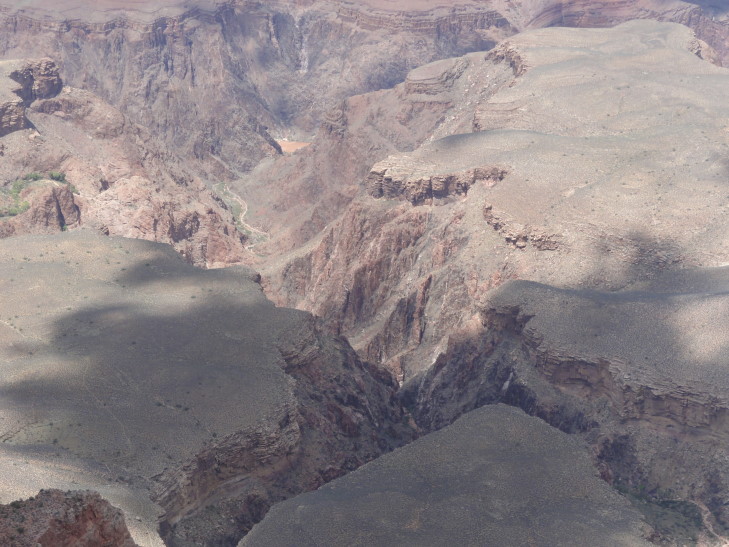
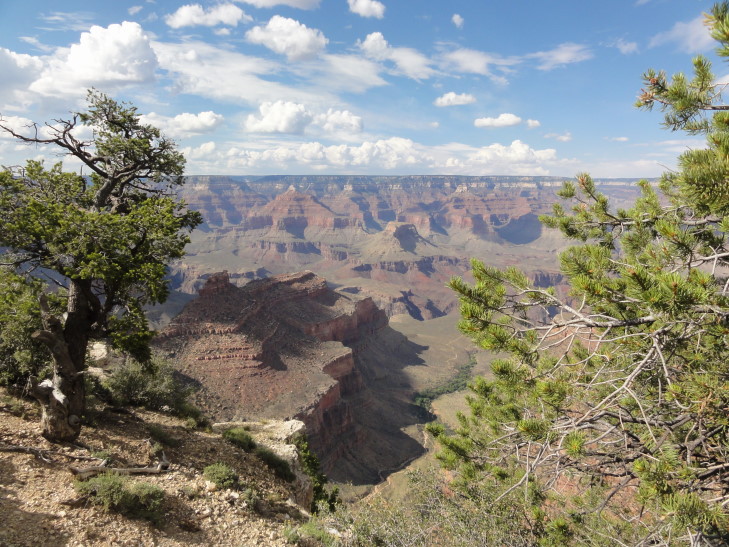
Headed back to the room and checked-out, heading toward the east entrance of the park.  We stopped at a few viewpoints, like Grandview, but they were already quite crowded.  At the very eastern part of the park is a seventy foot tall stone (with steel innards) tower built in the early 1900s and commanding an amazing view of the canyon, including a great view of the Colorado far below.  There was also a marker describing the tragic crash of two passenger planes in 1956 that killed all 128 people — and was catalyst for the founding of the FAA.

Grand Canyon from east entrance road viewpoint
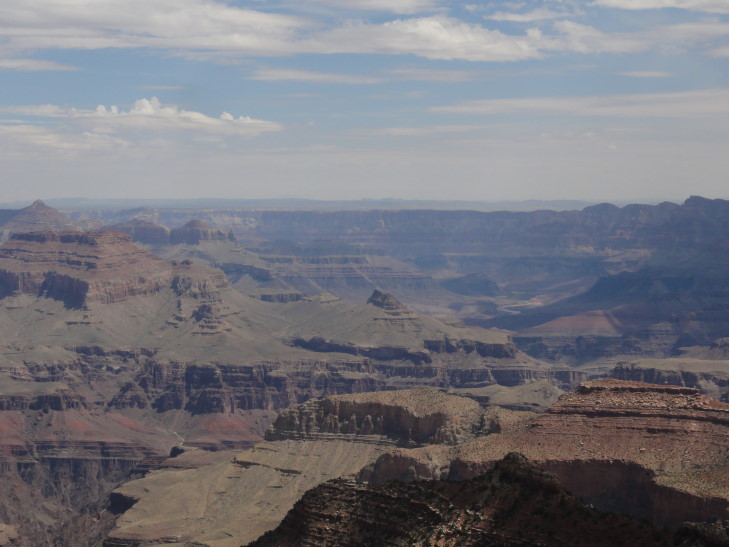
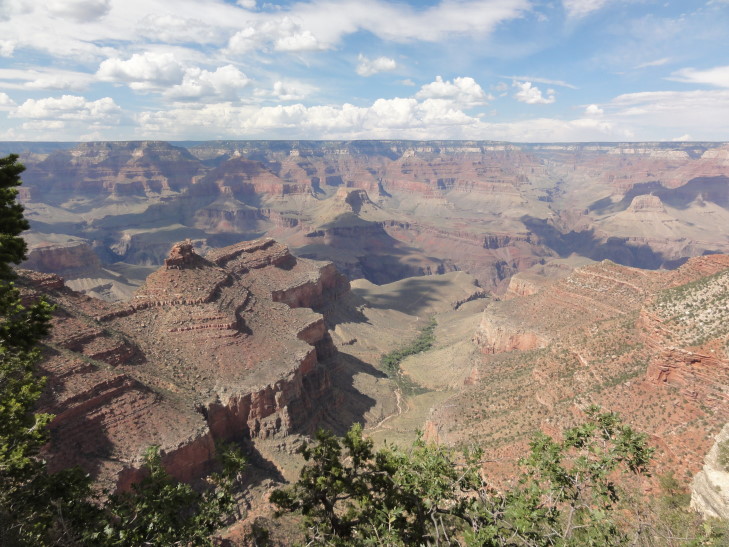
Another view of the Grand Canyon from Grandview Point
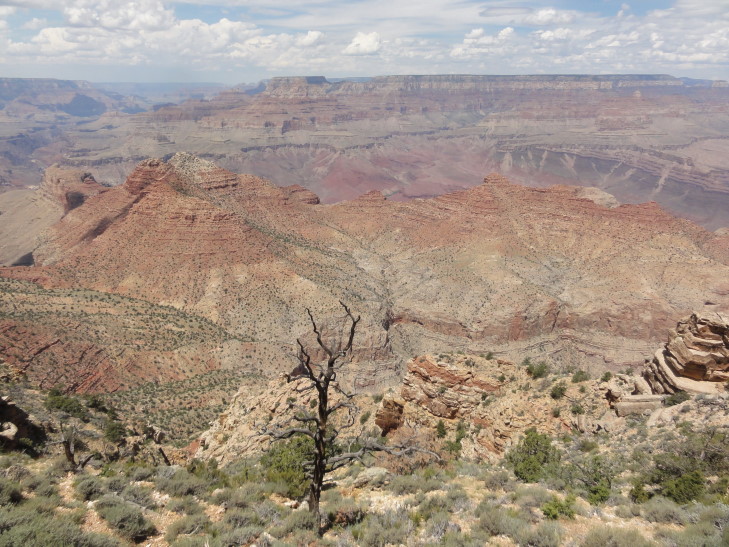
Grand Canyon from Desert View
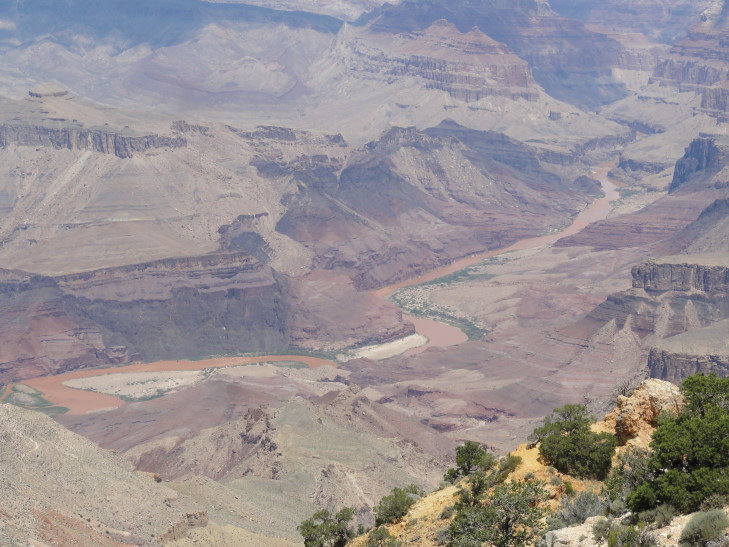
Colorado River as seen from Desert View

Addison and I climbed up to the top of the tower while the ladies remained below in a gift shop.  The steps were a bit narrow but overall not too bad.  The inside of the tower consisted of a few floors, each of which had walls painted with Indian motifs.  Very cool.  After climbing down we went to the snack bar for a quick lunch, I had a turkey and American cheese sandwich and a banana.  Yummy.

Desert View Watchtower, Grand Canyon National Park, Arizona
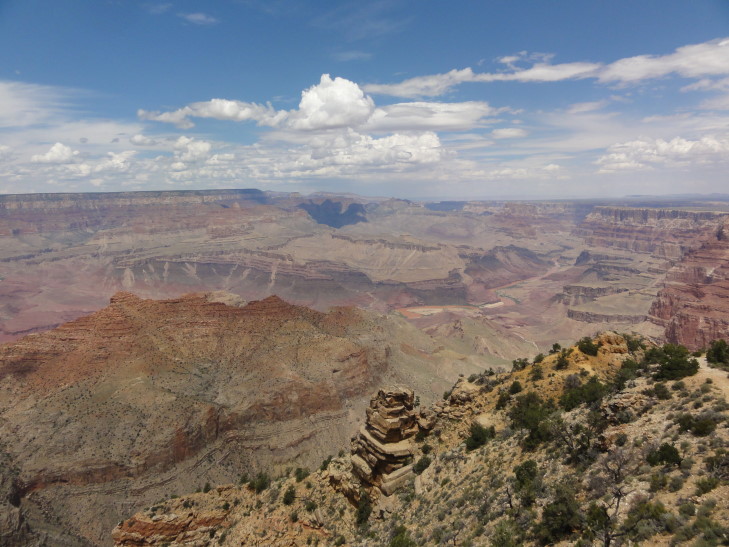
Another view of the canyon from Desert View Watchtower
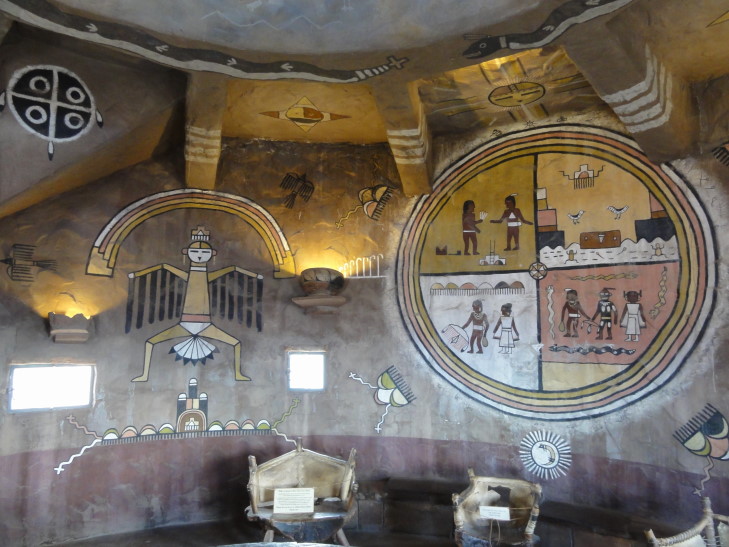
Interior of Desert View Watchtower

Hopped back into the car and left the park.  By this time an impressive thunderstorm had brewed up with lots of cloud-to-ground lightning.  We stopped at a scenic view just outside of the park near the spectacular (and very narrow, in contrast to the main canyon) gorge formed by the Little Colorado River to check out the storm.  As it started to rain (for those keeping score at home, that is 12 of 15 days of rain so far), we decided it best to hop back in the car and start driving the loop road that wound through Wupatki National Monument and Sunset Crater National Monument.

Very narrow Little Colorado River gorge

In 1085 or so there was an eruption that formed several cones, including Sunset Crater.  The material spewed from the eruptions provided fertile soil for farming, leading to several Indian groups moving to the area and staying the 150 years before the soil was depleted.  They built several pueblos in an area now encompassed by Wupatki National Monument.  The whole area is beautiful, probably helped by the rain — yellow, orange, and violet flowers contrasting with dark black soil (from the eruptions) and red rocks scattered about.  First we saw The Citadel, a pueblo built on top of a small hill.  As it was raining at quite a clip we didn’t get out and explore.  A few more miles down the road we came upon the visitor’s center.  Luckily the rain had let up so we were able to take the half mile trail around Wupatki Pueblo.
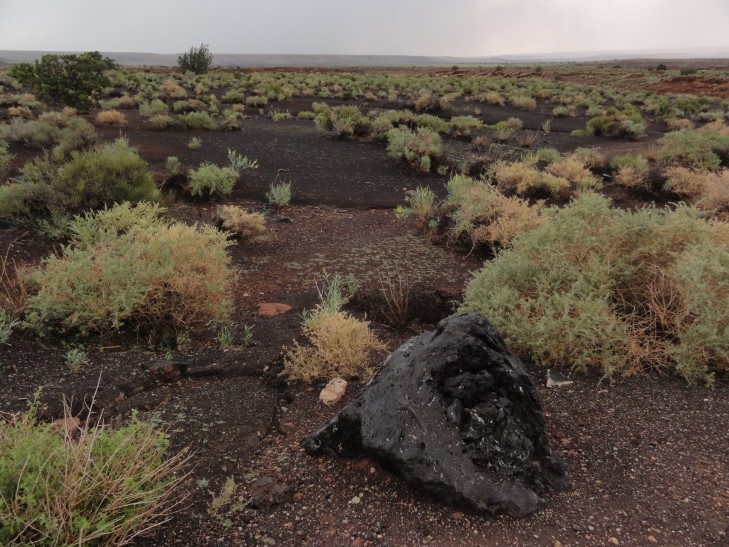
Black soil in Wupatki National Monument, Arizona

The pueblo itself had over a hundred rooms.  The ruins had been partially restored in the early 1900s and even used for the Ranger’s living quarters and monument office at the time.  That is a pretty common story, the same thing happened at Mesa Verde.  The approach of the National Park Service is quite different today — never reconstruct or rebuild.  Past the main group of rooms and down the hill there was a ceremonial building — but not a kiva as it was above ground and there was no evidence of a roof.  Further downhill was a ball court, the furthest north example.  As there had been a lot of rain recently it was filled with water.  Right next to the ball court was a “blow hole”, a natural phenomena that occurs when a narrow shaft drops into a cavern.  Depending on the air pressure the hole will either blow or suck — today it was blowing and I was amazed at the air it put out.  It was probably as good as a modern AC unit!
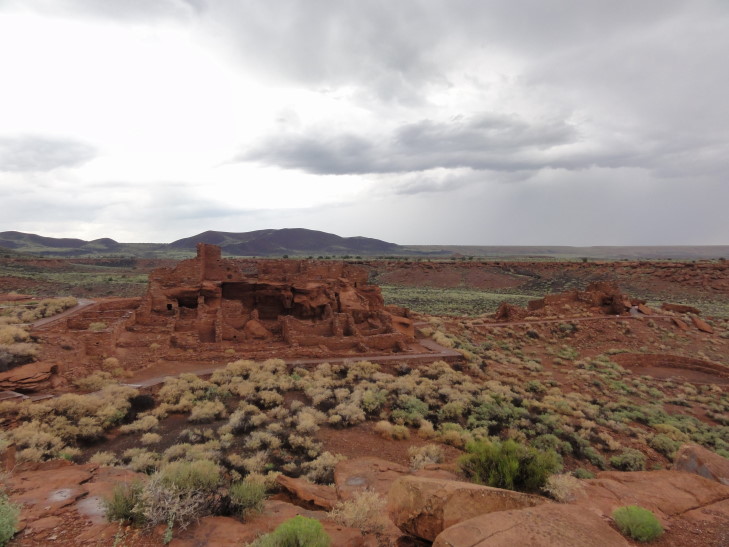
Wupatki Pueblo ruins
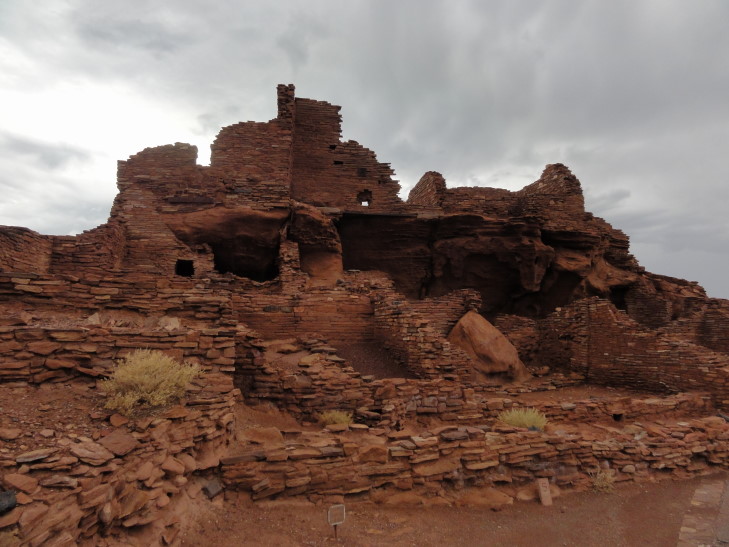
Closer view of Wupatki Pueblo ruins
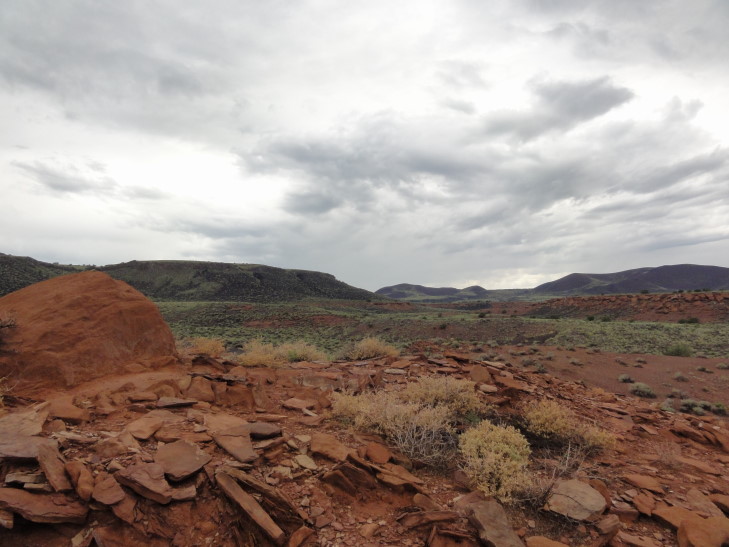
Rubble strewn about the Wupatki Pueblo ruins
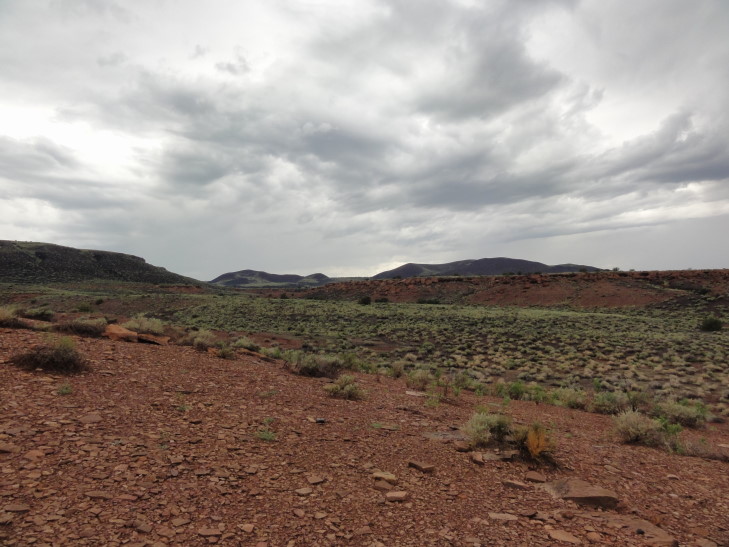
Beautiful terrain in Wupatki National Monument
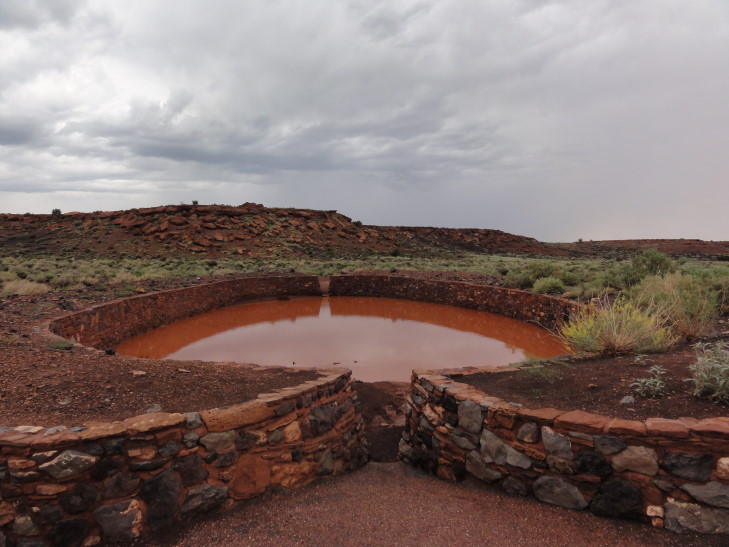
Flooded ball court in Wupatki Pueblo
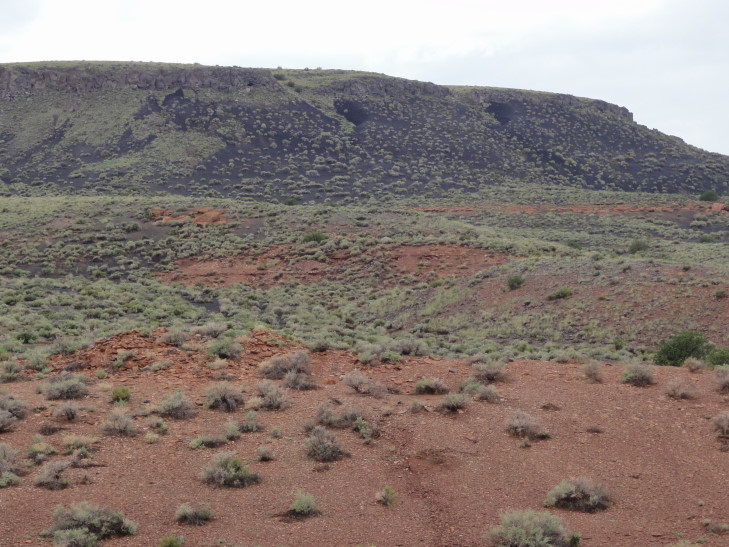
Wupatki National Monument, Arizona

The rain started up again so we got in the car and drove to the next pueblo, Wukoki, also perched on a hillside like The Citadel.  As it was raining we only took a few pictures from the parking lot and headed on out to Sunset Crater National Monument.  Sunset Crater is not hikeable but still is impressive — its colors range from black through reds to tan.  Two large lava flows occurred, leading to whole areas of missing forest occupied by sharp, jagged black rocks.  The rain continued and it was getting late so we didn’t stop.
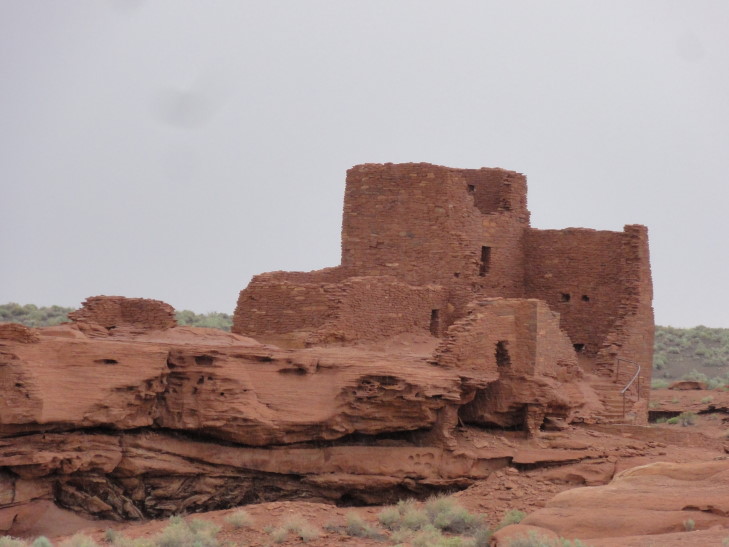
Wukoki Pueblo ruins, Wupatki National Monument

Lava flow, Sunset Crater National Monument, Arizona

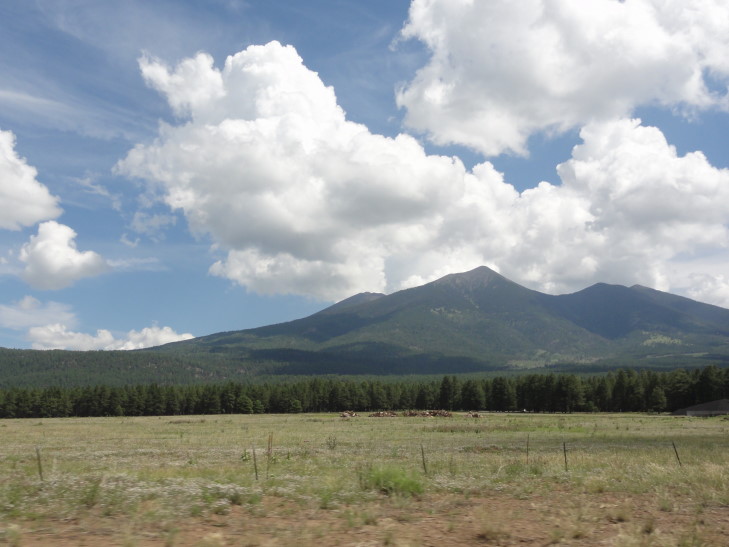
Rain clouds lifting over Humphreys Peak, Arizona

Returned to Flagstaff via route 89 then hit I-40 to Kingman, about 120 miles away.  Along the way we got some gas — $4.19/gallon.  Really?!?  Interesting change in terrain from forested hills at 6000 feet or so (and temperatures around 65F) to scrub and jagged rocky hills at 2000 feet (and temperatures nearing 100F).  Checked in to the hotel and got a recommendation for a nearby Mexican and Seafood (ruh-roh, danger!) restaurant.  It was actually quite good, I had a taco and two cheese enchiladas.  Returned to the hotel, cleaned out the car, re-packed in preparation for our flight on Tuesday, and blogged.

Route for Sunday, August 4th, 2013
August 3, 2013
Insignificant

Filed under: Travel — Tags: — BigWeather @ 11:59 pm

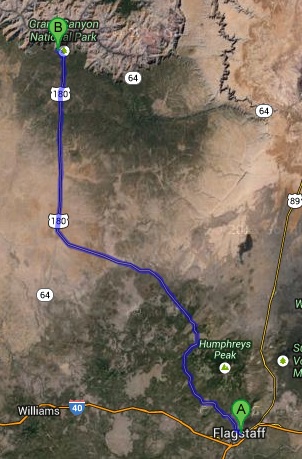
Checked out and headed out of Flagstaff on route 180.  Early on we passed Humphreys Peak, tallest point in Arizona.  After that the trees thinned out a bit and it was mostly scrub and some small trees.  There was quite a line to get into Grand Canyon National Park, mostly because people kept clogging the “pass only” lane and paying the entrance fee (which took forever, as many were paying with credit cards).  We did get in about noon, though, and parked at the visitor’s center near Grand Canyon Village.  We bought a few light sandwiches for lunch, I got a peanut butter, jelly, and honey on wheat.  None of the sandwiches were that great but at that point we’d have eaten anything.  An elk came up while we were eating — no fear at all.

Humphreys Peak, Arizona's highest point

Afterwards we walked out to Mather Point, which was packed, and took some pictures.  I think the wife and kids (who had never seen the canyon) had the same reaction I did when I first saw it in 1991 — bewilderment.  It’s just really hard to process, it’s so huge.  A full mile deep and twenty miles or so wide, and nearly 300 miles long it’s just massive.  Though the canyon itself is quite young, the rock it cuts through at the bottom is nearly two billion years old — old enough that there are no fossils as there were no significant living organisms at the time.  It made me feel so insignificant.

View from Mather Point, Grand Canyon National Park, Arizona

View from Mather Point

View from Mather Point, with a small glimpse of the Colorado River far below

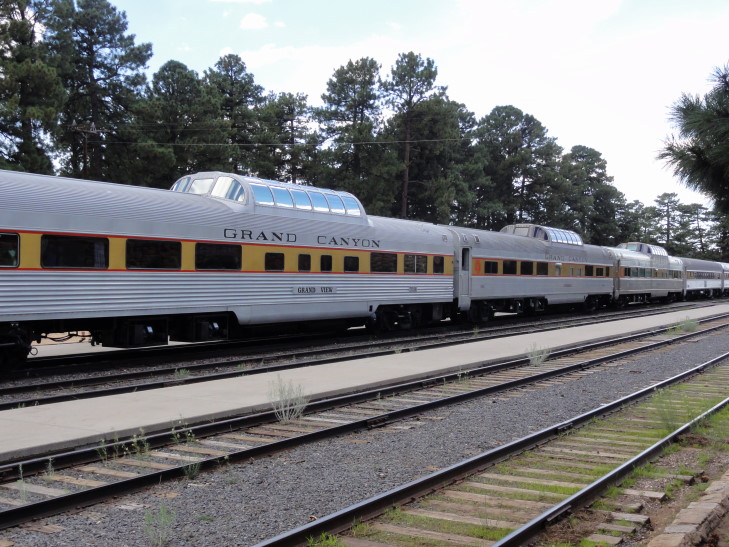
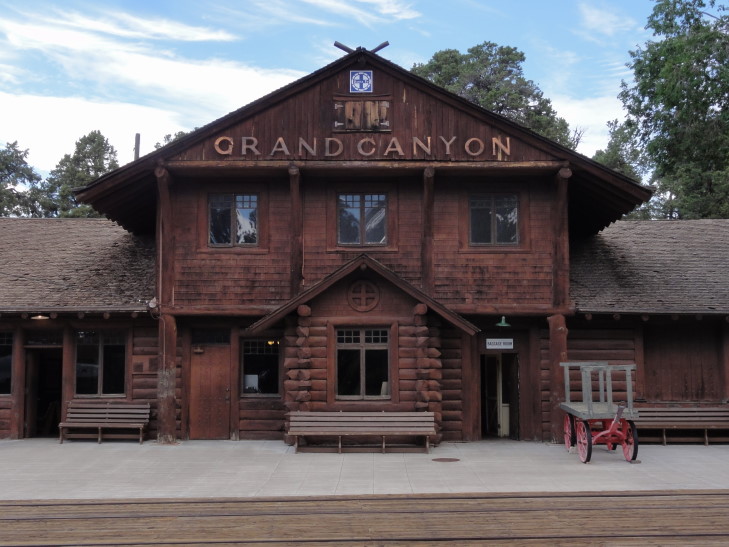
We turned back to the visitor’s center and looked through their few exhibits, including a bulky wooden boat that was used to survey the Colorado in the 1920s.  A quick trip to the gift shop yielded a few magnets (yay!) then we watched a pretty decent movie about the canyon.  Hopped back in the car and were very fortunate to find a parking space very close to our hotel, El Tovar.  El Tovar is impressive lodge built in 1905 and has hosted good ol’ Teddy Roosevelt.  We got two rooms, both on the floor below the lobby and across the hall from each other.  We decided to walk around a bit before getting all of our luggage to our rooms.  While the others went to the Hopi House, an Indian gift shop across from the hotel, I went down the small hill to take pictures of the passenger train that runs from Williams, Arizona to the Grand Canyon.  On return I went into the Hopi House briefly and saw a rather macabre book that detailed all 700+ of the deaths in the canyon since the 1800s.  On the way out I smacked my head on the top of the door — ouch!

Train running between Williams, Arizona and Grand Canyon National Park

Santa Fe Depot, built in 1909

Hopi House

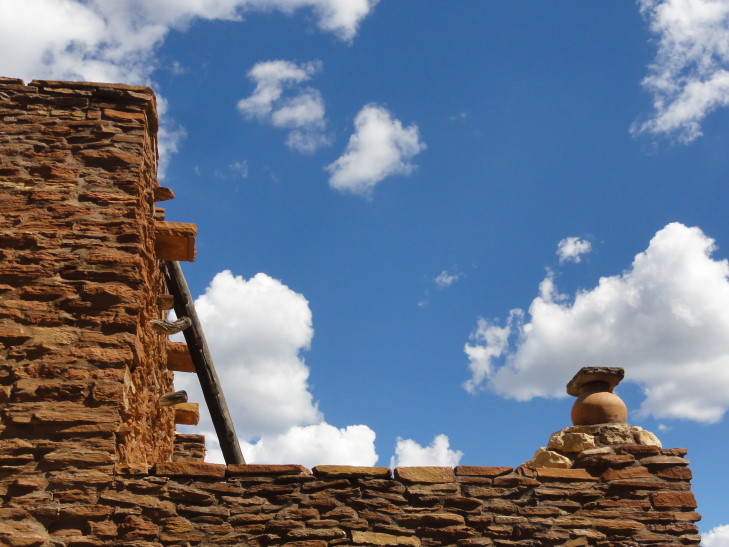
Hopi House roof

Walked a little farther to the east before turning back and grabbing our luggage.  Dropped it off in our rooms then went to dinner at the Bright Angel Lodge.  It wasn’t great, oh well.  I had pork loin and green beans so at least it was a bit healthy.  Afterwards we walked west to the Bright Angel trailhead and read about the mules they use to carry people down into the canyon, most of which are bought from farms in Tennessee.  Passed the Kolb Studio and its competitor back when the park was young, Lookout Studio.  We hung out at the Lookout a while and watched the sunset.  Genetta and I went to a lower viewpoint while Michelle and Addison stayed above.  Continued to walk back towards El Tovar as the sun set and got a espresso chip milkshake.  Yum!

View of the Grand Canyon

View of the Grand Canyon

View of the Grand Canyon

View of the Grand Canyon

View of the Grand Canyon

El Tovar, Grand Canyon Village, Arizona

El Tovar, perched on the canyon's south rim

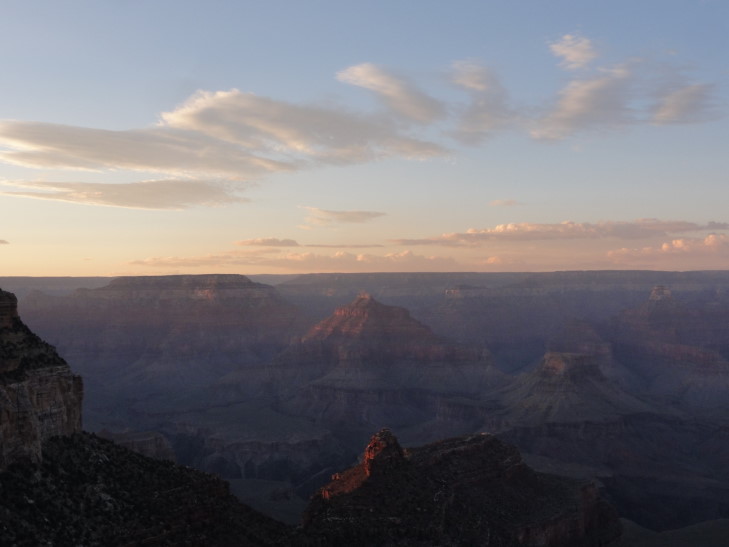
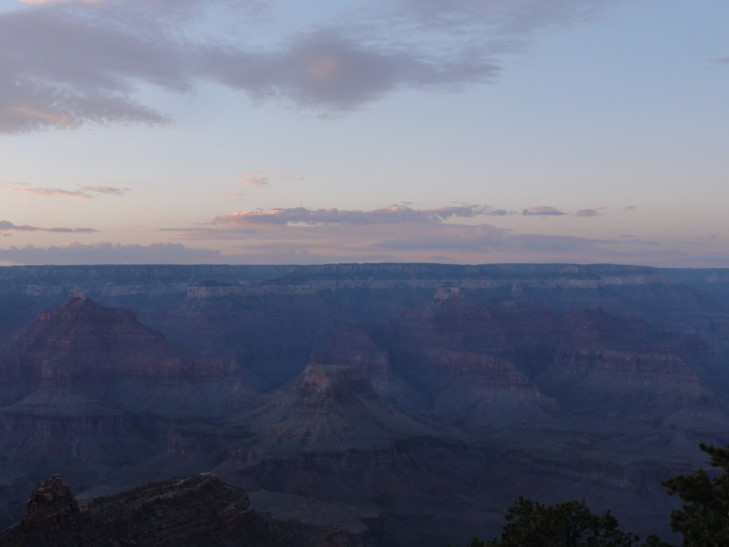
Grand Canyon at sunset

Grand Canyon at sunset

Grand Canyon at sunset

Grand Canyon at sunset

Grand Canyon at sunset

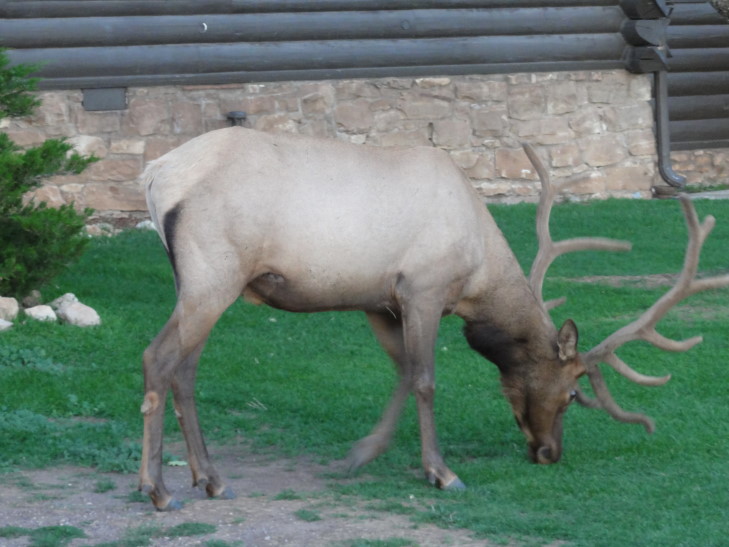
In front of El Tovar was an elk with a huge rack of antlers, then later another four elk came by.  We stayed on a bench on the rim for a while, then El Tovar’s porch, as the last of the day faded and the stars and the gorgeous milky way made me feel insignificant yet again.

Elk in front of El Tovar

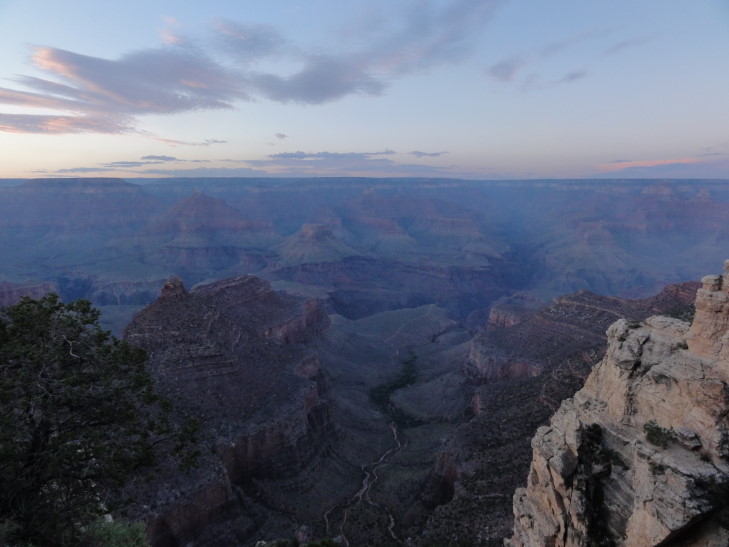
Grand Canyon at sunset

Route for Saturday, August 3rd, 2013
August 2, 2013
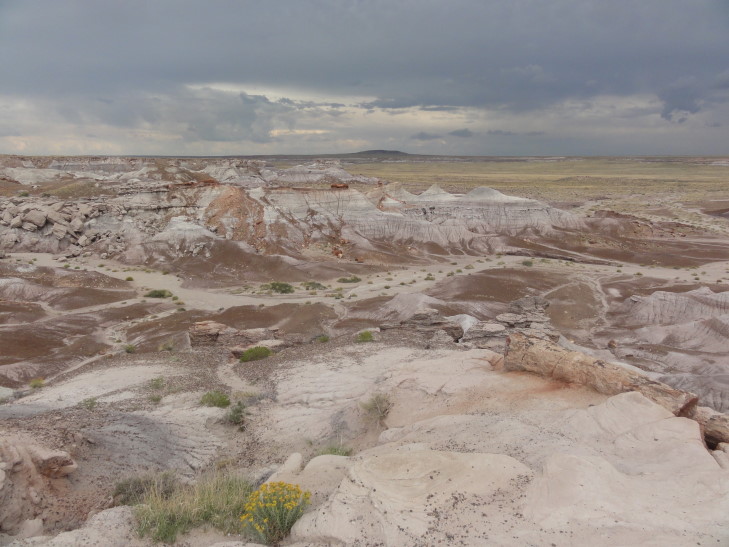
Petrified “Forest”

Filed under: Travel — Tags: — BigWeather @ 11:59 pm

We headed out a bit later than I’d have liked, mainly due to me taking my sweet time getting us packed up and out.  Took the short drive up route 77 to Holbrook (during which the terrain went from hilly and forested to barren scrub land) and then hopped on I-40 east for a few mile to the entrance to the Painted Desert part of Petrified Forest National Park.  We poked around a tiny bit in the visitor’s center and watched a film.  They had a serious of eight or so retro posters of other National Parks on the wall and it was startling to realize that we had been to every single one with the exception of Grand Canyon (well, I’ve been there, but not the whole family), and that was to be rectified on Saturday.  We really have been to a lot of cool places.  They had Yosemite, Lassen, Grand Teton, Yellowstone, Ranier, Smokey, Zion, Grand Canyon, at least represented.

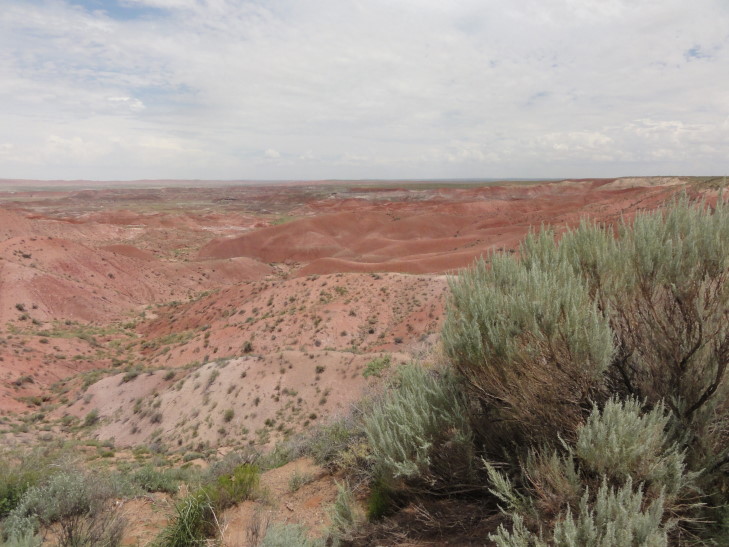
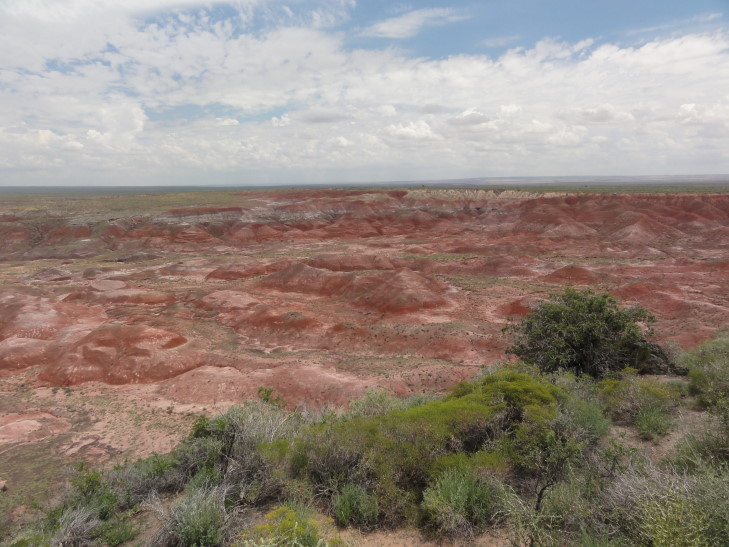
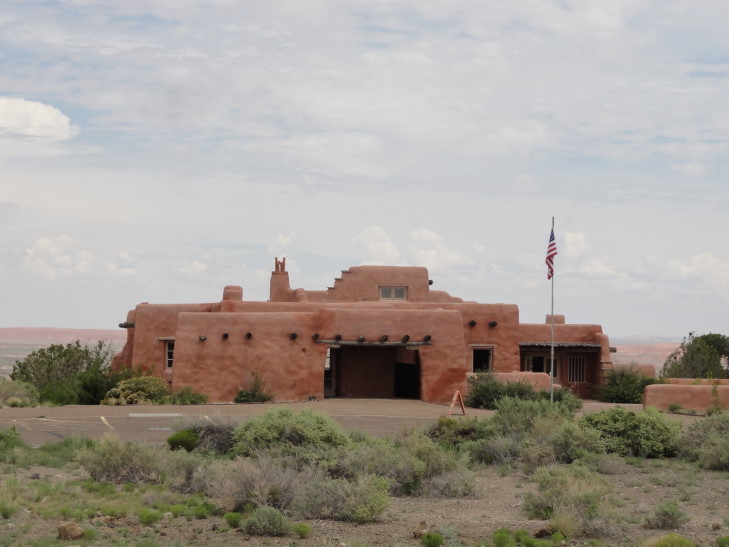
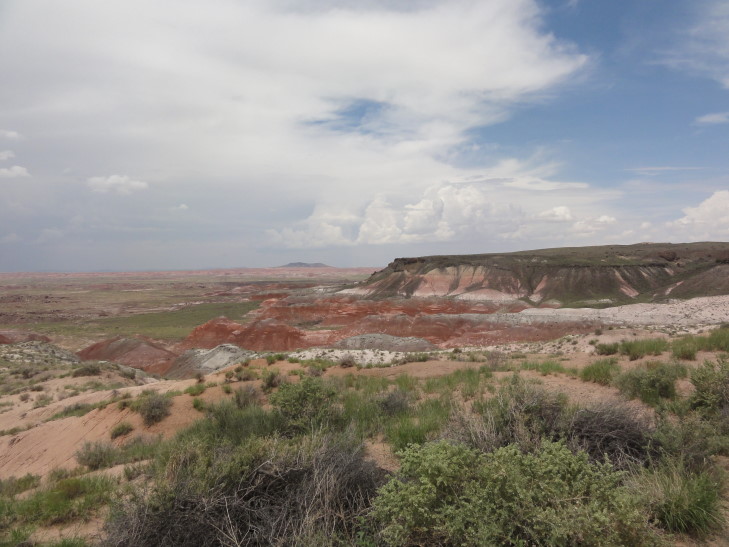
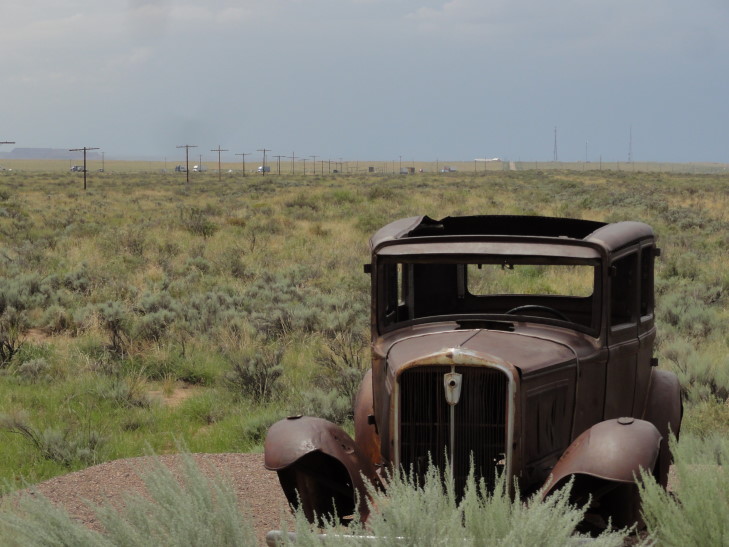
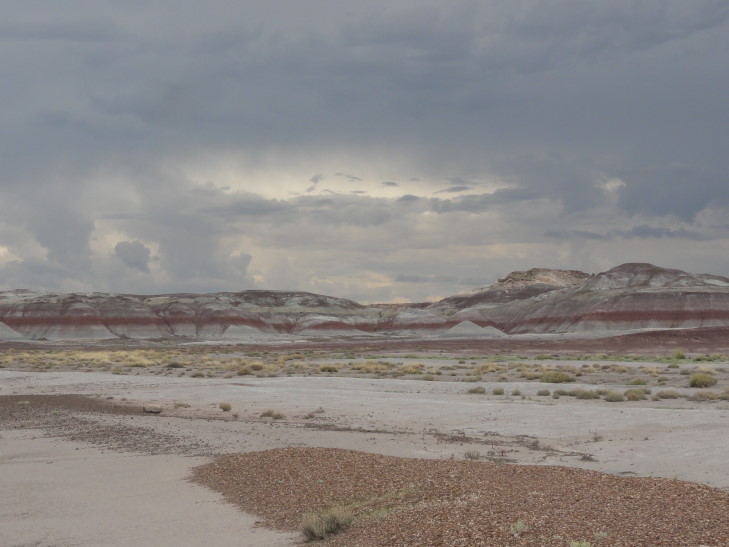
Set out in our car around the scenic drive — not a loop this time but a route that hooked around and down to the visitor’s center at the south end where the Petrified Forest part of the National Park was.  First up was the Painted Desert, coined by a Spanish explorer in the 1500s.  Amazing splashes of red and purple and beautiful views extending out a hundred or more miles to the north towards the Navajo Nation.  Also there was a beautiful old building called the Painted Desert Inn that was built in the 1930s.  Shortly before crossing I-40 and into the southern part of the park we crossed where old route 66 ran, marked by a rusty old car sitting in the grass and a chrome bumper with a plaque.

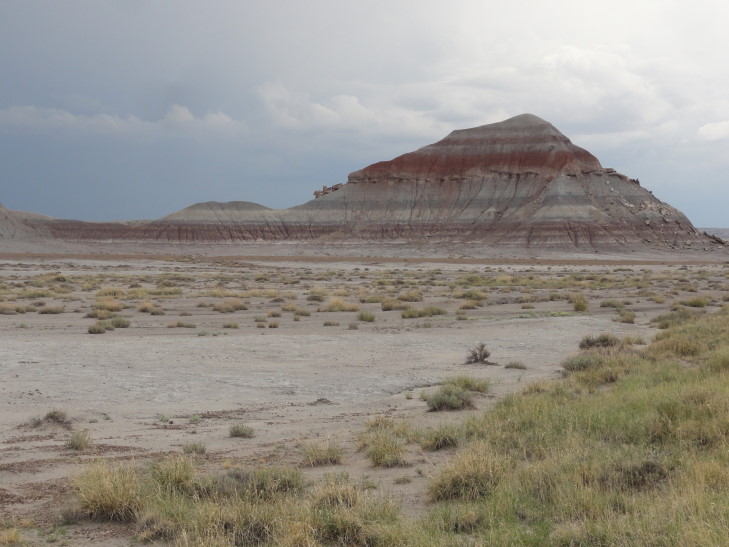
Painted Desert, Petrified Forest National Park, Arizona

Painted Desert

Painted Desert Inn, built in the 1930s

Painted Desert

Route 66 site, I-40 is in the background

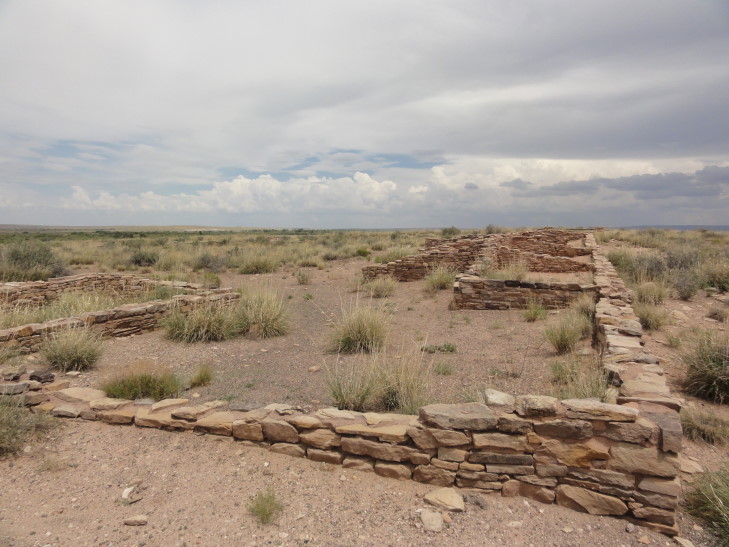
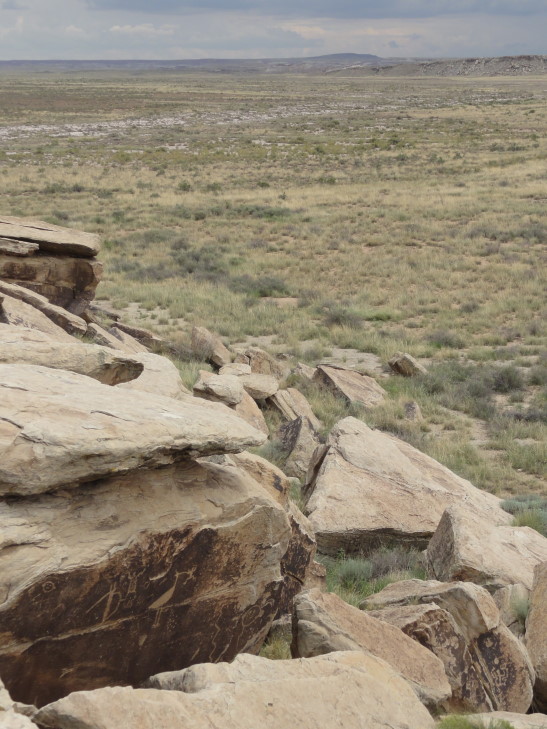
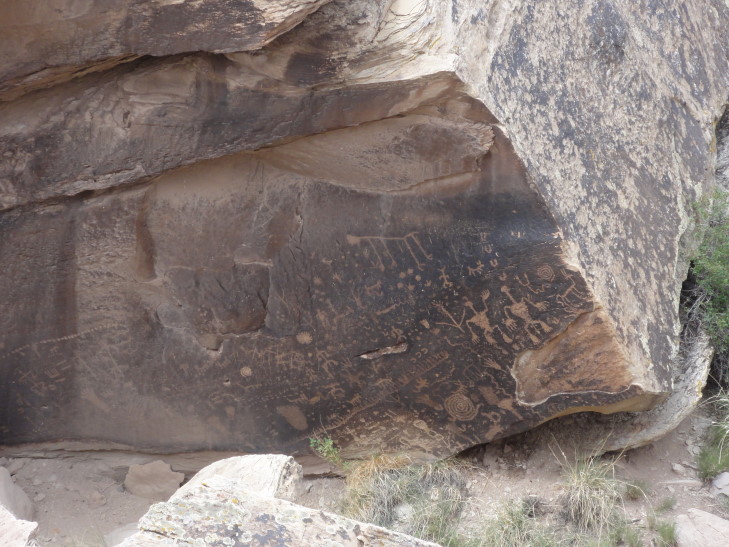
Just south of I-40 are the remains of a pueblo, Puerco Pueblo.  Home to two hundred or so people with just over one hundred rooms arranged around a central plaza, the pueblo was occupied around 1000 through 1300AD or so.  In addition to the rooms’ foundations there was also a kiva as well as a nice group of petroglyphs.  One of the petroglyphs was carved such that a beam of light would hit it at the height of the summer solstice.  There was one particularly awesome petroglyph of a ibis-like bird eating a frog (or something that looked like a frog).  Some speculated that it was just that, while others thought it may be a representation of a Hopi story about a giant bird that would eat kids that were rotten.  I like that interpretation!  To close out the Indian ruins portion of the park we visited Newspaper Rock which had even more petroglyphs but, as they were a bit further away, it wasn’t as impressive.

Puerco Pueblo ruins, Petrified Forest National Park, Arizona

At the bottom is the petroglyph of the Ibis and the Frog (or Child...)

Shale (?) rock

Petroglyphs at Newspaper Rock in Petrfied Forest National Park

View near Newspaper Rock

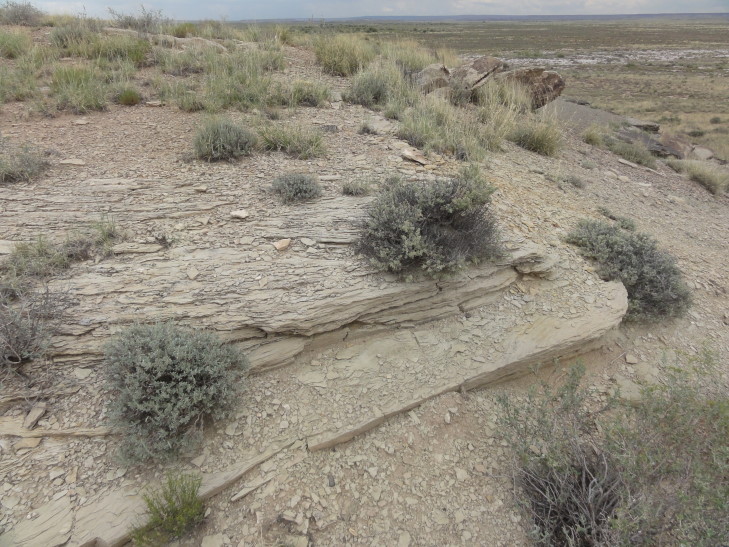
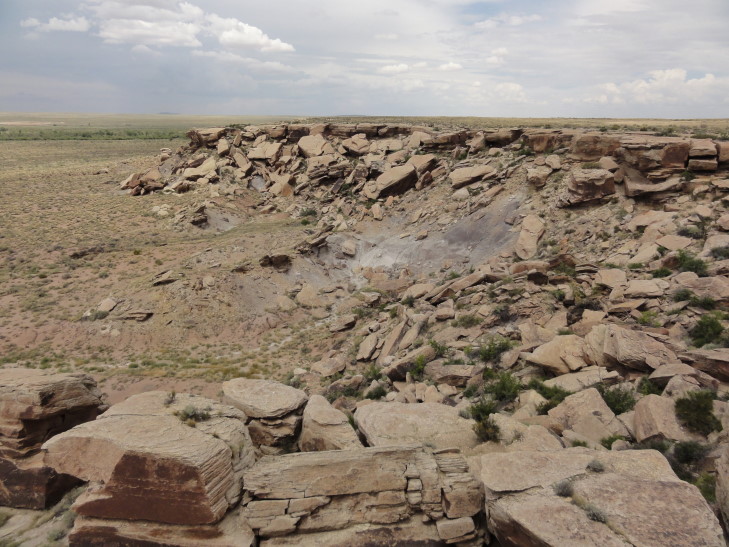
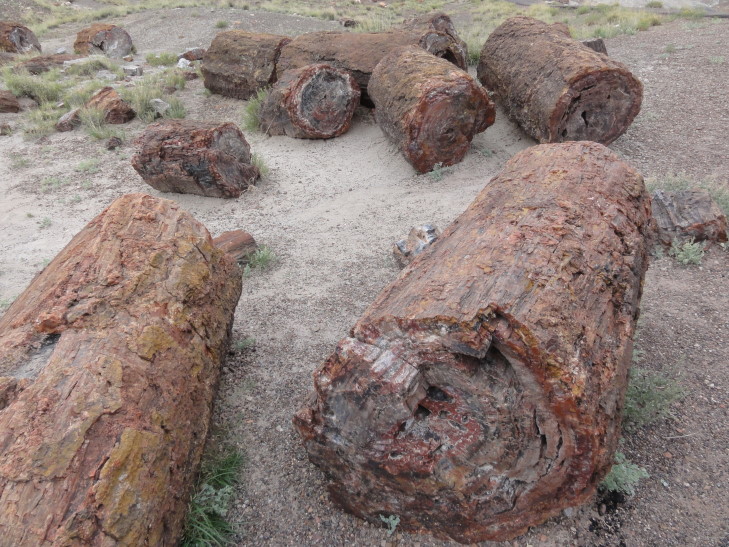
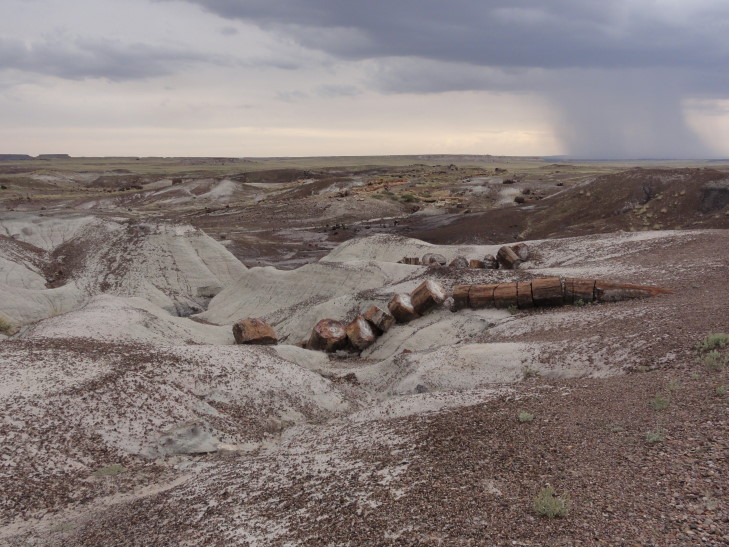
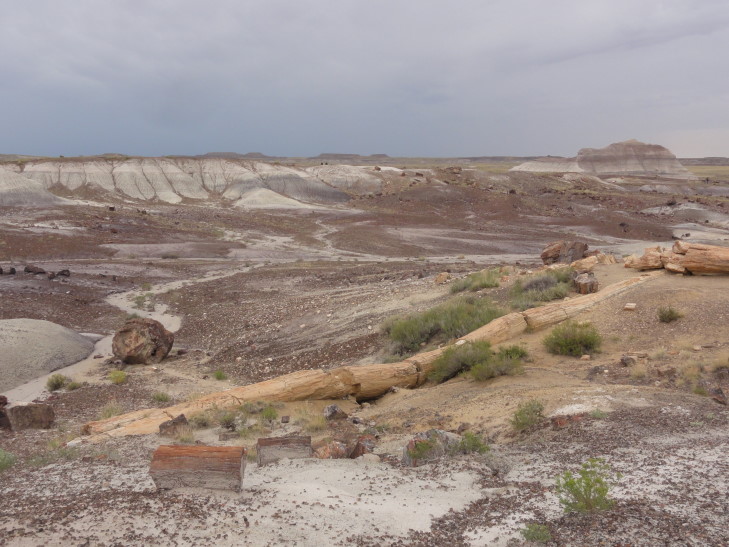
The southernmost portion of the park is the whole reason the park exists in the first place — the petrified forest.  It isn’t really a forest, but rather more like a petrified log fall.  None of the logs are standing, rather they are part of a three hundred foot deep layer — a forest 225 million years ago that was covered and had the organic wood replaced with minerals.  As the badlands are constantly eroding they reveal more and more of the petrified wood.  In the late-1800s and early-1900s tourism greatly increased and much of the petrified wood then visible was removed — sometimes even by dynamite to get to amethyst and quartz crystals in the petrified logs.  The government finally stepped in and set aside the area as a National Park in the early 1900s.

Beautiful colors in Petrified Forest Nationall Park

Beautiful colors in Petrified Forest Nationall Park

Blue Mesa area, note the log in the middle just laying there

View from Blue Mesa area of Petrified Forest National Park

More views near Blue Mesa

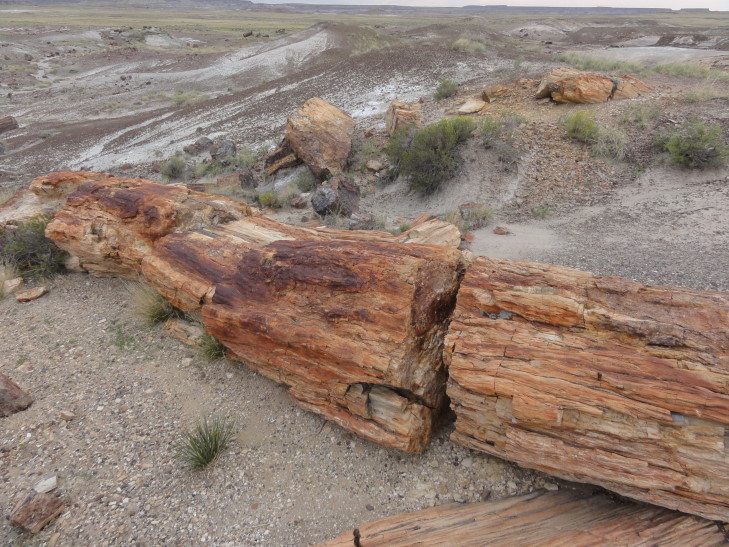
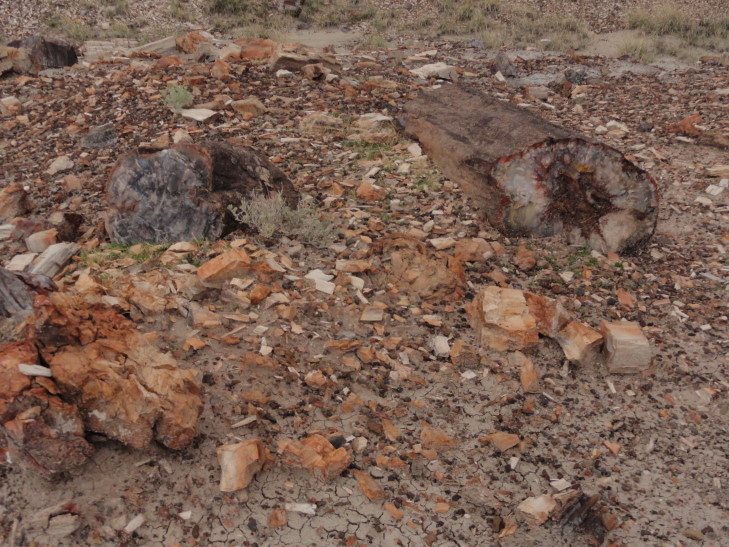
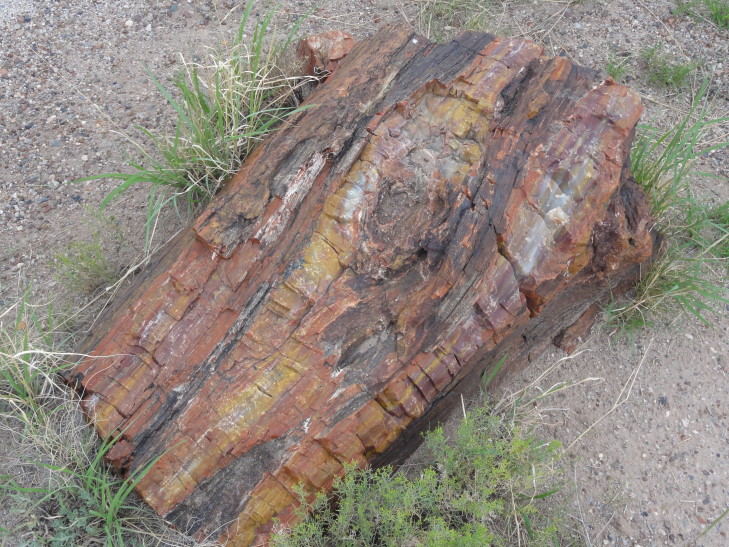
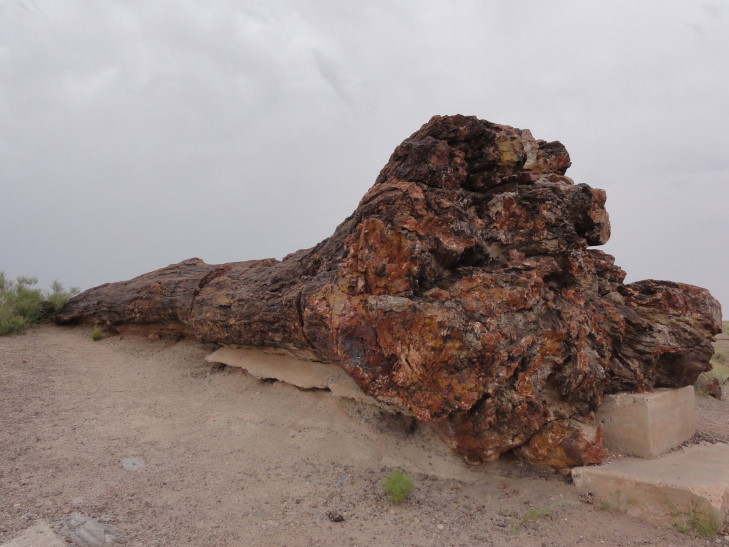
The logs were really colorful and it was remarkable how much they did look like wood.  I particularly liked the logs just being exposed, barely seen above the grass and shrubs.  We saw whole valleys with hundreds of pieces of logs strewn about.  Amazing.  At the very southern tip of the park we saw “Old Faithful”, the largest petrified log in the park.  The visitor’s center there also had a small, but fascinating, overview of the fossil record of the park and informed us that the National Park is the home of several holotypes, meaning the first ever fossil found for that species.

Petrified logs

Close-up of colorful petrified logs

Petrified log splitting apart

More petrified logs

Petrified log

Petrified log and "chips" that flaked off of it

Beautiful color

"Old Faithful", largest petrified log in the National Park

The rain that had been threatening for the past few hours — with ominous gray skies and jagged cloud-to-ground lightning (not fun when you realize you are — by far — the tallest thing around) and a wonderful cool breeze — finally broke.  Perfect timing, we piled into the car and headed back to Holbrook via route 180 then hit I-40 to the road to Meteor Crater.

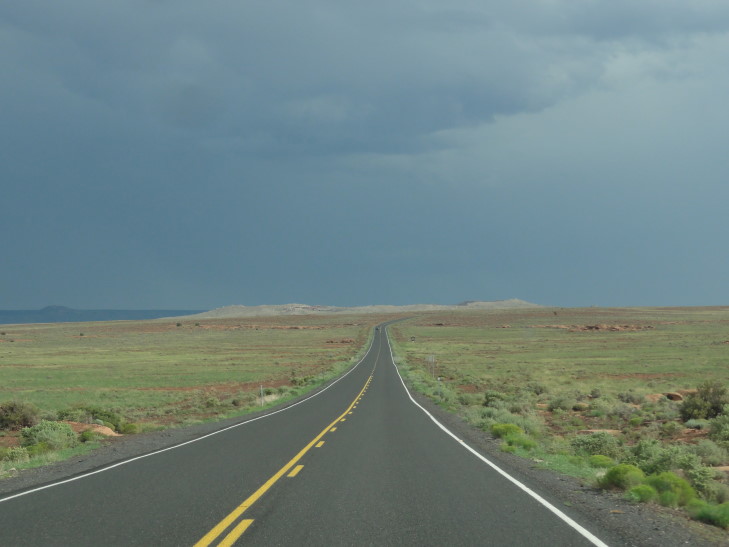
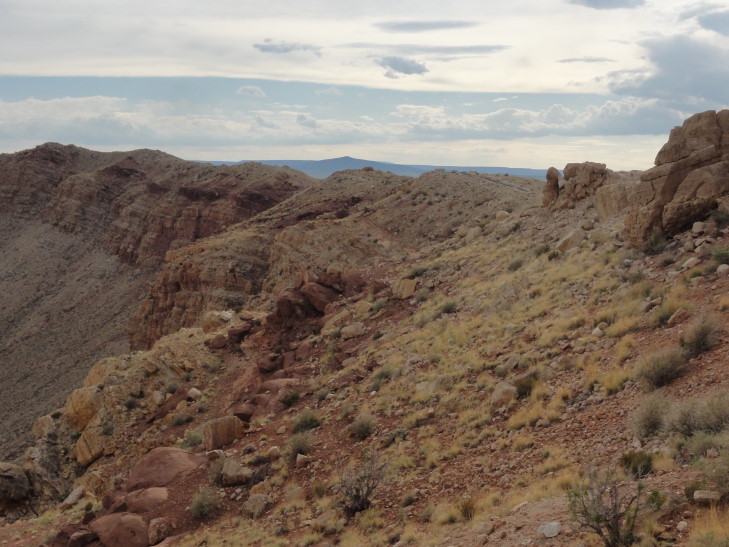
As we approached the crater from the north we could clearly see the rim of the crater rising up above the open scrub land.  After paying a princely sum of $48 for the four of us to enter we poked around the museum and saw a movie.  The museum wasn’t bad, actually, and Addison had fun using a simulator to create meteors and test the effects of their impact.  It also showed where other impact craters could be found around the world as well as the effects of a comet being captured by Jupiter, torn apart, then impacting on the surface — one of the 22 impacts from the torn-apart comet created an Earth-sized impact zone.  Also I didn’t know that Gene Shoemaker, geologist and planetary scientist, had wanted to go to the moon but had a medical condition that prevented it.  When he died, however, he became the first person to be laid to rest on another celestial body when some of his ashes were carried to the moon by a probe.  In life he had helped train some of the Apollo astronauts at the crater in preparation for their moon landing.

Meteor Crater as seen from the approach road

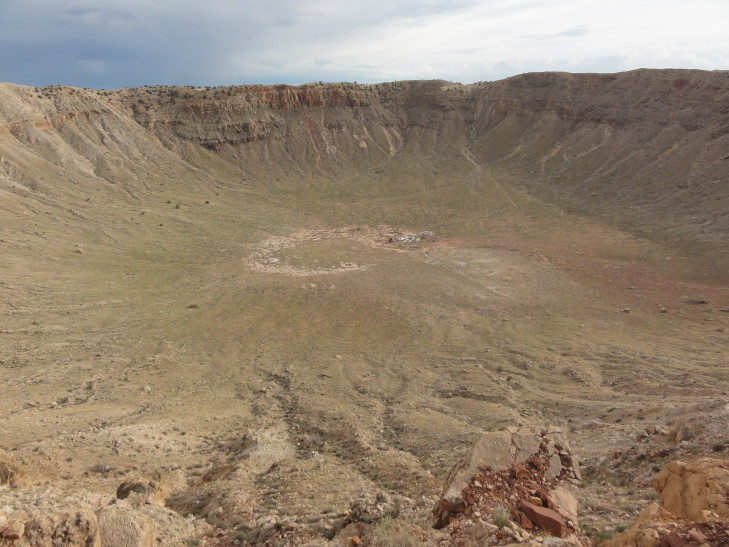
The meteor that created the crater was moving about 40,000 miles per hour and was 150 feet in diameter and struck about 50,000 years ago.  Only a small fragment has been recovered, the rest having vaporized in the atmosphere or been pulverized on impact.  On impact a 500km/h wind carrying some molten material would’ve washed over the area.  Ouch!  The crater itself is nearly a mile in diameter and 550 feet deep, though it was originally about 700 feet deep.  Twenty football games could be held in the crater at once, with two million spectators on the slopes.  Putting it another way, the central business district of San Francisco would fit in the crater and the Washington Monument, if placed at the center of the crater, would not peek above the rim.

The crater was very impressive, though very, very windy.  There were three observation platforms to visit, and great pictures to take, though it proved impossible to get without taking a panoramic photo due to its width.  I actually wished for a coat.  As the crater was nearing closing time we hit the road for Flagstaff.

Meteor Crater, Arizona

Rim of Meteor Crater

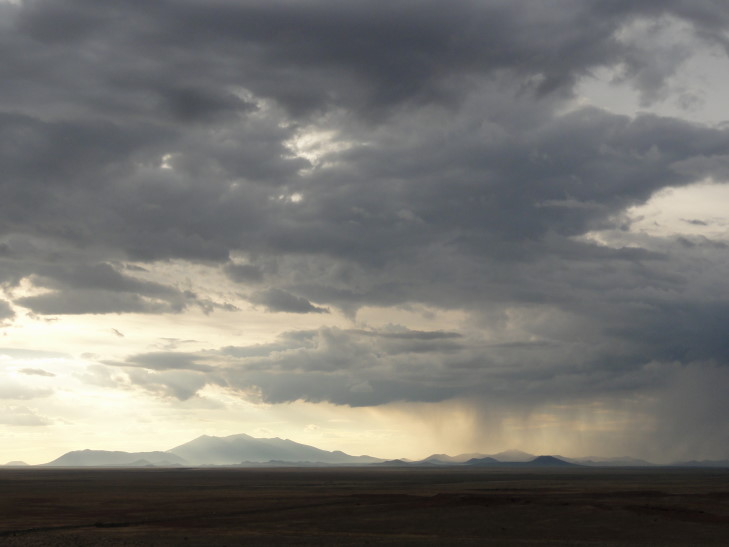
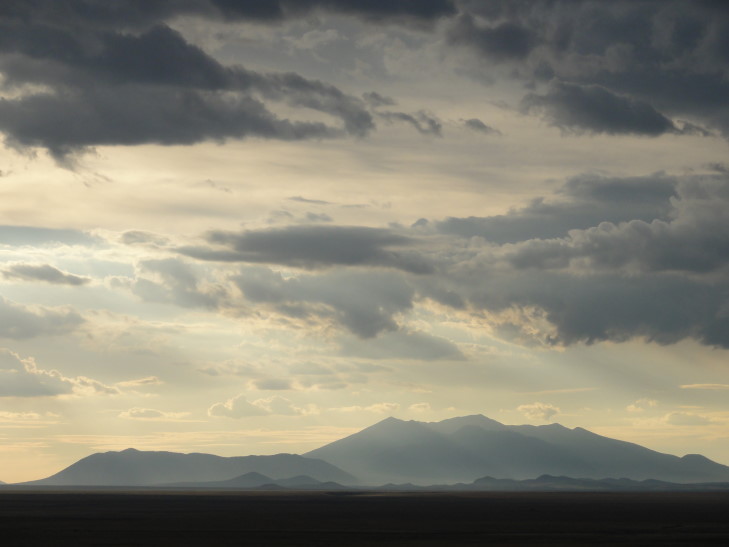
Along the way to Flagstaff we saw the most beautiful sunset right behind Humphreys Peak, largest mountain in Arizona at about 12,600 feet.  As Flagstaff is already over a mile in elevation it doesn’t look that tall from the road.  Arrived in Flagstaff before 8p and decided to eat at the Outback practically adjacent to our hotel.  Great food!  Fully satiated, headed to the hotel to check-in and blog the day’s events.

Stormy sunset over Humphreys Peak, Arizona

Sunset over Humphreys Peak, Arizona

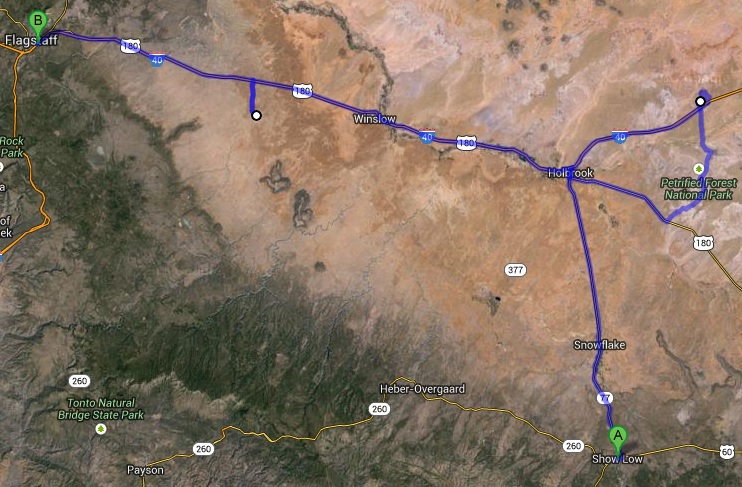
Route for Friday, August 2nd, 2013
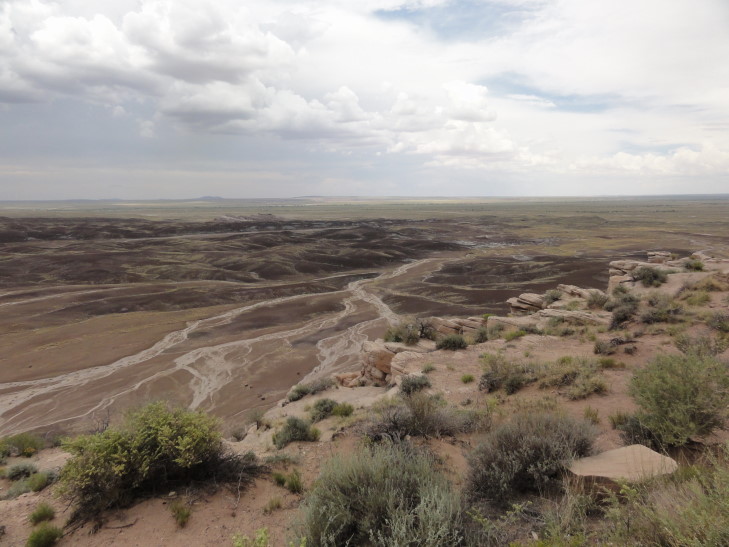
August 1, 2013
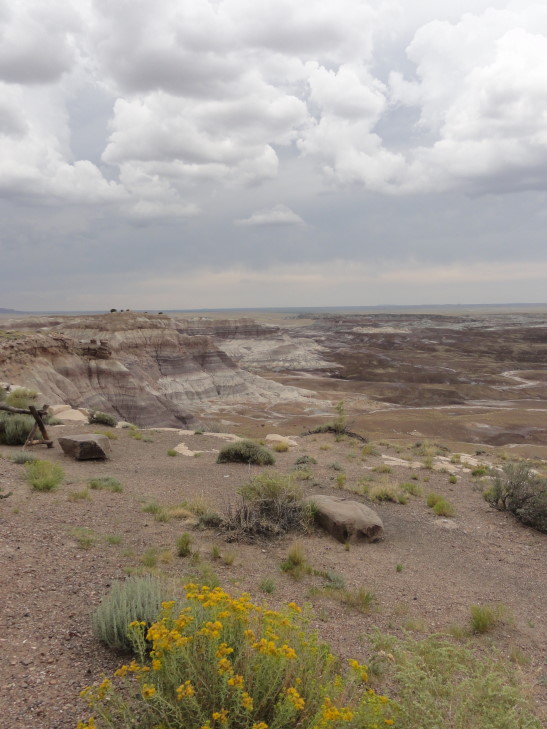
Free Room and Board

Filed under: Travel — Tags: — BigWeather @ 11:59 pm

Since yesterday was so light in terms of activities we got started super early.  After eating our Holiday Inn Express buffet (which was quite good) and checking out we headed out.  Saw a ton of Sonora, Mexico license plates in the hotel parking lot.  Headed south of Tucson to the Mission San Xavier del Bac, called the “White Dove of the Desert” by Ansel Adams.  Interestingly, the signs to the mission gave their distance in kilometers and not miles.

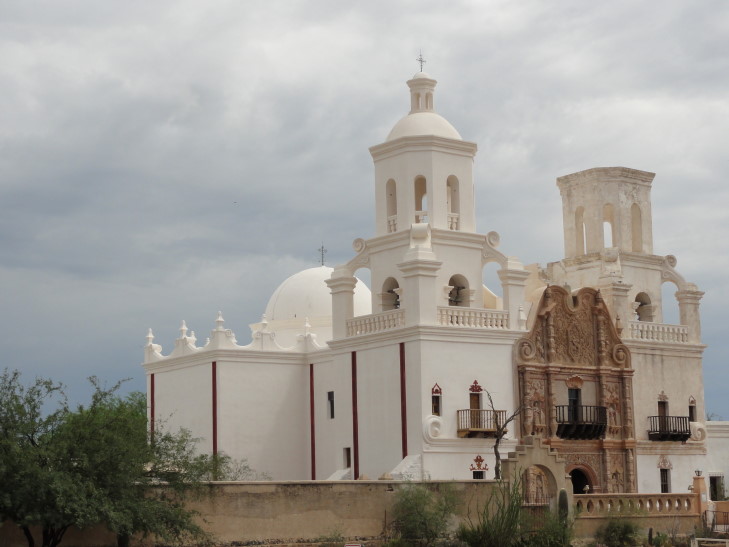
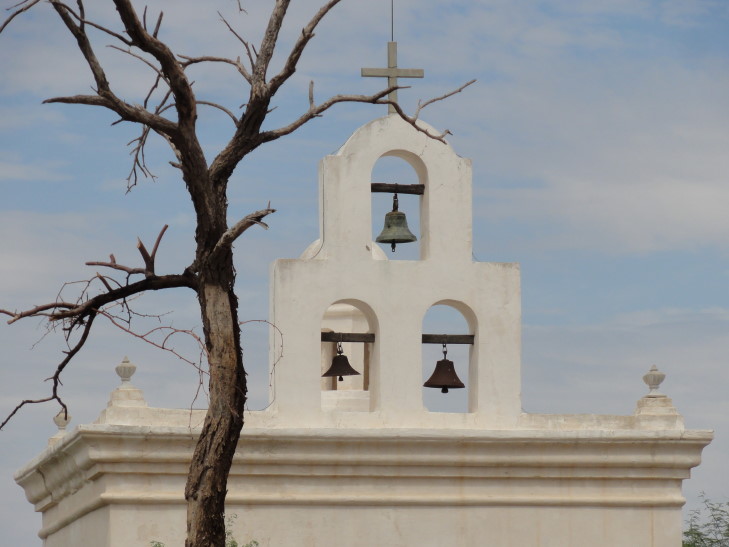
We got our first view of the mission from a distance.  Quite spectacular, particularly because it is not surrounded by tons of restaurants and businesses since it is located on a reservation.  As it is summer the crowds were quite light.  We visited the church and then the museum by ourselves, learning that it was founded by Jesuits in the early 1700s but the original mission was destroyed and re-built in the late 1700s (and by that time the Jesuits had been expelled by the Spanish crown, so the Franciscans replaced them).  The mission was founded by the Jesuit priest Kino, who extensively explored the southwest and northern Mexico and founded at least twenty missions.  Mom would be proud, I noted a plaque that used “effected” instead of “affected” and cringed…

Mission San Xavier del Bac south of Tucson, Arizona

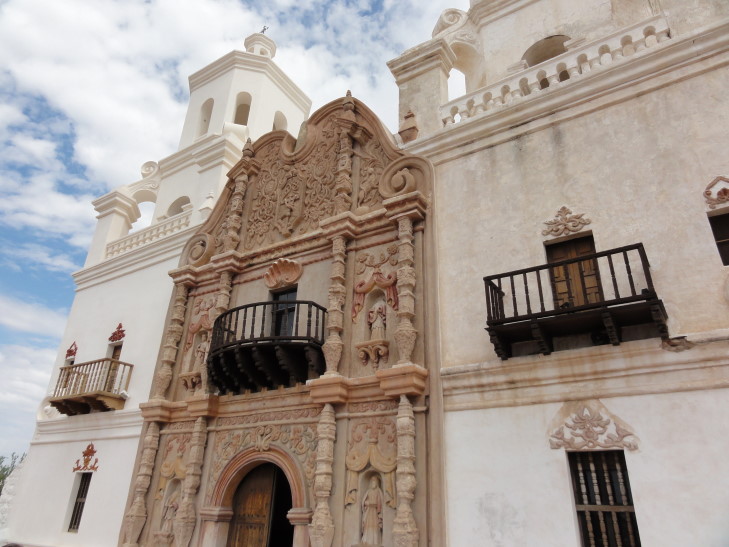
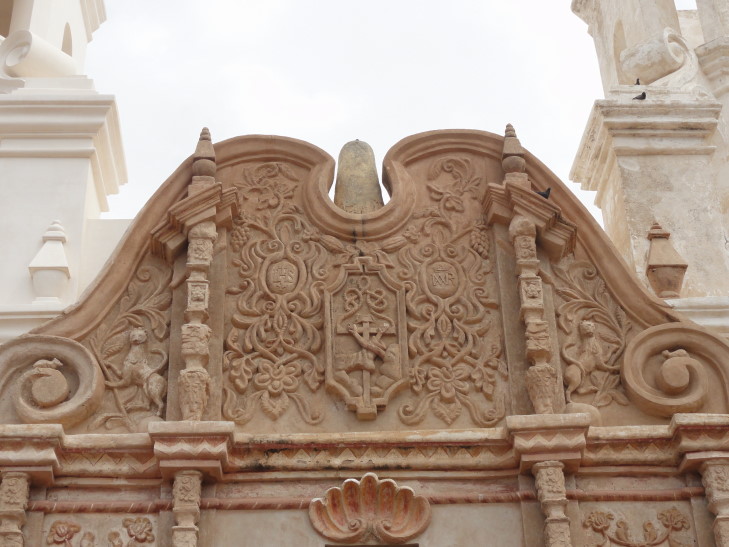
Close-up of the Mission entrance

Mortuary Chapel, Missino San Xavier del Bac

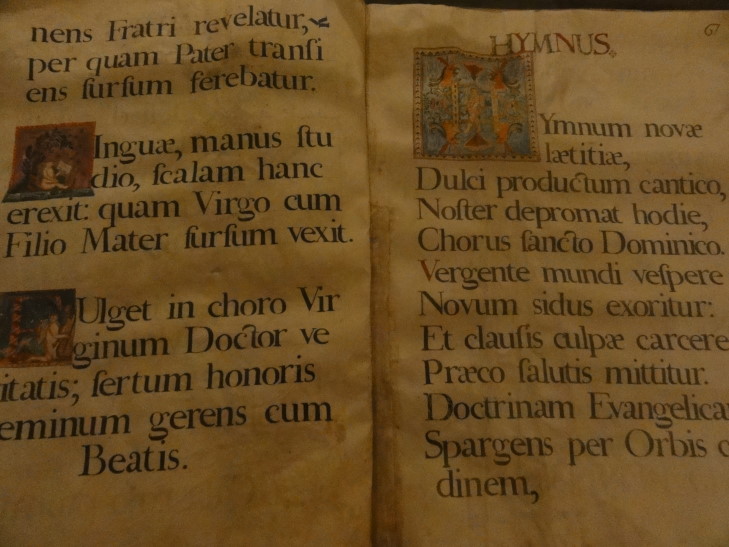
Just as we were sitting down to a film about the mission the call went out that a free tour was assembling.  Despite the kids’ (oh, OK, Addison’s) objection we decided to join it.  The guide, a former professor at the University of Arizona who had moved to Tucson thirteen years prior and was a member of the mission, was excellent.  He first led us through the museum and pointed out that Kino was Italian and had nearly died at 18.  He promised if he recovered from his illness that he would join the Jesuits.  Though he had hoped to be assigned to the Orient he was instead sent to the New World.  He made the best of it as he contributed significantly to the body of knowledge about the southwest and was also the one that proved that California is not an island.

Beautiful text at the Mission's museum

The original mission had fallen into ruin and was replaced in the late 1700s with a new one.  That too fell into disrepair due to the Mexican Revolution in the 1820s and then the subsequent transfer of modern-day southern Arizona to the United States due to the Gadsden Purchase in 1853.  The mission was used for shelter for years, the campfires’ soot blackening the walls.  It was saved from complete ruin by the Bishop of Tucson in the early 1900s.  Restoration in the 1990s removed much of the soot staining and some prior well-intentioned but poorly executed repairs.

Petitioners make pilgrimages to the mission and leave milagros, or charms, pinned to a statue of Saint Xavier.  The charms are often fashioned to look like the thing that needs help — arms, hearts, homes, etc.

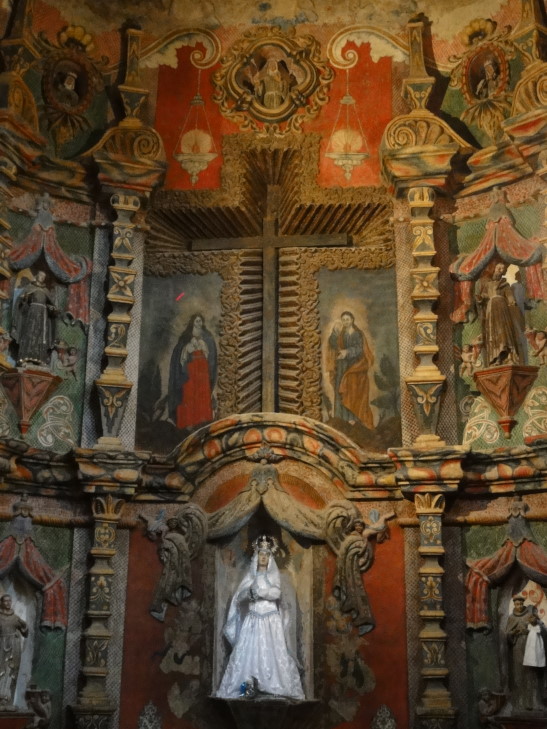
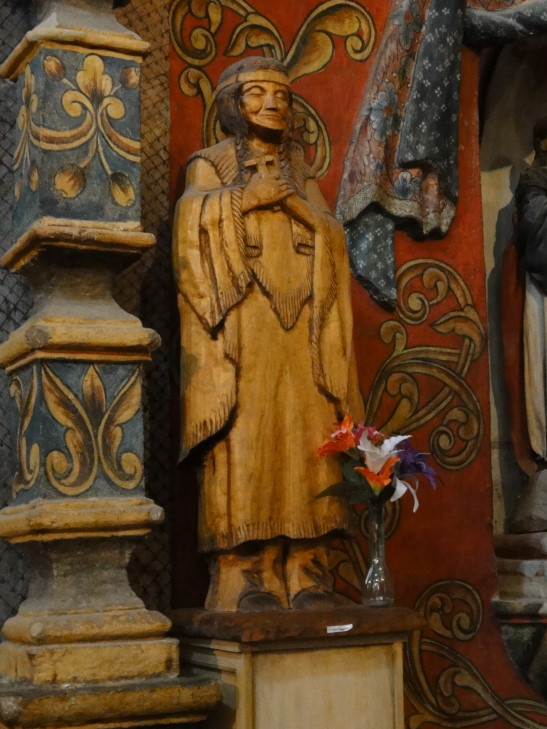
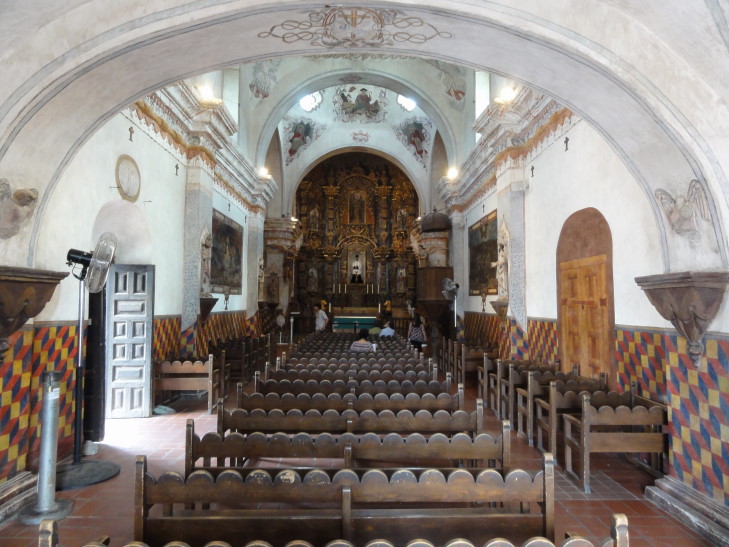
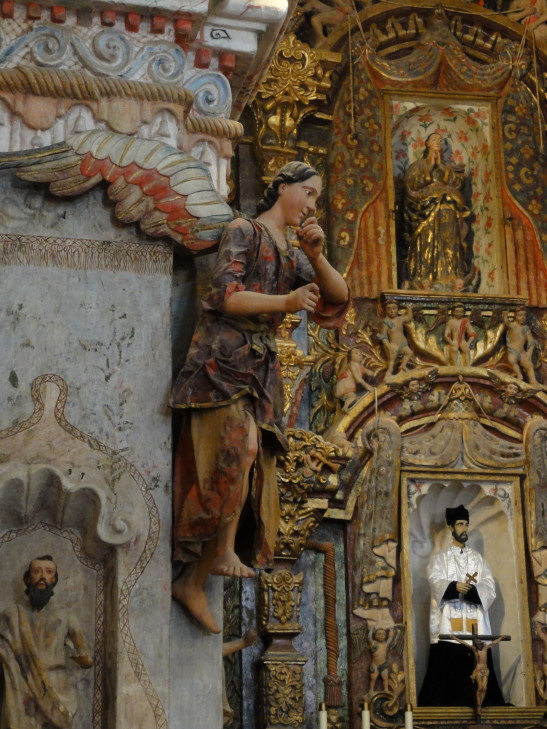
The guide pointed out many interesting things about the church itself.  The architecture and gutters of the mission heavily borrowed from Moor influences and the interior was baroque.  The altar was adorned with a cloth with a native symbol of a person in a maze.  There were two golden lions, said to represent the kingdoms of Aragon and Castille, on either side of the altar.  These, however, were not original — the originals were stolen in the 1980s by a man that was taken in by the mission and doing odd jobs (shades of Jean Valjean).  A local artist commissioned new lions from a carver of carousel animals and painted them — turns out she is the mother of Gabrielle Giffords, the Arizona Representative shot a few years back.  The church, being poor (they could not afford to finish their right tower), painted tile work on the walls as well as picture frames around their murals because they could not afford real tiles or wooden frames.  In order to have the mission be as symmetrical as possible if there was a door on one side but not the other they’d paint a door on the wall.  Finally, the church had a statue of a Mohawk woman that died of smallpox and was later sainted — St. Kateri — who has since become the patron saint of Indians.

Mission San Xavier del Bac nave

Statue of Saint Kateri, patron saint of Indians

Interior, note the painted "tile" and door (for symmetry)

Interior, the statue in the white robes predates the current church built in the late 1700s

Outside, the front of the church had a cat carved on one side and a mouse on the other, the cat about to pounce on the mouse.  Little details like that, or the mesquite doors’ handles being snakes or the rainbow carved over the doors, were really neat.  After a few more pictures we decided it was time to head out and headed north and west towards Saguaro National Park West located to the west of Tucson.  Just before getting to the park we passed Old Tucson, a place where several famous movies had been filmed like the Three Amigos and Outlaw Josey Wales.  Unfortunately it was closed for the season.

Close-up of the entrance, note the cat on the right and the mouse on the left

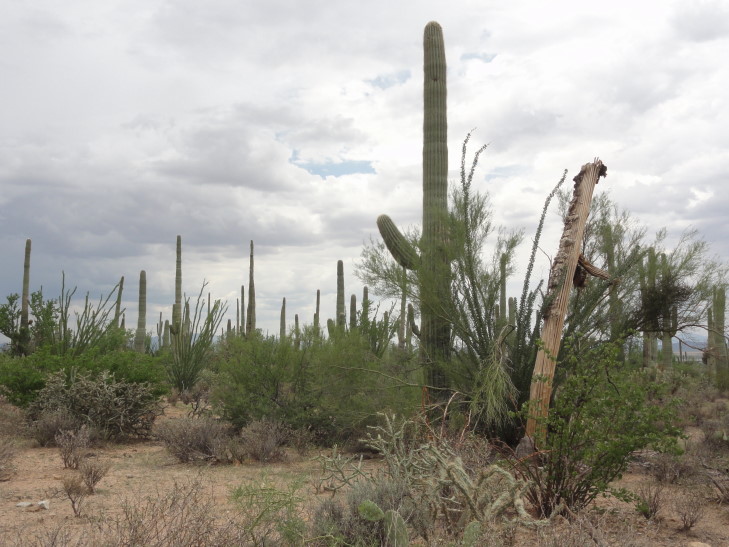
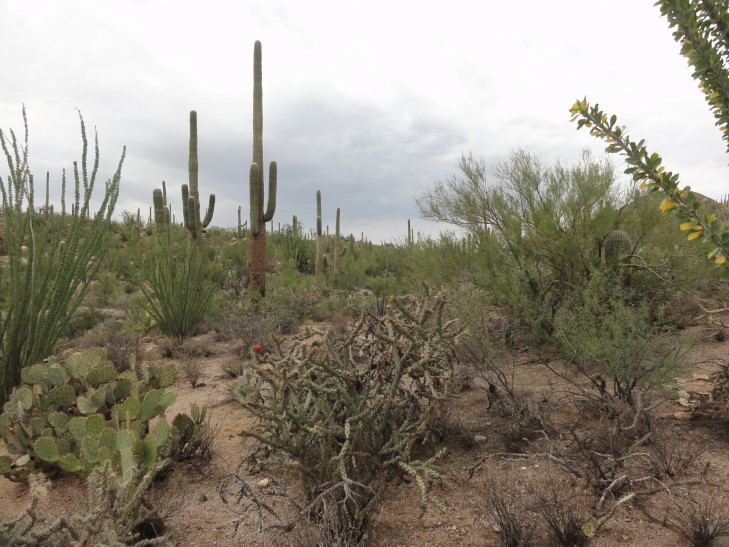
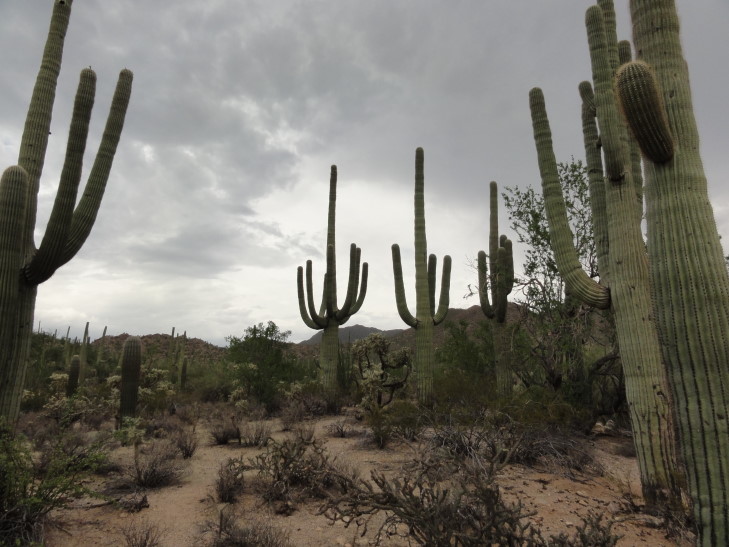
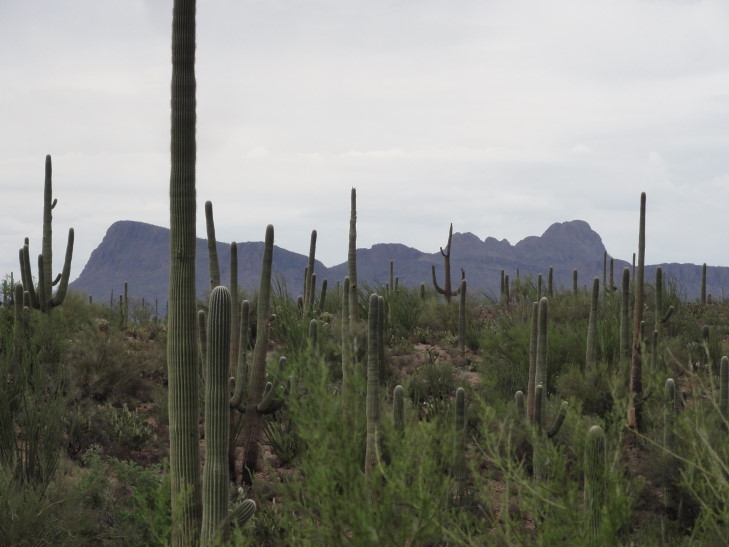
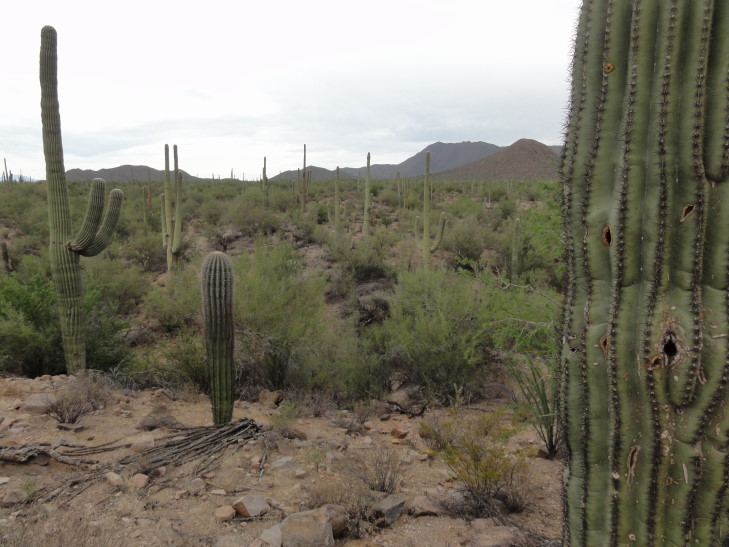
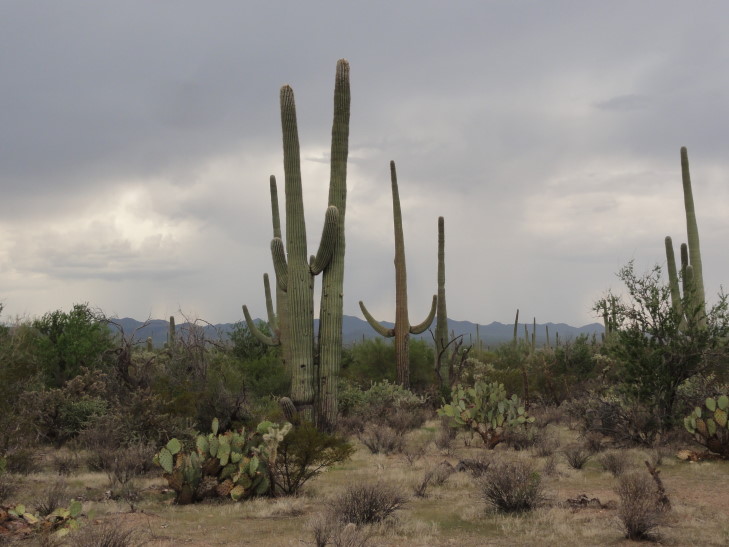
I kind of fell in love with Saguaro cacti.  They’re just so alien, yet, due to seeing them for years in westerns and the like, familiar.  They live about 200 years or so, rising to about fifty feet or so.  The visitor center provided an excellent overview of them and other cacti as well as some of the desert wildlife.  There was an excellent film as well that ended with pulling the curtains up and revealing the desert beyond the center, just like we saw at Mount Saint Helens last year.

Saguaro cacti, including a dead one to the right

Saguaro National Park West, Arizona

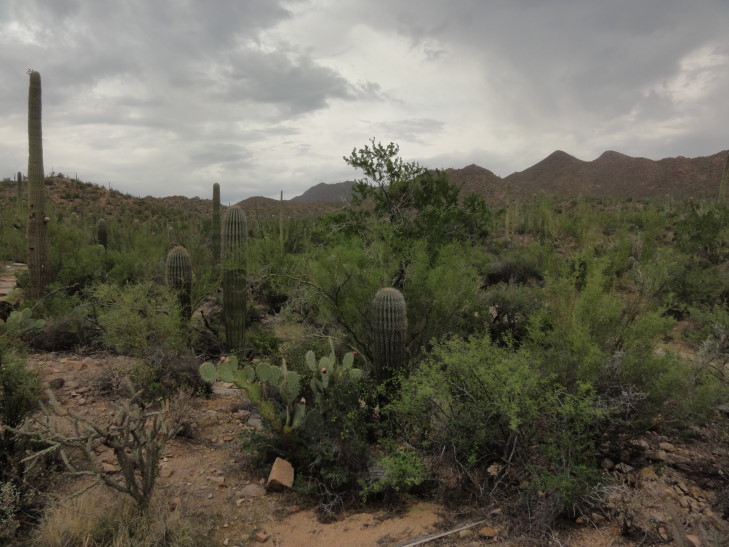
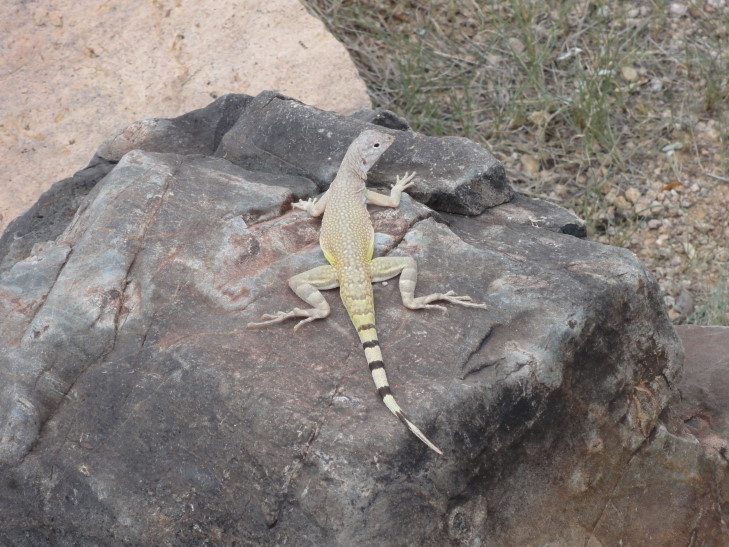
We decided to drive the loop road and take two walks.  The first walk was a bit over a mile and ended in a beautiful overlook of the park.  On the way we saw not only many Saguaro but also other cacti, prickly pear and chollo and yucca and even ones I called “Lorax” because they looked like something out of Dr. Seuss.  We saw a couple of lizards, particularly in areas that were washes during heavy rains.  One lizard would curl its tail up like a scorpion as it ran, I suppose as a defense mechanism.  Addison and I took to calling them “Lorpions” and imagined further a tornado of scorpions, or “Scornado”, would be terrifying.  I had a fun moment when I convinced Addison that I may finally have spotted a scorpion (a lie, we never did find one) and while he was looking at where I was pointing I poked him lightly in the ankle with a dry branch and scared the crap out of him.  Joys of parenthood, gotta enjoy the little things.

Lizard that would curl its tail like a scorpion and run away

Cacti, Saguaro National Park West, Arizona

Saguaro cacti

We had seen two A10 Warthog jets fly over the mission earlier and while we were on the walk we saw another seven or eight jets fly over, this time fixed-wing combat craft — not sure what type exactly.  Back on to animals, we saw some birds and even a jack rabbit with huge upright ears.  We got lucky with the jack rabbit, I had hoped to spot one after talking with some folks from Alberta earlier on the hike who had seen one.  They didn’t see scorpions or tarantulas either, sadly.

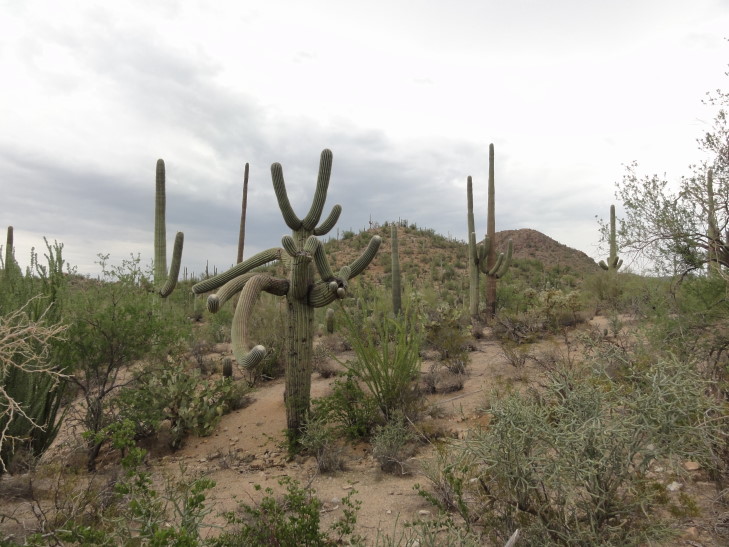
Tada, Saguaro cactus trying its hand at being a balloon animal

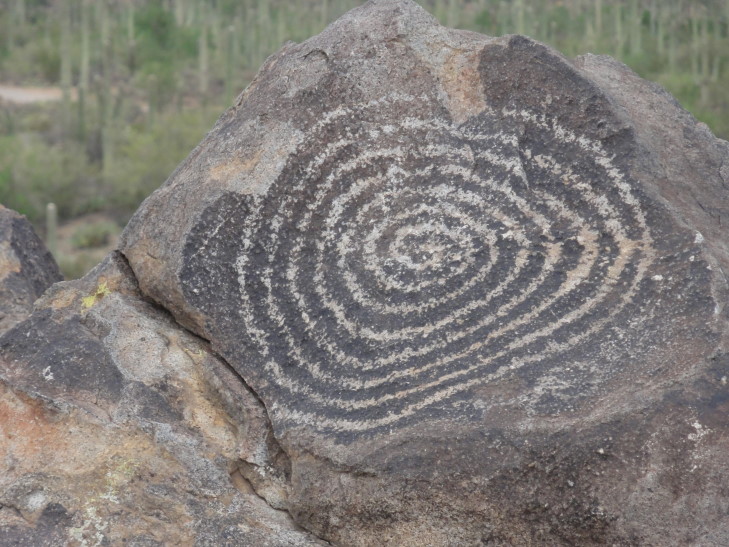
After the first walk we went around the loop some more before doing a half-mile trip up to the top of Signal Hill and back.  Signal Hill is significant for its petroglyphs dating back at least a thousand years.  Spiral patterns, some of animals, etc.  All etched upon rocks that were part of a big pile of rocks with a sign stating “Rattlesnake Area.”  You don’t have to tell me twice, I stayed clear!  While climbing up to Signal Hill we met some folks from Charlotte.  Small world!

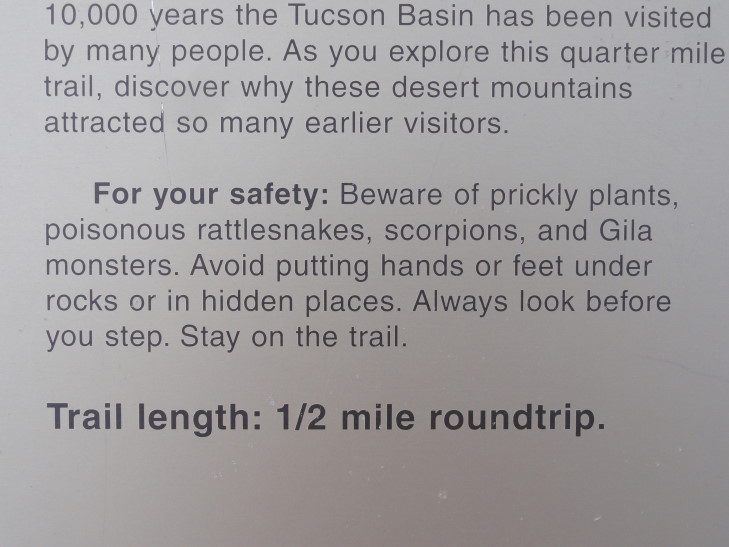
Rattlesnakes and scorpions make a trail cool, add in the Gila monster and it's just showing off...

Saguaro National Park West, Arizona

Signal Hill petroglyph

Saguaro National Park West, Arizona

Saguaro National Park West, Arizona

The whole time we were at Saguaro there were storms threatening.  Despite making for some cruddy photography conditions it was pretty nice.  They kept the temperatures down and the strong outflow breeze was very welcome.  It finally started raining (dry Southwest, ha!) after we left the park and were getting some food at Subway before starting the long (three hour plus) drive to Show Low.

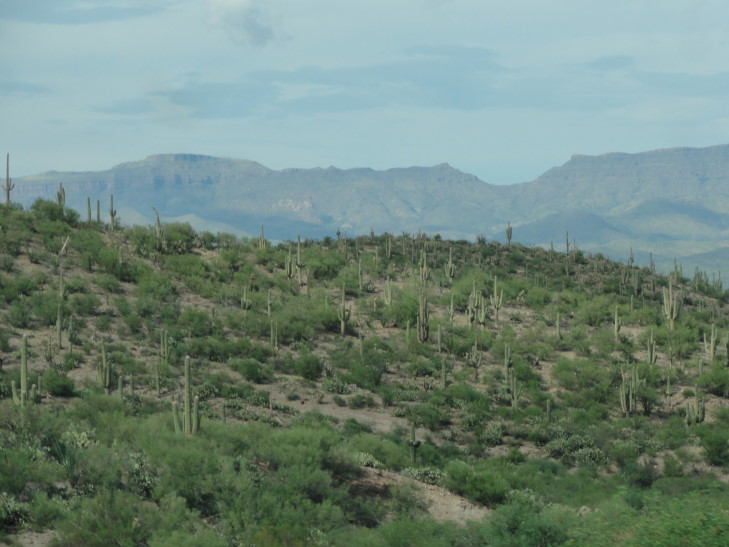
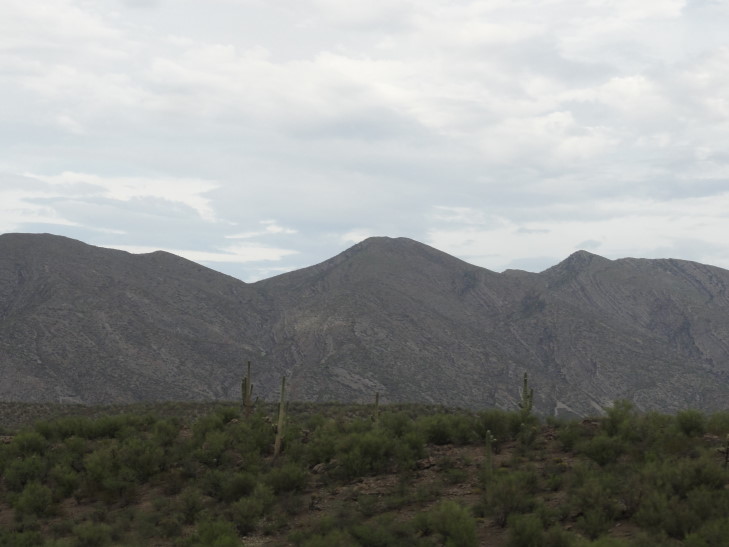
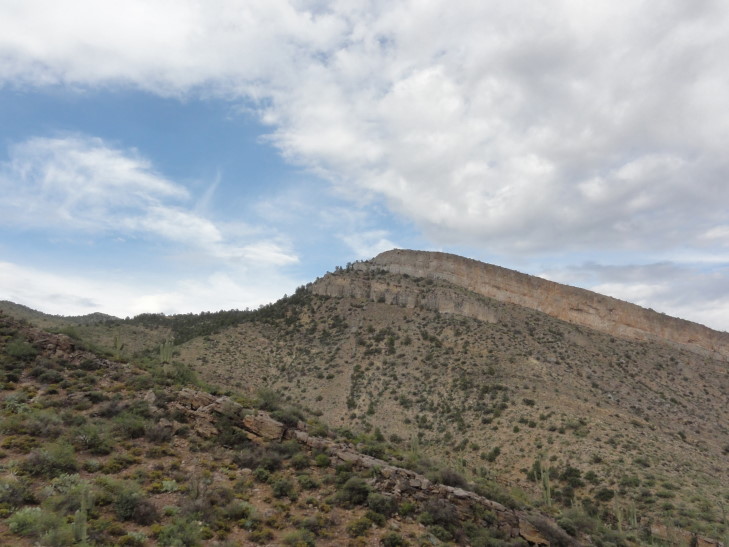
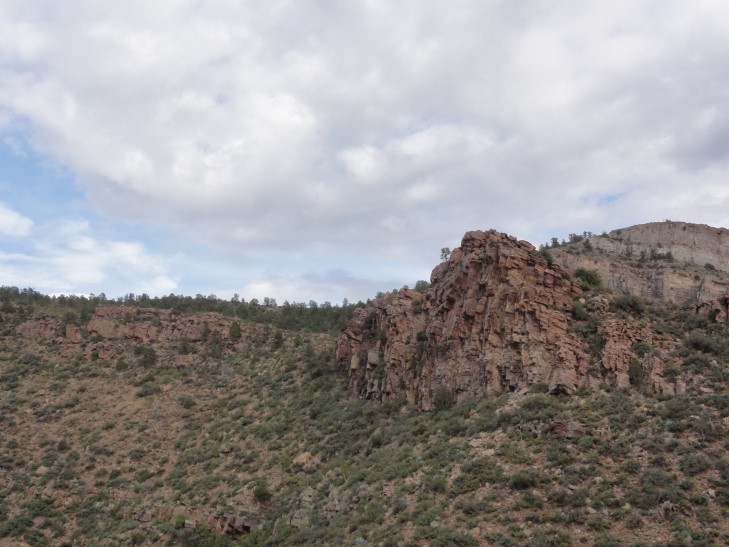
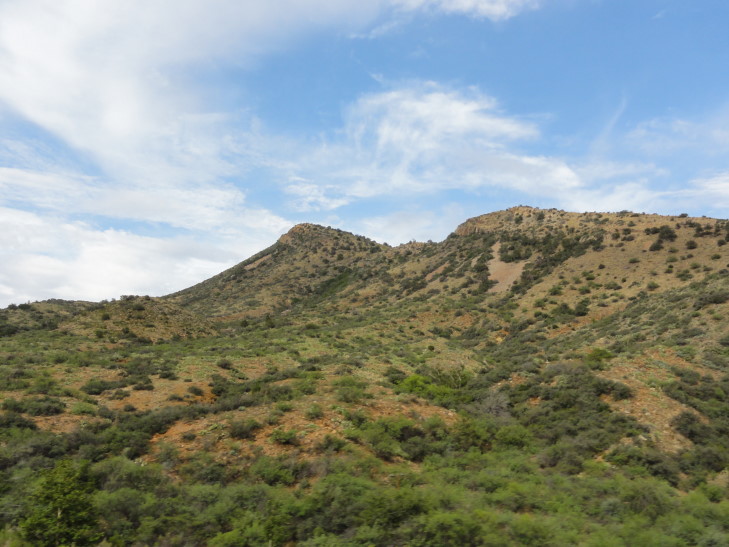
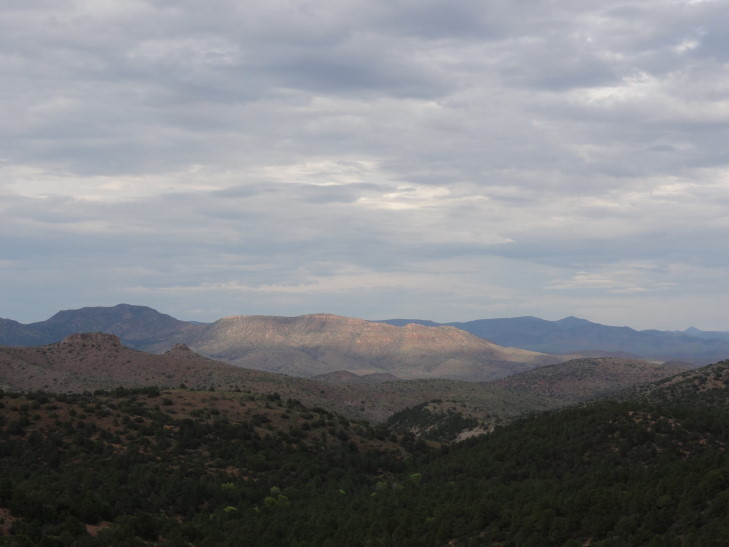
The drive along route 77 was breathtaking and, luckily, uneventful.  We saw some huge yuccas by the side of the road (ten feet plus in height) and though Saguaros would thin out in spots they didn’t fully disappear until just south of Globe, nearly 100 miles north of Tucson.  It was there that the terrain’s strata were clearly uplifted, about 30 degrees, and the elevation was enough to be hostile to the Saguaro.  We drove alongside a canyon that had seen fire, it had even burnt the wooden supports for the guardrail to a crisp and had to be replaced.  Globe was charming enough, I suppose — it had a McDonald’s to give Michelle some half-cut sweet tea for the remaining part of the drive as well as something I had not seen for years — a drive-in theater!

Scenery between Tucson and Globe, Arizona

Scenery between Tucson and Globe, Arizona

Scenery between Tucson and Globe, note the uplifting

Scenery between Tucson and Globe, Arizona

Scenery between Tucson and Globe, Arizona

Scenery between Tucson and Globe, Arizona

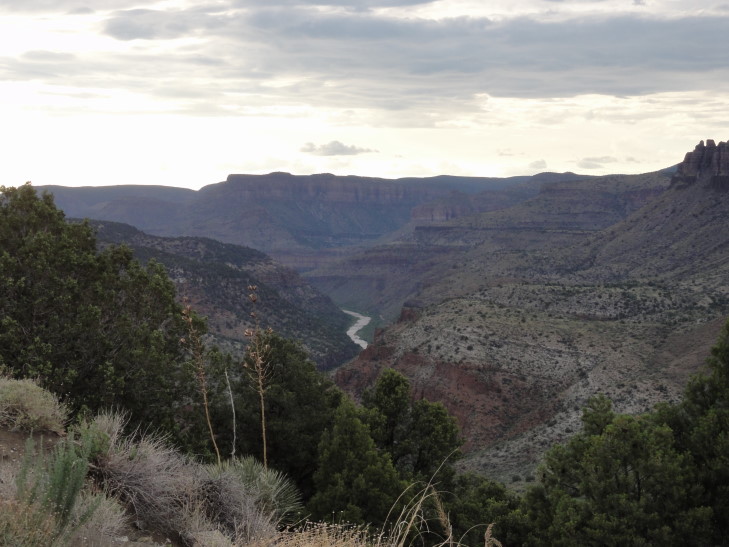
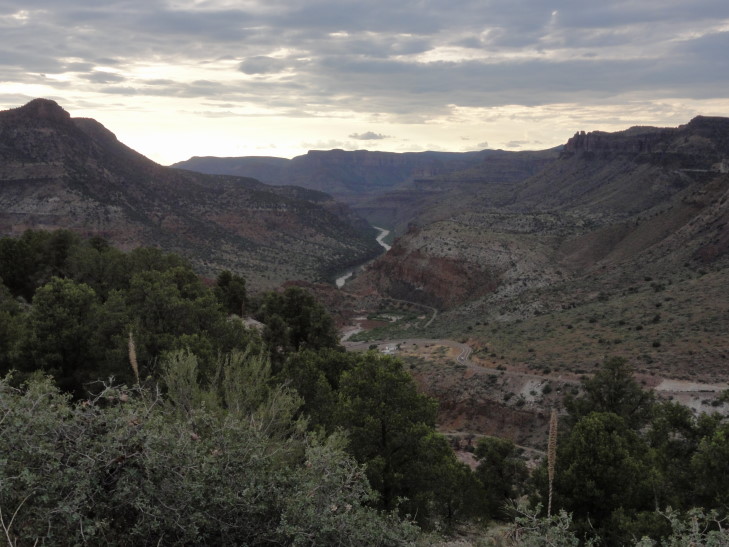
North of Globe the hills were more wooded.  We soon came upon a gorgeous canyon, the Salt River Canyon.  The road made several switchbacks to get to the bottom of the canyon, cross the river, then go back up to the rim on the other side.  After that the forests became predominantly pine as we entered Show Low.  Show Low got its name due to two people playing cards for ownership of a 1,000 acre ranch.  The winner would be the one with the lowest card (“Show Low”), in this case a two of clubs — explaining why route 77 in town is called “Deuce of Clubs.”

Salt River Canyon, Arizona

Salt River Canyon, Arizona

As it was nightfall and we were hungry we first went to Sonic for dinner.  We had waited a bit for our food when the waitress came out rolling on skates and tried to deliver our food to the wrong car, almost hitting the menu stand.  When she realized it wasn’t the right car she tried to get back on the curb… and tripped, spilling the meal all over the other car’s hood.  She was practically in tears, we felt bad for her.  She offered to wash their car but they declined, saying it was going to rain soon anyhow.  Another long wait and we get our food, turns out they decided to remove the charge for the food.  Combine that with our hotel being free due to cashing in frequent stayer points and it was free room and board day!

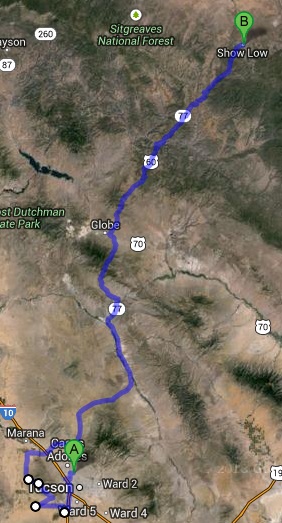
Route for Thursday, August 1st, 2013
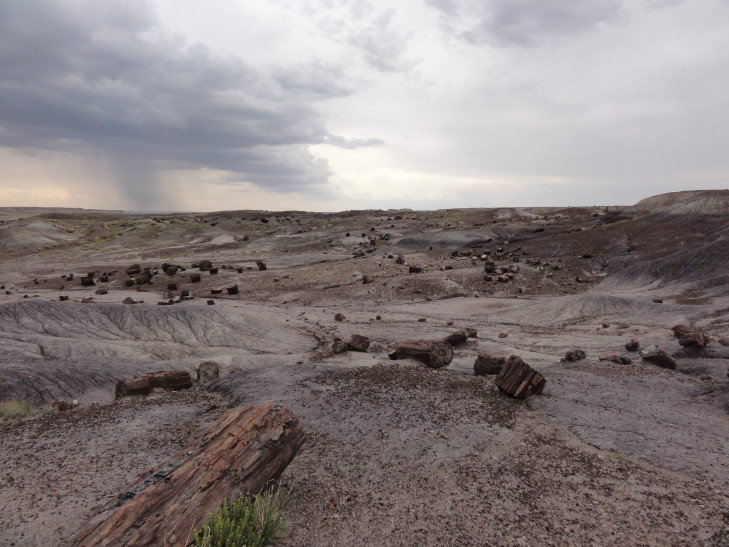
July 31, 2013

Sign, Sign, Everywhere a Sign

Filed under: Travel — Tags: — BigWeather @ 11:59 pm

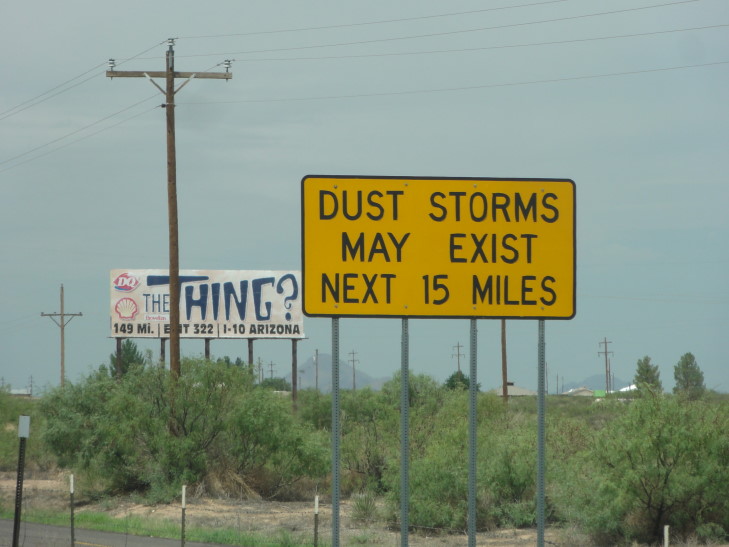
We decided to take today a bit easier after the very full day yesterday.  After our free Holiday Inn Express breakfast, which included this odd omelet with some weird pepper hash… stuff… the family relaxed while I typed up the blog (since the prior night the connection was so poor I couldn’t get it done).  Hit the road about 10:30 and, after hitting McDonald’s for some stay-awake-during-long-drive juice, took I-10 westward towards Tucson, about 250 miles away.  The weather was pretty enough but the thunderstorms were already starting to fire.  New Mexico has these funny signs, stating “Dust Storms May Exist,” that really make me ponder.  I mean, we know they exist, they’re documented phenomena.

Yeah... and?

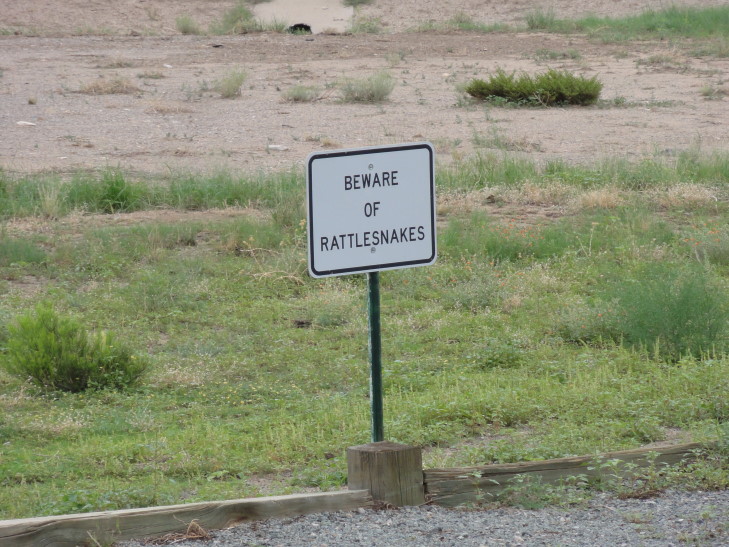
A little later, after crossing into Arizona, we stopped at a rest area where I spotted a sign that stated “Beware of Rattlesnakes.”  Though having a picture of Mr. Stick being bitten by a snake would’ve really ramped up the awesome I was thankful this wasn’t New Mexico or it would have stated “Rattlesnakes May Exist” or some such.

Now we're talking (sadly, I did not see any)!

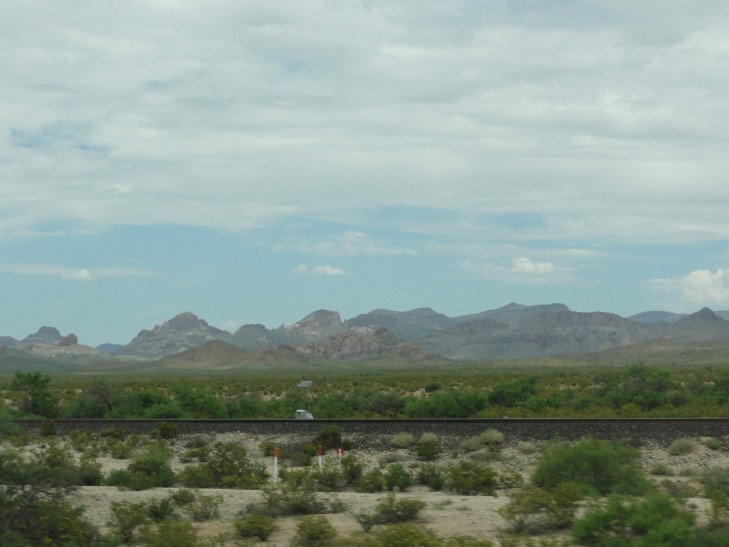
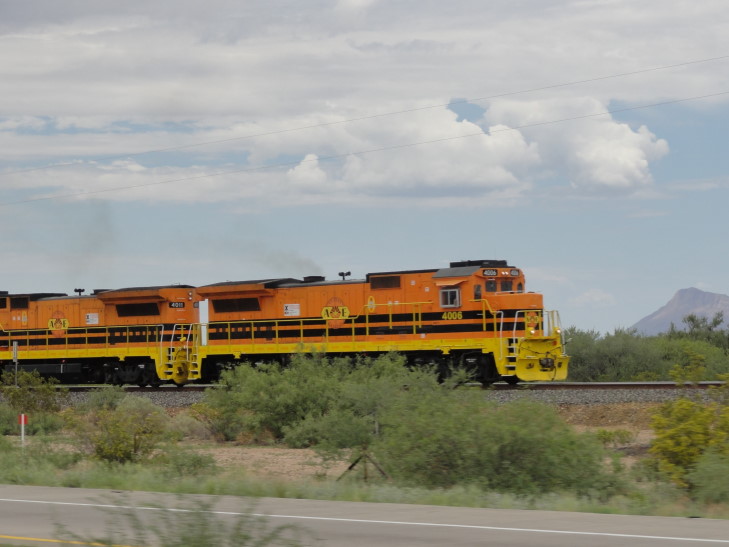
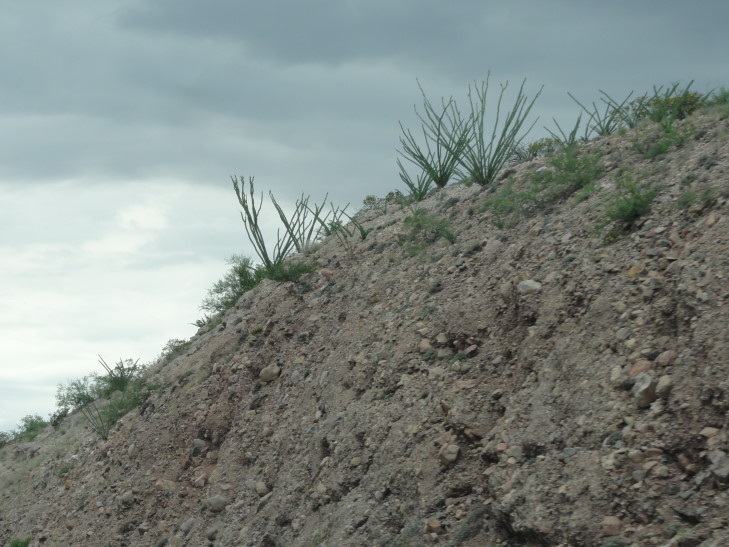
The terrain was very flat, ranging from sandy scrub land bordering on desert to fairly green with grasses and small shrubs.  There were always mountains visible in the distance, however, and occasionally they’d come right up to the road.  I-10 is pretty remarkable in that there was always cell reception, unlike all of the state and US routes we had taken in the preceding days where cell reception would drop for hours.  Most of the stretch of I-10 was also paralleled by train tracks.  It was awesome, I saw at least five trains, mostly Union Pacific.  There were also pecan groves between Las Cruces and Tucson — I had no idea that they could be farmed in that environment.  We saw a good number of yucca plants, some nearing fifteen feet tall or so, and some curious cacti that looked almost like aquarium plants.

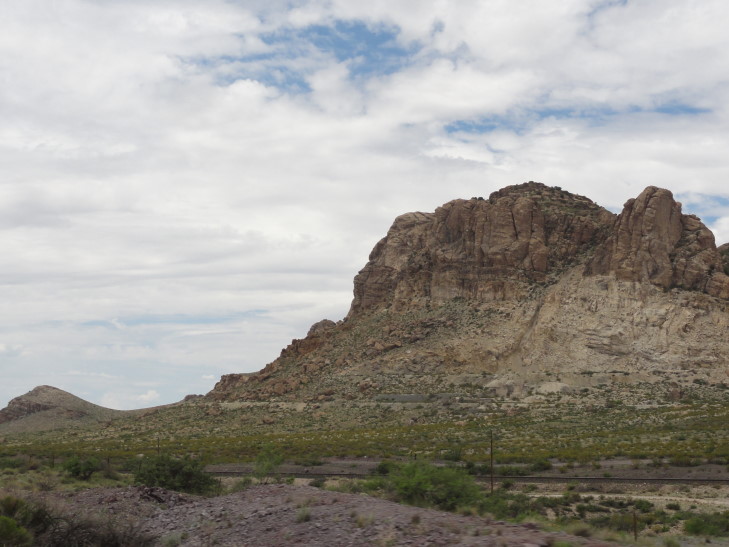
Mountain beside I-10

Southern Arizona mountains

Choo choo choo choo

Odd cacti

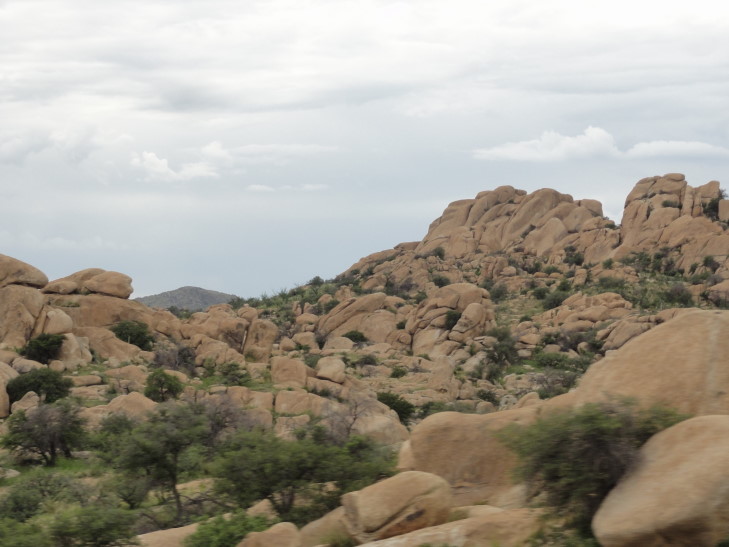
After a couple of failed attempts at finding lunch by leaving the highway in a few small eastern Arizona towns we found success at the Pizza Hut in Wilcox.  We had originally looked at a Mexican restaurant but it just looked a bit iffy when we got there.  I know, we’re not very adventurous I guess.  Lunch was good, we had the buffet.  And, yes, it rained again while we were eating.  All but two days so far!

Cool rocky hills near Tucson, Arizona

Headed back towards Tucson for another hour and change before arriving around four (or so I thought).  Also saw our first In-N-Out since last year’s trip to the Pacific coast.  Looked down at the temperature and it was 106F.  And not a dry heat — it was storming about a mile away so the humidity was up there, and the outflow from that storm caused a brisk, furnace-like blast.  Ick.  Checked in to the hotel which looked far fancier than we expected but still was a Holiday Inn Express.  We decided to knock out a couple of loads of laundry (our last for this trip) and relax a bit before seeking food, putting off the trip to Saguaro National Park until tomorrow (besides, it was super hot out).

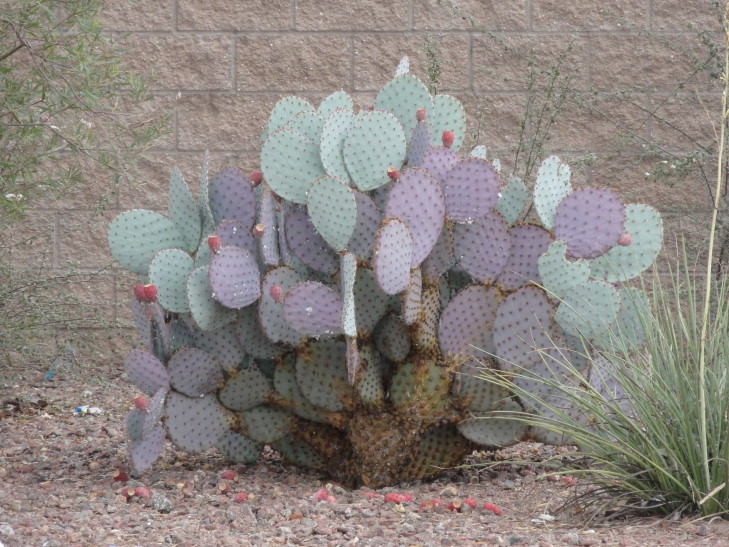
Cactus near our hotel in Tucson

We decided to eat at the mall very close to the hotel, at Toby Keith’s I Love this Bar and Grill (I kid you not).  The food was decent and I managed to eat somewhat healthy, ordering broccoli, squash, and peppers along with a burger.  It was in the restaurant that we realized that despite Arizona being in the same time zone as New Mexico that it was really an hour behind, as Arizona (other than the Navajo Nation) does not recognize daylight savings time.  Turns out we could’ve probably made Saguaro NP.  Still would’ve been hot, though.  Returned back to the room for blogging and an early bedtime.

Route for Wednesday, July 31st, 2013

« Newer PostsOlder Posts »

Powered by WordPress